
Sales trend analysis reveals high-potential prospects by identifying emerging market shifts and helps B2B enterprises adapt sales strategies before competitors do. Many B2B teams still depend on sales data to describe what happened in the past, but hardly use it to predict future commercial prospects.
Salesforce’s research finds that 83% of B2B teams that employ AI sales analytics witness revenue growth. Internal sales trend data captures buyer behavior shifts, deal velocity, and segment conversion rates before they become visible in broader market trends, which is why it must be prioritized over external market intelligence.
Trend analysis is all about finding where enterprises get a competitive edge before competitors respond. B2B enterprises often lose prospects as they prioritize the quarterly output over directional movement.
How Sales Analytics Identifies Market Trends
Although B2B enterprises emphasize external competitive intelligence, a more bankable signal is internal close rate data, as it reflects actual buyer activity. Beyond explaining historical revenue, sales analytics must predict future trends, and only those B2B teams that focus on the future will gain an edge rather than relying on quarterly reports.
The first signal preceding external market intelligence is the rising win rate in a particular ICP segment. Increasing conversion rate for consecutive quarters might indicate improving market conditions, not better sales execution.
Shortening sales cycles in a product line is another indicator that highlights increasing buyer readiness, while increasing deal size within an emerging segment without change in corresponding pricing signals that the segment’s budget authority has pivoted.
Which Competitive Sales Intelligence Strategies Give B2B Teams a First-mover Advantage
B2B teams often carry out external research and treat it as competitive intelligence, but it only helps them understand where competitors are strong. On the contrary, finding where competitors have created openings through their behavior offers a real first-mover edge to companies.
Detecting that competitors increased prices through B2B sales analytics and treating it as a market entry signal instead of considering it as a threat will give teams a first-mover edge.
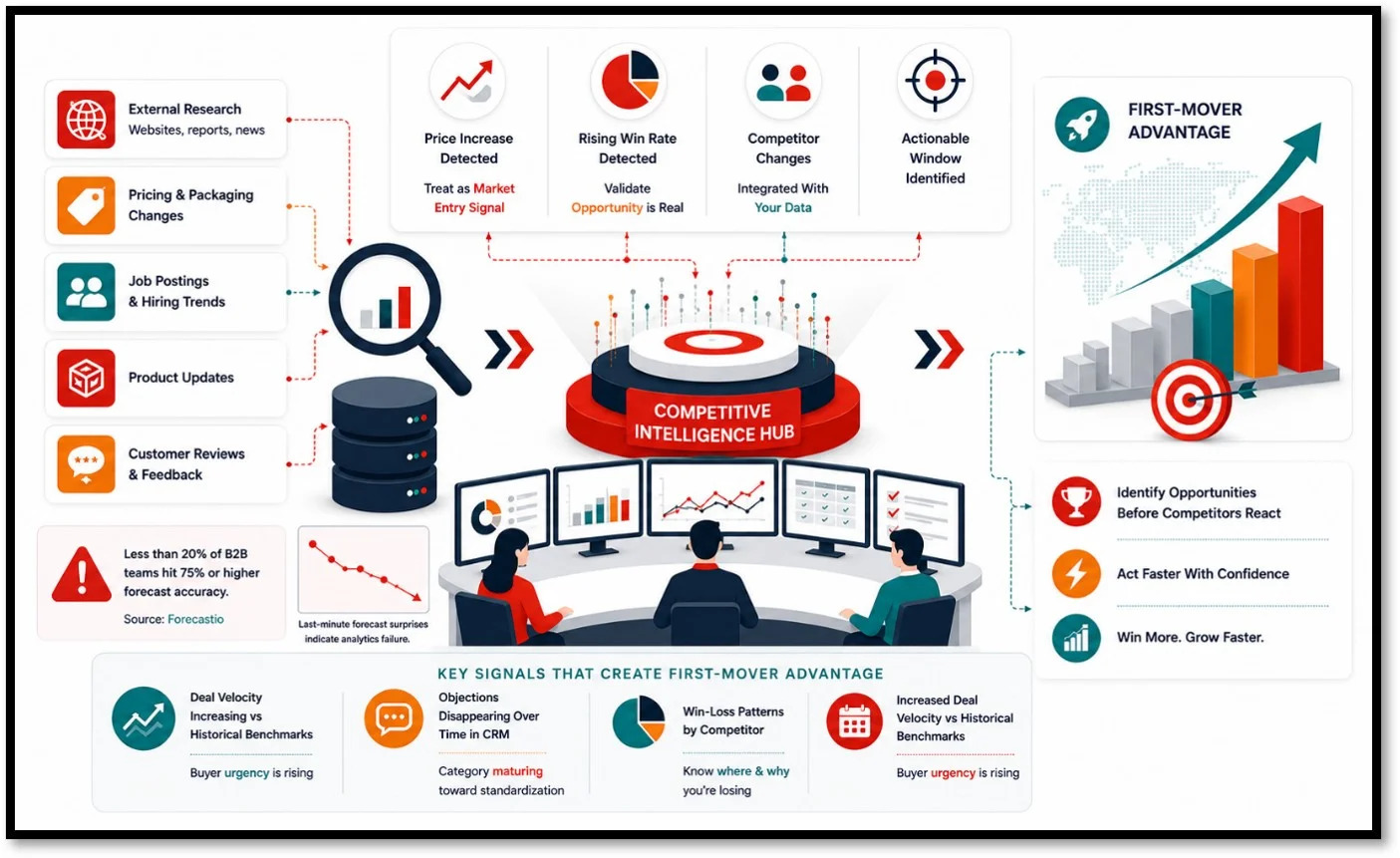
When information that competitors changed prices is integrated with the data on rising win rate, it develops an actionable window that siloed data cannot produce. Tracking win-loss patterns against competitors describes where and why the team is losing.
Increased deal velocity against historical benchmarks reveals that buyer urgency is rising, while disappearing objections over time in a CRM field indicate the category is maturing toward standardization.
How AI-powered Sales Trend Analysis Changes the Opportunity Detection Speed
Instead of replacing commercial judgment, AI increases the number of meaningful signals sales forecasting tools can simultaneously evaluate. AI-driven B2B sales trend analysis enhances the value of existing sales data, and B2B enterprises extracting the maximum from these tools have already built on data discipline before AI.
Optif’s 2025 report finds that AI boosts sales efficiency by 2.3x compared to traditional tools. AI reveals the increasing win rate in a micro-segment, which is not surfaced even at the team-level manual review.
Predictive sales analytics identifies deal velocity deviation in real time, and AI integrates internal trends and external market signals to assign a probability to opportunities. This transforms a qualitative observation into a list of ranked priorities.
How Sales Trend Analysis Using CRM Data Converts Historical Patterns Into Revenue
Most B2B organizations retrospectively report what the team has achieved, but the real commercial value of CRM data lies in forecasting market trends. A forward-looking CRM strategy transforms historical records into revenue forecasting intelligence.
The following three CRM data fields produce commercially valuable sales performance analysis:
- Win Rate by Segment: It reveals an emerging ICP segment before a quarterly business review can describe it. Acting promptly on emerging trends one quarter prior to competitors provides an edge to B2B teams, and this is why it produces the most commercially valuable sales insights.
- Average Deal Size by Product Line: It triggers an ICP update by analyzing whether average contract value increases, indicating a shift in customer buying trends.
- Source-to-close Time by Acquisition Channel: It indicates that teams should invest more in channels that consistently provide faster-closing deals.
Final Thoughts: How to Spot Sales Opportunities Before Competitors Using Data-driven Sales Trend Analysis
Beyond business intelligence and best reps, timing advantage in B2B comes from finding shifts in sales pipeline data before they surface in external benchmarks. B2B enterprises that consistently forecast shifting buyer preferences and evolving market demands via market trend analysis often gain an irreplicable competitive edge.
The standardization of AI-powered trend analysis in sales will surface opportunities for those B2B teams that have clean and consistently captured CRM data that is structured to surface signals that precede opportunities.
Contact Marketboats to build a data-driven sales strategy that can help you forecast prospects before your competitors can act on them.
FAQs
1. Why is sales trend analysis important?
Revenue trend analysis predicts emerging buying patterns early, which helps B2B teams emphasize new opportunities, respond quicker to them, and improve their forecast quality.
2. How do you analyze sales trends?
Start by analyzing historical sales data, followed by CRM insights, pipeline velocity, buyer behavior, market signals, and conversion rates to observe repetitive commercial patterns.
3. How can B2B companies identify sales opportunities?
B2B enterprises often identify sales prospects through buying trends, historical revenue performance, competitive intelligence, and CRM analytics.