
A structured sales pipeline analysis framework allows B2B enterprises to not only improve pipeline velocity but also to bolster their forecasting accuracy. It enables teams to predict bottlenecks before they hamper the pipeline.
Most B2B teams measure pipeline volume over quality, that too, only after deals stall or forecasts erode, and assume pipeline management is only a progress-monitoring task. Corporate Vision’s analysis finds that 71% of stalled opportunities can be recovered.
Revenue operations (RevOps) teams that defend their forecast accuracy often analyze daily pipeline signals rather than conduct a weekly review. A pipeline review becomes only a reporting ceremony when it fails to surface root causes of stalled deals.
How to Identify Sales Pipeline Bottlenecks
Deals that slow down at the same stage due to the same reason across different segments or reps result in a specific stalling pattern, creating sales pipeline bottlenecks.
Increasing average time spent in a pipeline stage relative to the historical benchmark, reducing stage-to-stage conversion speed, and unusual deal concentration in a stage with no corresponding deal progression are the three signals indicating a bottleneck.
Instead of fixing only one stalled deal, resolving the stall-creating pattern becomes a more commercially significant intervention, yet many pipeline reviews choose to resolve individual stalled deals.
Misdiagnosing a pipeline bottleneck as an isolated deal risk instead of a process failure is one of the most expensive mistakes revenue teams make.
How to Increase Sales Pipeline Velocity
Revenue timing is connected to pipeline activity only through pipeline velocity, yet most pipeline reviews fail to surface the metric. A high-velocity pipeline generates more revenue in less time, and reveals whether the pipeline is healthy or simply large.
Enhanced stage conversion, reduced sales cycle length, and improved entry-level qualification of leads are three levers that improve pipeline velocity.
Most organizations expand pipeline coverage to compensate for the reducing velocity, but this is the wrong sales pipeline management approach. Increasing deal volume in a pipeline with a systemic conversion problem increases noise.
How to Analyze a Sales Pipeline With Metrics Surfacing Actionable Intelligence
Instead of pattern analysis, B2B teams carry out individual deal review, and this makes pipeline reviews only pipeline reporting. On the other hand, B2B teams that actively manage their pipeline produce 28% more revenue as per Get Monetizely’s research.
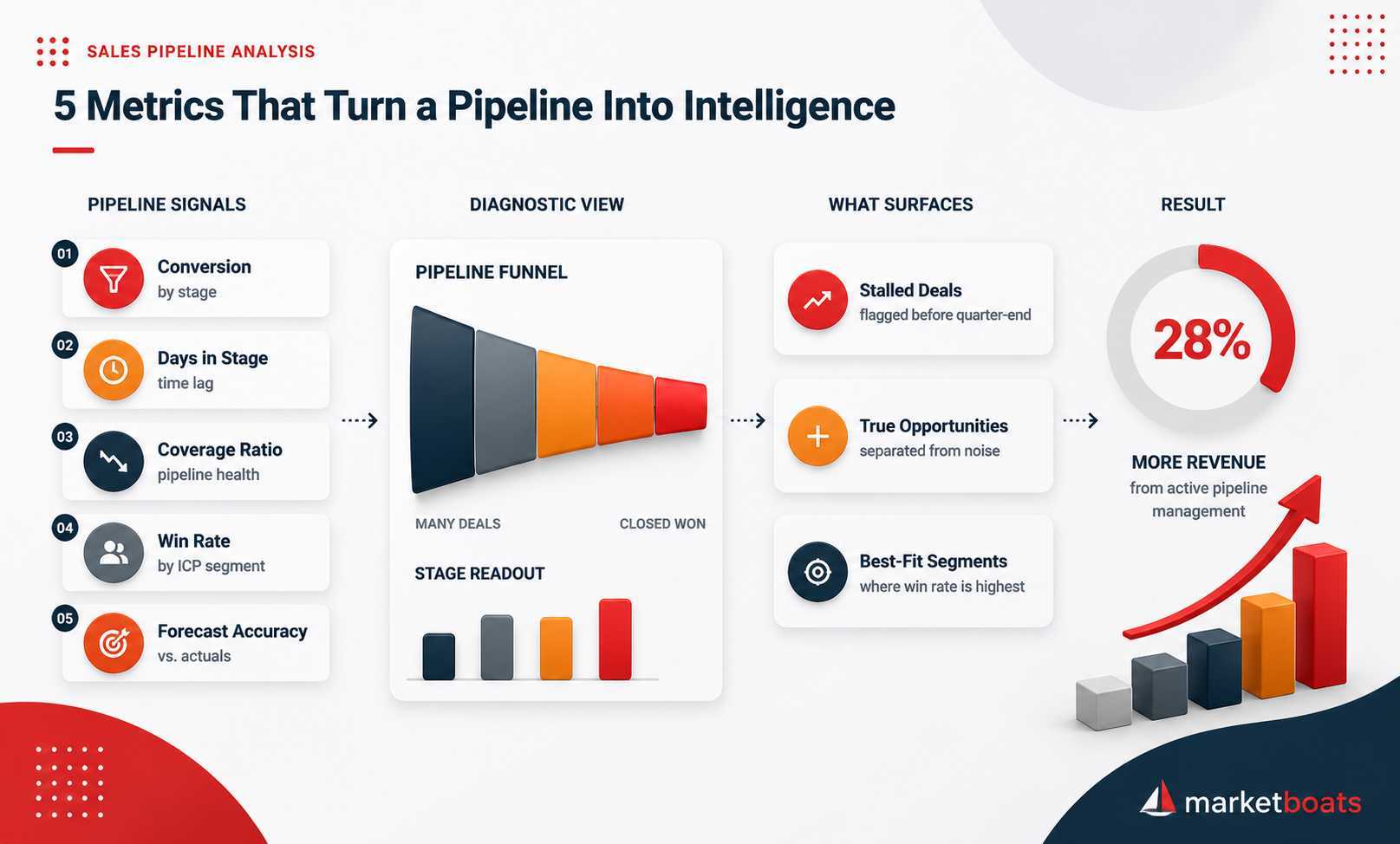
Here are five pipeline analysis metrics that address different commercial questions-
- Stage Conversion Rate: It reveals where the pipeline loses opportunities and whether the pattern is uniform or concentrated across sources.
- Average Days in Stage: Persistent deviation from the benchmark gives a warning signal of a stalled deal before it affects revenue.
- Pipeline Coverage Ratio: A pipeline built on aging opportunities should be evaluated differently from the one built on qualified prospects.
- Win Rate by ICP Segment: It helps teams find the type of converting customers and direct outbound efforts based on that.
- Sales Forecasting Accuracy Rate: The gap between forecast and actual revenue helps teams evaluate forecasting consistency across rolling quarters.
How CRM Pipeline Analysis for B2B Companies Improves Forecasting Accuracy
Most CRMs are often optimized for the revenue team’s ease of use, which hardly produces revenue intelligence or sales administration data. Every deal that does not produce any usable analytical data creates a configuration problem, which is the most expensive CRM implementation failure.
When CRM pipeline management goes beyond administrative data recording of deal status to collect signals predicting close probability, it transforms the CRM from a deal database into a forecasting tool.
CRM pipelines are often optimized for stage tracking, and a rep can easily manipulate deal value, stage, and close date. Here are three configuration decisions that improve forecast accuracy:
- Collect multi-stakeholder engagement data.
- Maintain a log of objection type and its frequency at each stage.
- Build a benchmark by comparing predicted versus actual close dates.
Most B2B enterprises leave these fields incomplete, even though they generate the most valuable forecasting signals.
Final Thoughts: How to Optimize Sales Pipeline Performance
Revenue pipeline analysis, more than a retrospective task, is an operational mechanism. B2B teams can take enough time using this framework to fix their broken pipelines before they become a missed quarter.
Bottlenecks, forecast risks, and velocity drops will become common for those B2B teams who conduct sales performance analysis at the status level, instead of conducting it at the signal level. Healthiest pipelines are those that identify problems early.
Marketboats’ takeaway is simple: maturing CRM AI capabilities will allow enterprises with signal-rich and clean pipeline data to extract more intelligence efficiently with the same analytical input. Data quality will be more important than tool sophistication.
Contact us if your sales funnel analysis still emphasizes deal stages instead of pipeline signals, because by the time stalled deals become visible, revenue has already been affected.
FAQs
1. How do you identify bottlenecks in a sales pipeline?
After monitoring conversion rates, deal progression, opportunity aging, and average days in stage, recurring patterns across different deals can be observed. This often signals bottlenecks.
2. What are the key sales pipeline metrics?
Win rate by ICP segment, stage conversion rate, forecast accuracy, pipeline coverage ratio, average days in stage, and pipeline velocity are the key metrics that measure pipeline performance.
3. How can sales pipeline analysis improve revenue?
Revenue pipeline evaluation identifies stalled deals early, improves forecast accuracy, enables proactive revenue decisions, increases pipeline velocity, and strengthens qualification to improve revenue.