
The traditional departmental execution is falling short of supporting complex revenue motions, fragmented data, and AI-powered buying journeys, which is why GTM engineering has gained its place.
B2B enterprises produce disconnected workflows while optimizing for different functions independently, which slows down revenue growth despite heavy investment in new technology.
The GTM execution framework is a response to the failed structure, as process complexity exceeds human bandwidth for managing it. According to Salesforce, reps spend only 28% of their week selling, and the rest is wasted in manual non-selling tasks.
GTM engineering for SaaS companies shifts the RevOps function from coordination to execution, and B2B teams investing in it eliminate bottlenecks from signal-to-action, while every automated workflow produces the compounding advantage of speed.
What Is GTM Engineering in B2B, and How Is It Different from RevOps
Go-to-market engineering is a design discipline used for developing and optimizing technical systems that execute GTM strategy. It connects data sources, automates workflows, and routes signals to the right platform at the right time.
The revenue operations (RevOps) strategy is an operational discipline that defines processes by aligning revenue operations, and GTM engineering automatically executes them, eliminating human intervention.
Most RevOps teams optimize those processes that humans execute manually, but GTM data architecture automates systems by replacing the human execution layer. As a result, it embeds an infrastructure layer, making RevOps strategy commercially executable at the same speed at which the market moves.
A human-dependent RevOps process hardly behaves as a revenue system, but only acts as recommendations worth ignoring.
Why Revenue Systems Fail in B2B, and Which Problems with Traditional GTM Models Cause the Most Damage
Despite people working hard, GTM processes often fail because they were not meant to connect signals to actions in a complex commercial environment. Signals generated in one part of the B2B revenue engine remain invisible to functions that need to act on them, which is why GTM execution fails.
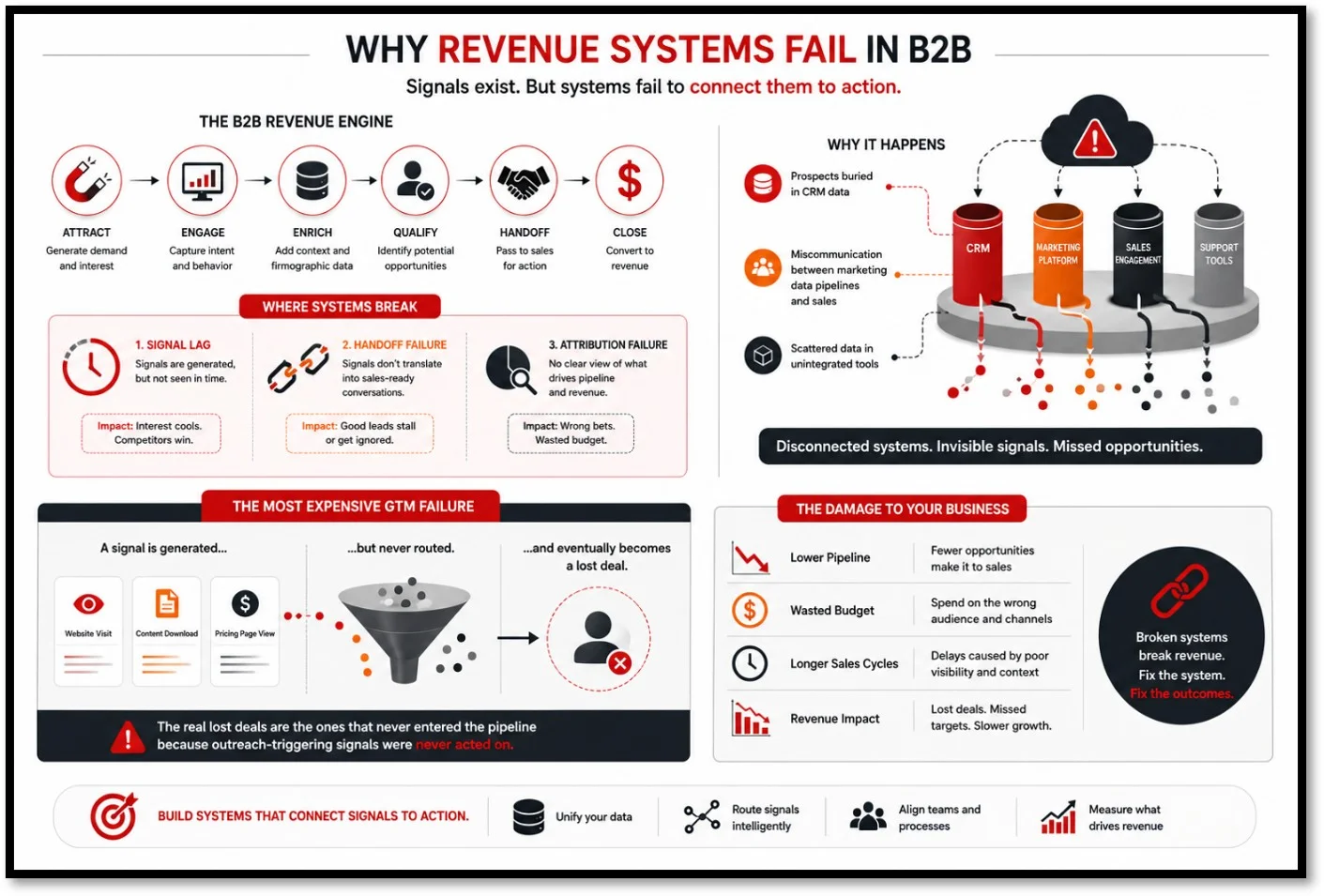
Signal lag, handoff failure, and attribution failure are the most common breakdown modes that cause the maximum damage. Prospects buried in CRM data, miscommunication between marketing data pipelines and sales, and scattered data in different unintegrated tools are the fundamental reasons for this failure.
A signal that never gets routed, despite existing in CRM, and eventually becomes a lost deal is the most expensive GTM failure. The real lost deals due to GTM breakdown are those that never entered the pipeline because outreach triggering signals were never acted on.
How to Build a GTM Engineering Function, and How to Align GTM Engineering with Business Goals
Contrary to the belief that current processes should simply be automated, the GTM engineering framework implementation becomes commercially more valuable when processes are redesigned around what automation can do. Automating broken processes only accelerates poor results.
Here are three decisions that answer how to fix disconnected GTM processes:
- Define the signal-to-action map.
- Build the layer of data unification in RevOps.
- Establish instrumented feedback loops.
Every workflow becomes revenue metric-driven, rather than activity metric-oriented, when GTM engineering aligns with business goals. This ensures that automation produces commercially valuable outcomes rather than only supporting operational activities.
How Agentic AI in GTM Engineering Creates Autonomous Revenue Systems
Agentic AI for go-to-market teams introduces a new category in GTM, where systems shift from rule-based execution of pre-defined workflows to adaptive decision-making based on real-time GTM data processing output. However, the decision quality depends on the set of rules and data used to train the system.
Dynamic lead scoring using AI continuously updates based on changing account behavior, whereas autonomous GTM systems adapt messaging, channel, and timing based on engagement response.
With changing buying committee engagement signals, the system produces real-time forecasts. Salesforce’s 2024 report finds that 83% of B2B teams are 1.3x more likely to see an increase in revenue if they integrate AI correctly into their systems.
Agentic AI amplifies the encoded commercial logic quality. Introducing autonomy before validating decision logic will often make enterprises scale the incorrect decisions.
Final Thoughts: How to Build Smarter Revenue Systems With AI
A GTM strategy shifts from coordinated manual activities to self-improving revenue intelligence platforms with the help of GTM architecture. Enterprises that execute this faster often eliminate human bottlenecks from signal-to-action. Every automated workflow introduced amplifies the speed advantage.
The maturing revenue systems with AI will help B2B enterprises with validated decision logic and clean signal-to-action maps extract autonomous commercial intelligence, outperforming competitors.
Marketboats can help you build a GTM strategy with AI that will convert revenue signals into an automated pipeline. Contact us now.
FAQs
1. How is GTM engineering different from RevOps?
While RevOps aligns processes, governance, and revenue teams, the GTM framework builds automation, AI workflows, and technical infrastructure, helping B2B teams scale and execute those operations automatically.
2. What tools are used in GTM engineering?
CRM platforms, analytics tools, marketing automation, workflow automation tools, API integration platforms, AI-powered lead scoring, revenue intelligence solutions, customer data platforms (CDPs), and buyer intent platforms are some key tools that are used in GTM engineering.
3. How do you build a revenue system with AI?
Building a unified data architecture is the first step in developing a revenue system with AI. Defining signal-to-action workflows follows. Automating repetitive processes is the third step, while the following steps include AI-driven predictive decision-making and continuous outcome tracking. Lastly, refine workflows based on performance feedback.