
Instead of treating a high-performance B2B GTM tech stack as a best-in-class collection of software, it must be viewed as a commercial operating system that drives revenue growth.
Enterprises often fragment their workflows, execute GTM poorly, and duplicate data by adding new tools to solve individual issues, and this is a key problem. More than a tool-quality issue, the tech stack failure stems from an integration architecture problem.
Technology creation rarely gives a competitive edge. Productiv’s report finds that SaaS teams use only 45% of licensed software applications, which is why commercial architecture is more important than technological accumulation.
The GTM tech stack for B2B companies is expected to reflect customer journeys rather than mirroring organizational charts. More than the addition of individual tools’ value, the tech stack ROI is the quality of data connections between these tools.
How to Build a GTM Tech Stack for B2B Without Accumulating Redundant Tools
B2B teams that prioritize software selection often generate disconnected workflows, but enterprises that map the revenue process first, followed by assigning technology to every stage, perform better. Instead of only defining proven commercial processes, technology must automate them.
Data foundation is the fundamental layer of the go-to-market tech stack. CRM records contacts, buyer interactions, or opportunities, and every downstream layer either enriches the data or consumes it. Inconsistent or incomplete CRM data, thus, transfers error to every downstream output.
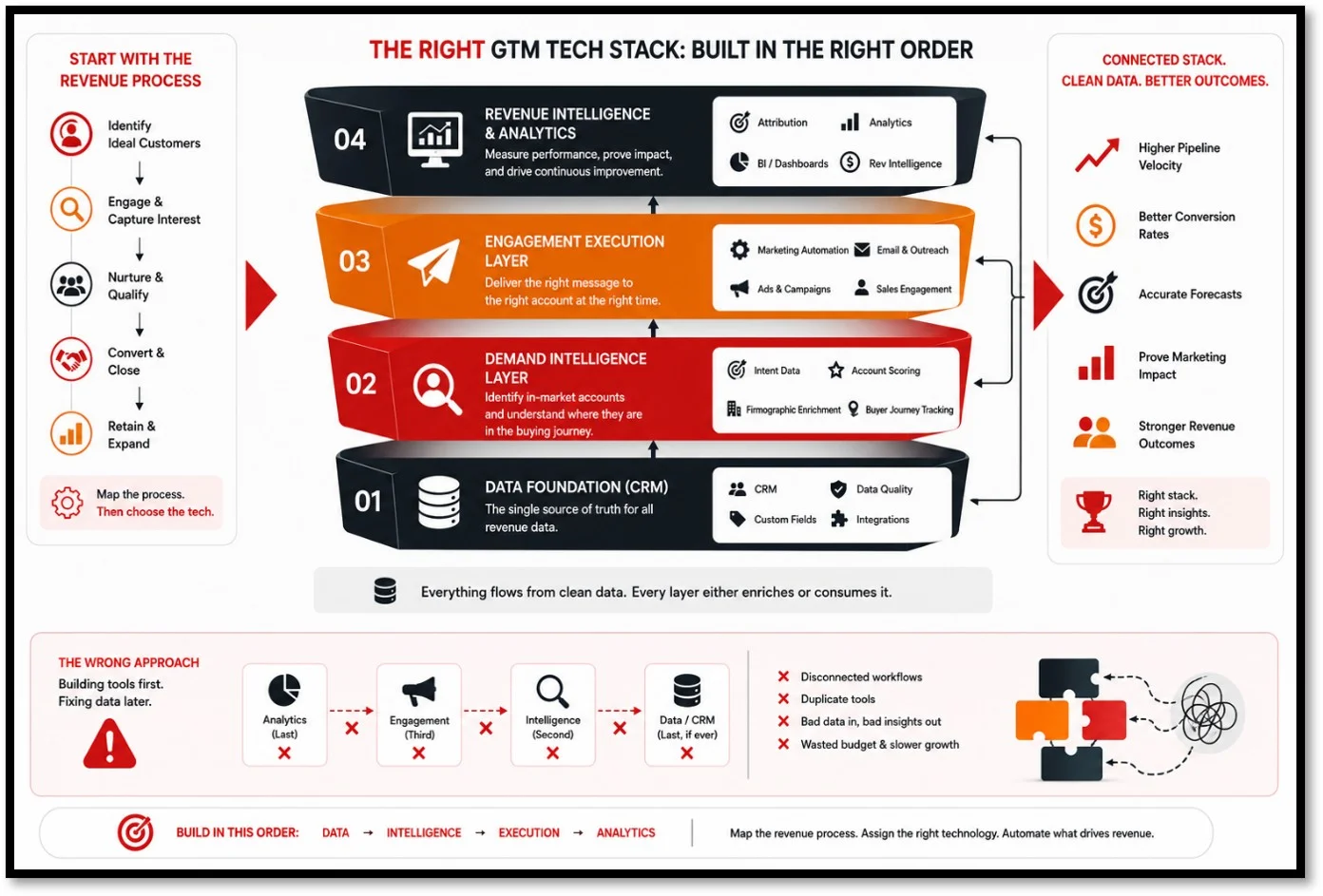
While the demand intelligence layer identifies in-market accounts and at which stage they are present, the engagement execution layer delivers the correct message to the right account. Revenue intelligence platforms, coupled with attribution and analytics tools, close the feedback loop between the output and execution.
The ideal building sequence always flows from data to intelligence to execution to analytics. However, many B2B enterprises build the last two layers first, and then place the fundamental layers on top, which only amplifies the inefficiency.
Why GTM Tech Stacks Fail, and Which Common GTM Tech Stack Mistakes B2B Teams Must Avoid
GTM execution tools often fail via three modes, out of which tool redundancy is the core failure mode. An average tech stack has 3-4 tools that overlap in the same layer. However, teams often purchase every tool to solve a specific pain point instead of buying them as part of an integrated architecture.
AEO Growth Studio found that only 15% of B2B teams completely integrate their marketing technology stacks. When two tools track the same data at the same time and report it differently, it creates a data inconsistency issue.
These GTM stack tools for B2B teams only solve symptoms rather than solving the underlying architectural problem, and debt accumulates as B2B enterprises add new tools to solve issues created by the previous ones.
Manual export processes often introduce errors and lag because tools bought at different stages never exchange data with each other, generating an undefined workflow. A tool purchased under these conditions is never integrated into daily execution, further degrading the analytical layer dependent on it.
How to Align GTM Tech Stack With Revenue Goals to Drive Measurable B2B Growth
Instead of aligning to revenue outcomes, most B2B marketing tech stacks are aligned to campaign performance because it measures the stack against marketing metrics. Here is how to fix disconnected marketing tools and connect the stack to revenue outcomes:
- Establish bidirectional CRM sync across all execution platforms. By writing back to the CRM record, each engagement event completes the account history.
- Implement at least one of the marketing attribution models across every revenue channel. This distributes pipeline credit based on commercial value.
- Define a shared pipeline definition across marketing and sales tools. It allows both departments to work on the same account status.
A unified attribution model produces the commercially most valuable decision because it helps teams allocate budget to resources that produced revenue.
How an AI-Powered GTM Tech Stack Changes B2B Revenue Operations Performance
AI-integrated revenue operations tech stack can only amplify the underlying data quality, and B2B teams with clean CRM data and a basic AI layer on top often outperform companies with fragmented data and advanced AI tools.
AI enables predictive lead scoring, where it analyzes account behavior patterns to assign conversion probability. Further, it aggregates buyer intent signals to surface in-market accounts based on first- and third-party intent signals. Lastly, AI introduces engagement-based forecasts by replacing rep confidence ratings.
The data quality on which the B2B revenue tech stack runs determines the ROI of AI in GTM, which makes the data architecture the high-value AI investment. AI-driven revenue operations on incomplete data often accelerate the wrong decisions, and that is why AI is only an amplifier, while clean data is the non-negotiable prerequisite.
Final Thoughts: How to Create a Scalable GTM Tech Stack
A scalable B2B growth tech stack is only built by designing a data architecture that every technological platform strengthens. Which architectural layer does the new tool improve, and does it genuinely add commercial value? are the two questions that every B2B team must ask before adding the new tool.
Maturing AI-powered tools will allow stacks with clean, connected data foundations to compound intelligence from every new capability. Contact Marketboats to develop this capability and build a high-performance GTM strategy by identifying and eliminating where integration debt emerges in your current strategy.
FAQs
1. What tools are required for a GTM strategy?
Attribution and revenue intelligence platforms, CRM, sales engagement software, marketing automation platform, analytics, and buyer intent tools are some key platforms that help you employ a strong GTM strategy.
2. How do you build a high-performance GTM tech stack?
The first step in building a GTM tech stack is to design the revenue process, followed by building a CRM data foundation and adding execution and intelligence layers. The next step is to integrate each platform and monitor performance with revenue outcomes rather than relying on departmental metrics.
3. What is the difference between CRM and CDP?
While CRM governs sales and buyer relationships, the customer data platform (CDP) unifies customer data from multiple sources to improve marketing execution by enhancing segmentation and personalization.