
The B2B go-to-market strategy establishes a repeatable system for enterprises that creates and captures demand, helping teams scale their revenues efficiently. However, many B2B teams consider the GTM strategy as a product launch plan rather than treating it as a never-ending operating system.
The Starr Conspiracy’s research finds that only 23% of B2B teams meet their revenue goals in the first year after the product launch. This failure is never due to a weak product, but to the GTM engineering inability to translate market demand into predictable revenue.
Fragmented GTM frameworks often amplify pipeline waste amidst the increasing buyer journey complexities, where AI plays a major role in reshaping decision-making. A GTM strategy is a plan, not just a document, and many B2B teams miss a quarter or two before diagnosing the actual problem.
Why the Step-by-Step B2B GTM Strategy Guide Actually Converts to Pipeline
B2B enterprises often assemble a go-to-market strategy framework in the wrong order. Before validating ICP, teams build messaging. They select channels before ensuring that the ICP actually converts, and before knowing what win rate data supports, they set pipeline goals.
The framework that actually converts into a pipeline follows a specific causal chain. The following are five steps that produce a GTM framework guide:
- ICP Definition: A data-driven segmentation derived from customer types that produced the highest win rate, better retention, and shortest sales cycle.
- Value Proposition: It articulates which commercial problem the ICP solves and formulates the cost of not solving that issue.
- Channel Selection: The step analyzes where ICP actually researches and actually evaluates.
- Messaging: Beyond the technical language of the product team, it is derived from the ICP’s commercial language.
- Execution Architecture: The demand gen approach, content strategy, and sales motion frame the ICP’s message through the channels.
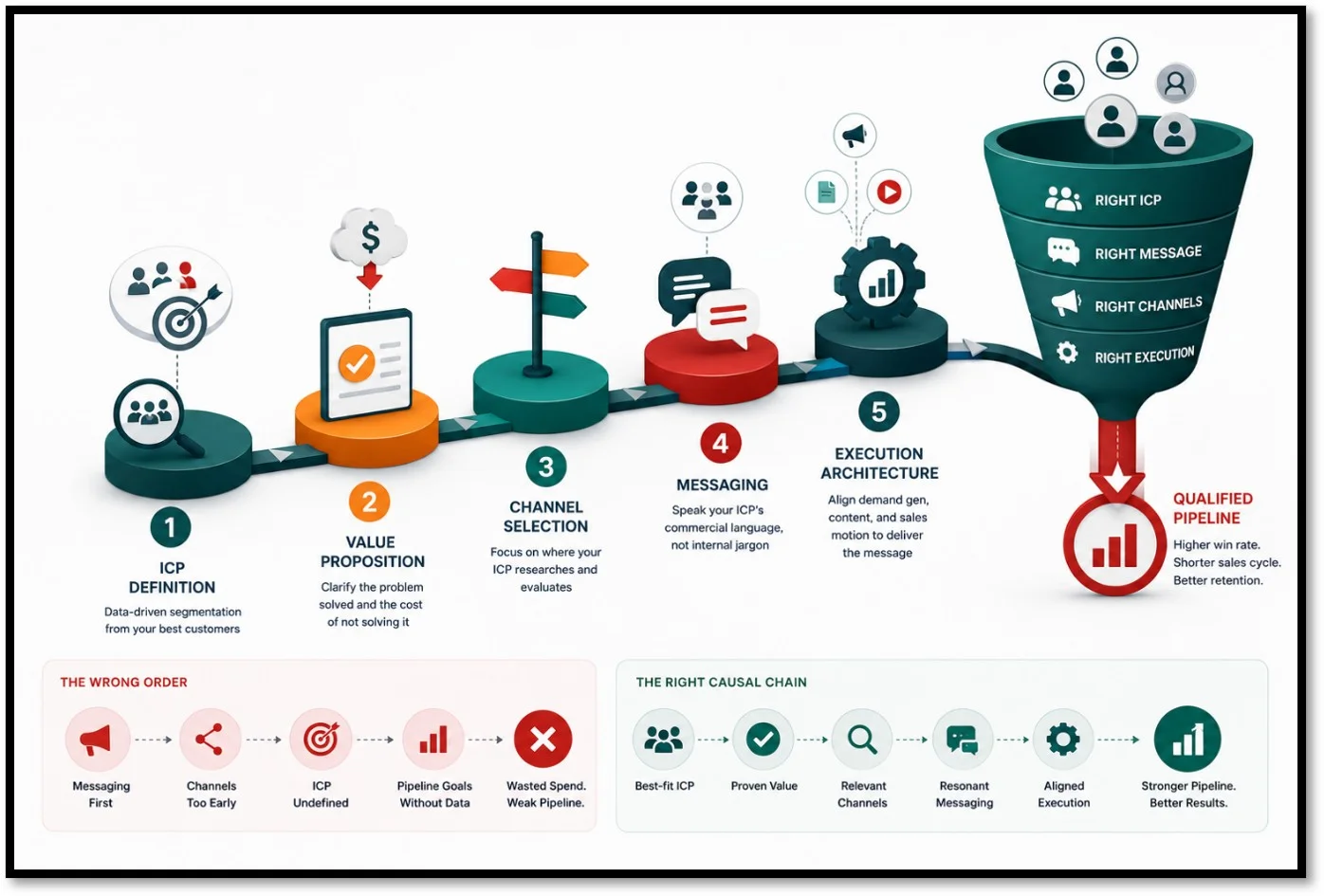
This causal chain matters because B2B teams that loosely define ICP often produce a value proposition to their aggregated customers instead of serving the best ones. The correct GTM investment ensures accurate downstream decisions.
A GTM strategy built on a tight ICP and validated value proposition outperforms a sophisticated framework built on a loosely defined ICP.
How to Align Sales and Marketing in B2B GTM to Eliminate the Handoff Problem
Sales and marketing teams often optimize for metrics that behave contradictorily. The proper alignment between the two teams needs shared metrics rather than shared calendars.
More than poor communication, the go-to-market strategy for B2B fails due to misaligned sales and marketing teams, and the real problem lies in definitions of metrics both teams monitor.
Both teams operate on different lead qualification definitions, attribution models, and pipeline-readiness concepts. Gartner’s 2024 research finds that 90% of sales and marketing executives claim that their functional goals are conflicting with each other.
Sharing mutually agreed qualification criteria and ICP definitions for accounts before the account enters the pipeline can be the first response to resolve this misalignment. A shared pipeline definition differentiating demand capture from demand generation, and a shared attribution model crediting across the entire buyer journey can also be helpful.
How to Build a B2B Go-To-Market Strategy in 2026 Using AI and Data-Driven Execution
More than being a strategy accelerant, AI-embedded GTM is an execution amplifier, which amplifies the quality of strategy applied, including its shortcomings. By aggregating firmographic data, engagement history, and behavioral intent signals, AI enriches ICP at scale.
AI can also track competitors’ pricing decisions, shifts in buyer sentiments, and product launches, which feed market signals to positioning teams, increasing efficiency over traditional manual research.
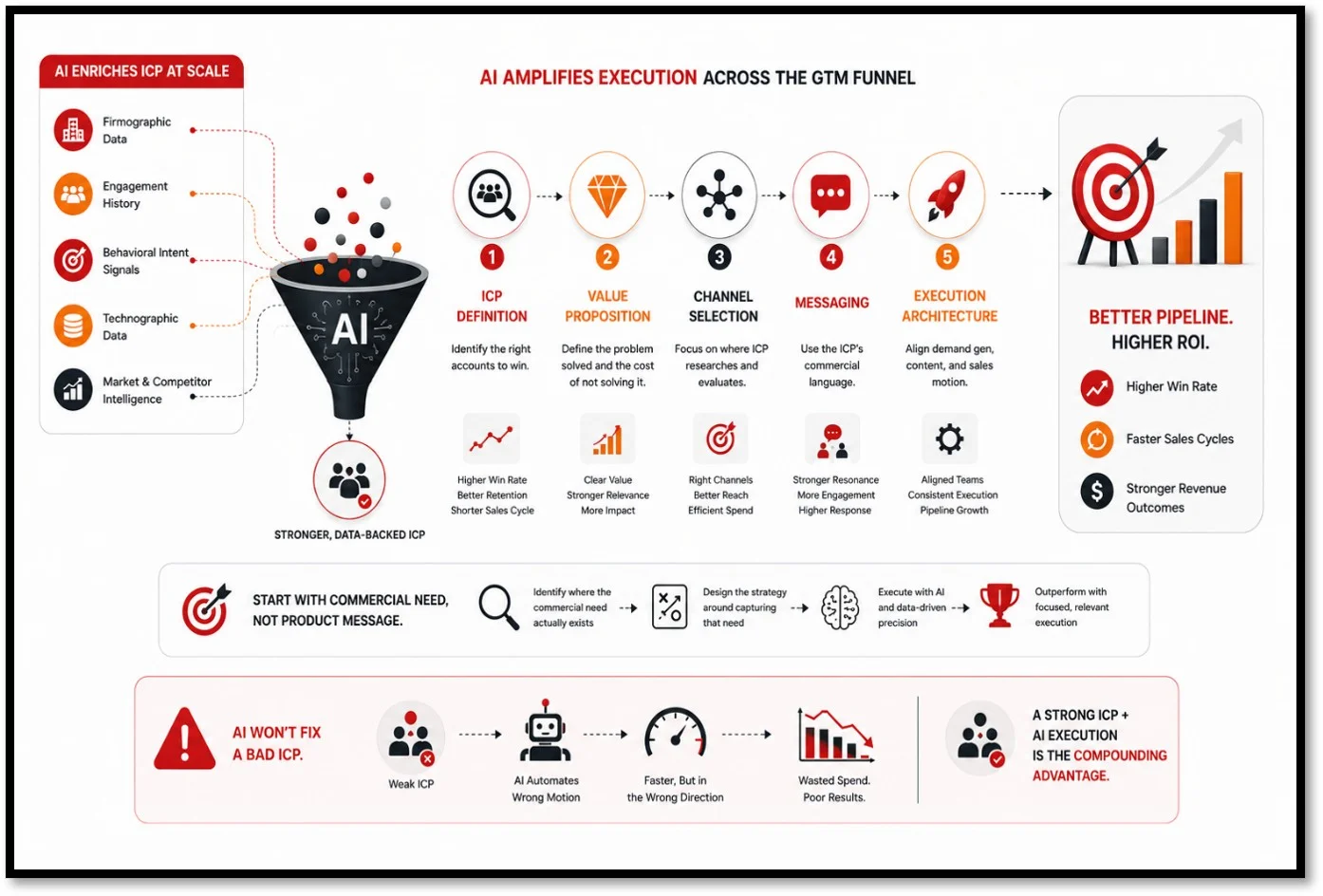
AI produces content variations to achieve personalization, and this segment-level personalization makes a weak ICP in B2B customer segmentation a stronger one. However, AI can only make a stronger ICP precisely executable, implying that B2B teams that use AI blindly to compensate for a poor ICP will only end up automating the wrong motion faster.
Rather than starting with product messaging, ROI of GTM strategy comes from knowing where the commercial need exists to make organizations design around capturing it.
Which Latest B2B GTM Trends in 2026 Help Enterprises Stand Apart in the Competition
ICP precision is the most important GTM trend that matters more than anything else. When ICP is defined precisely and every trend is applied to it, teams will often produce better outcomes. However, the GTM planning process fails when the right trend is adopted against the wrong targeting foundation.
Here are the four GTM trends that define its commercial performance through 2026:
- Demotion of MQLs as Primary GTM Metric: B2B teams pivot their reporting to new GTM metrics and KPIs, including buying group engagement, revenue contribution, and pipeline influence, to improve sales-marketing alignment and enhance forecast accuracy. According to Geisheker’s 2024 report, shifting from MQL to SQL can help enterprises achieve up to 3x higher conversions and 24% faster revenue growth.
- Emergence of Buying Group Targeting: Decision-making has shifted from one champion to a committee, and companies that ignore this lose deals at multiple stages.
- Product-driven Growth as a GTM Motion: Rather than restricting PLG to a growth tactic, companies are using it as a demand generation source.
- Ecosystem and Partner-driven Growth: Partner-led ecosystems enable B2B teams to expand their market reach without increasing headcount.
Beyond prescriptions, GTM trends are directional signals, and adopting them without validating against competitive position and ICP will replicate the framework without external market forces that made it work. GTM trends are contextually applicable, and the real question is whether they fit the ICP, sales motion, and price point.
How to Improve B2B GTM Performance
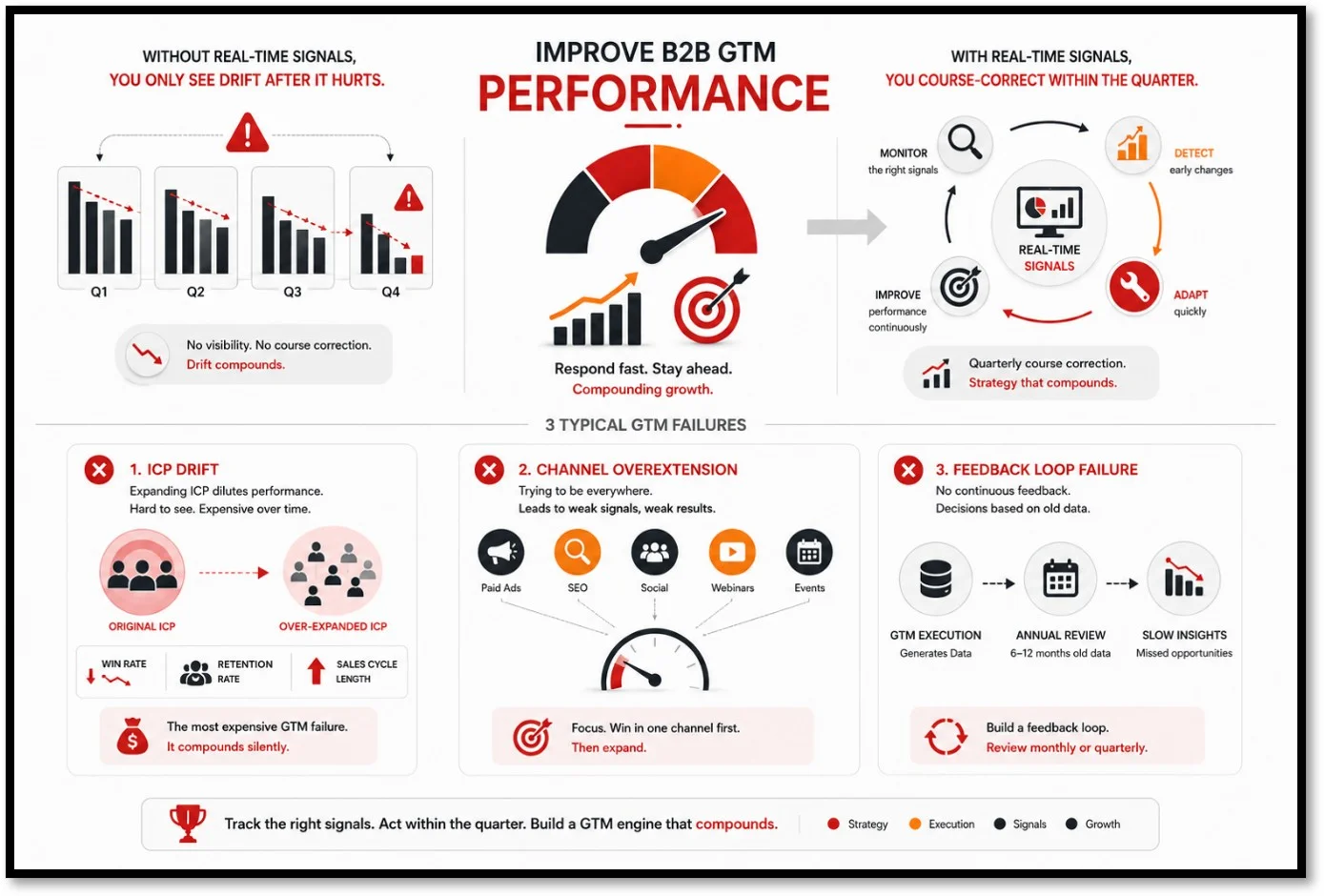
Despite the right strategy, when a company fails to track the right signals, it cannot predict drift until it actually impacts a couple of quarters. Only those strategies reflect compounding growth that respond to performance signals within the same quarter, and those that rely on an annual review only generate drift.
Here are three typical failures that are consistently reflected across B2B enterprises:
- ICP Drift: It is a measurement failure that occurs when the originally defined ICP expands and eventually starts converting at half the speed of the original ICP. ICP drift is hardly visible in a single dashboard metric, but it accumulates across win rate, retention rate, and sales cycle length, and this is why it is the most expensive GTM failure.
- Channel Overextension: Executing the strategy across all five channels never produces a strong signal, and to mitigate this failure, prioritize meeting conversion benchmarks in one channel before extending to the second.
- Feedback Loop Failure: B2B go-to-market strategy failures are predominantly feedback loop failures. Teams that fail to refine the data that GTM execution generates often see failure. Annual reviews over quarterly or monthly feedback make enterprises work on six- to twelve-month-old data.
How to Scale B2B Growth With GTM Strategy
When companies lose ICP precision determined during B2B business strategy planning, they fail to scale the GTM model, but the blame is often shifted to insufficient resources. Beyond sticking to processes, GTM scaling needs signal encoding.
B2B enterprises can achieve scalable growth when their GTM approach consistently generates predictable commercial output, irrespective of market dynamics. Process standardization is the first step in scaling, maintaining ICP precision built early.
The next point in the GTM strategy checklist for B2B companies includes documenting the winning sales motion, enabling reps to replicate the successful approach. Strategy-strengthening technology is the last requirement for scaling, where automation, CRM platforms, revenue intelligence, and AI elevate commercial decisions.
Only the correctly instrumented GTM motion before scaling becomes successful, which can predict performance degradation before it becomes a revenue issue.
Final Thoughts: How to Create a Go-To-Market Plan for B2B Products
More than just a launch activity, B2B GTM strategy 2026 is a continuous operating model that connects AI-assisted execution, ICP precision, measurement feedback, and sales-marketing alignment into a compounding revenue framework.
Sophisticated GTM documents will have less relevance compared to B2B enterprises with the fastest and most disciplined feedback loop between execution decisions and market signals.
Treating GTM as a one-time activity is the biggest mistake in B2B marketing strategy 2026, while enterprises that redesign their commercial operating systems faster than everyone else will have a competitive edge.
Contact Marketboats if your current GTM model only explains market entry and you want to construct a product go-to-market plan that captures opportunities, scales predictable revenue, and optimizes execution.
FAQs
1. How is AI in B2B go-to-market strategy changing execution?
AI enhances forecasting, optimizes campaigns, improves personalization and prioritization, and improves commercial decision-making through buyer behavior analysis and real-time evaluation of buying signals.
2. Which are the best B2B go-to-market strategies for 2026?
Concentrating on ICP and focusing on a single channel depth proves beneficial for early-stage, while growth-stage demands channel expansion and targeting buying groups. The scale stage requires PLG as a qualification framework, along with partner ecosystems.
3. What are the key challenges in B2B go-to-market strategy?
Feedback loop failure, channel overextension, and ICP drift are three crucial failures that amplify invisibly before reflecting in the quarterly results.
4. Which common GTM mistakes in B2B marketing affect the revenue pipeline?
Inaccurate ICP definition, disconnected technology, not optimizing GTM consistently, channel-focused planning, and weak marketing-sales alignment are common errors that affect the revenue pipeline.
5. Which parameters make the B2B go-to-market strategy template more actionable rather than decorative?
A defined review cadence embedded in a performance feedback mechanism is the key parameter that makes the GTM strategy more actionable.