
Three structural decisions can help enterprises convert B2B webinar leads into sales-ready opportunities: a predefined engagement threshold that qualifies a prospect for sales contact, a 24-hour post-event routing window, and personalized SDR outreach that references the lead’s specific engagement signal.
As automated routing cannot create opportunities alone, converting webinar leads to opportunities depends on how quickly and contextually SDRs act on engagement data.
EPIC MARKETING EVENT’s 2026 research finds that out of all webinar attendees, 38% become MQLs. The share of attendees who meet both ICP-fit and high-intent criteria provides a more useful basis for evaluating webinar lead quality.
Many systems either automatically route the right leads to sales or depend on manual review, introducing delays and inconsistency, which is why webinar-to-opportunity conversion is a system design issue. Webinar engagement becoming sales conversion depends on handoff quality.
How to Identify Sales-ready Webinar Leads, and How to Move Webinar Leads from MQL to SQL
When the composite score from live engagement signals and registration-level ICP fit meets the predefined qualification benchmark, and at least one high-intent signal appears in the engagement record, high-intent prospects become sales-ready webinar leads.
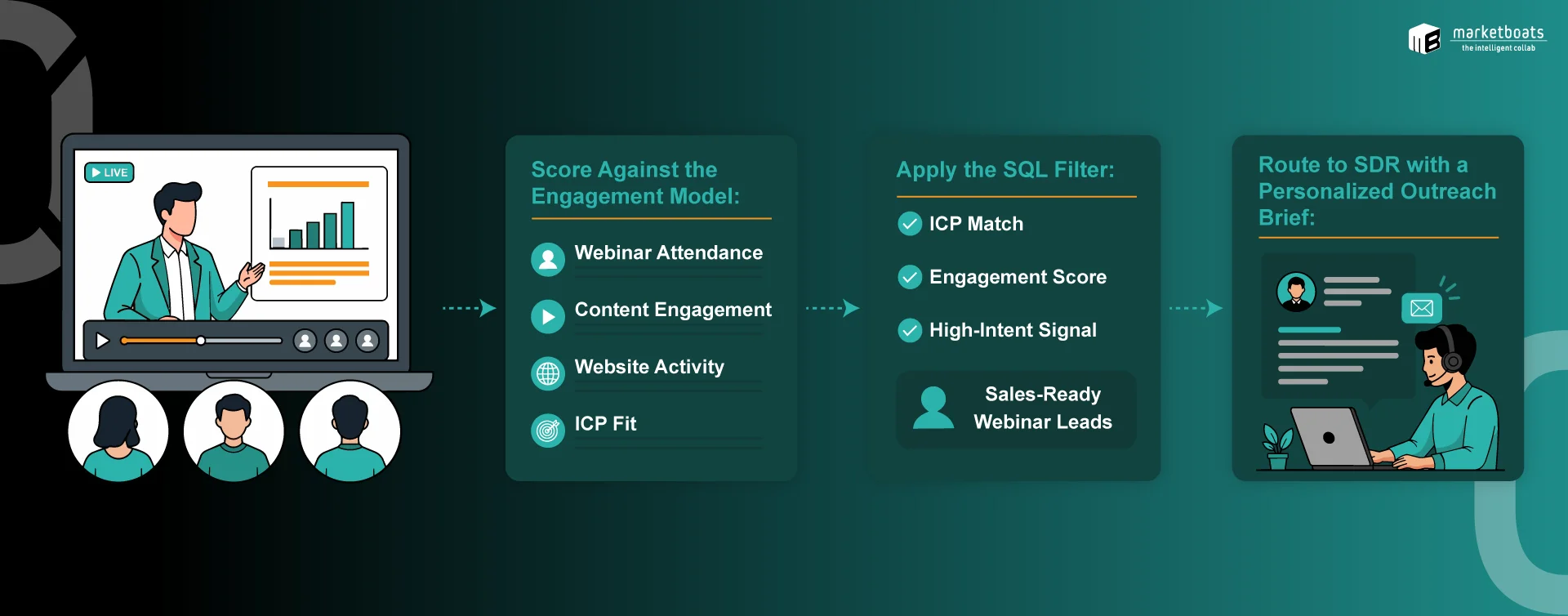
The following can be a practical webinar lead scoring process:
- Score Against the Engagement Model: Before determining a lead’s entry to the sales queue, apply the defined engagement scoring model to each attendee, while those scoring 40+ can hit the MQL threshold.
- Apply the SQL Filter: If the lead from the available MQL pool either asks a product-specific question during the event, visits the pricing page within 48 hours, or requests a post-event direct demo, shift the prospect to the SQL queue.
- Route to SDR with a Personalized Outreach Brief: Include the recommended outreach angle, attendees’ stated challenge, and specific engagement signal in the outreach brief. LeadSpark AI’s 2026 analysis finds that a personalized SDR outreach can generate 2-3x higher conversion.
Although attendance duration signals interest, it might not be a sufficient SQL metric. Product-specific engagement, on the other hand, reflects evaluation intent.
The SDR outreach brief replaces generic follow-up with a contextualized and specific opening, referencing what the attendee asked, making it more commercially defensible. A pricing-page visit within the first 48 hours can serve as a stronger automated buying-intent signal for sales qualification.
How to Nurture Webinar Leads After an Event, and How to Convert B2B Webinar Leads into Sales
Reactivation for no-shows, targeted content nurture for medium-intent prospects, and personalized SDR outreach for high-intent leads, employed simultaneously, ensure post-webinar lead nurturing. Each track is mapped to a different timeline and conversion target.
| Track | Audience | Follow-up Content | Suggested Timeline | Intended Conversion Target |
| Track 1- SQL | Sales-ready leads meeting the 40+ threshold and showing high-intent signals. | A personalized SDR outreach tied to a product-specific question or action. | 24 hours | A discovery call should be made within 5 business days. |
| Track 2- MQL | Prospects scoring between 20 and 39 without high-intent webinar buying signals. | ROI calculator, case study, or next-webinar invitation. | 3 emails within 12 days | Resource download or pricing page visit should trigger SDR outreach. |
| Track 3- No-show | Registrants who did not attend the webinar. | Replay link + one-question survey. | Within 48 hours | Replay view and re-entry into MQL scoring model. |
No-show registrants can still represent meaningful interest because they completed registration despite not attending the webinar.
The webinar follow-up strategy should reference a question or behavior that sparked the qualification signal, and a relevant follow-up can encourage buyers’ existing research rather than restarting the conversation.
Summary: How to Measure Webinar-to-opportunity Conversion and Prove Pipeline Impact
Tracking metrics like MQL-to-SQL conversion rate, webinar-generated pipeline, and average time from webinar attendance to opportunity creation can help B2B enterprises measure webinar-to-opportunity conversion. CRM activity linked to opportunities should be logged to measure these outcomes.
Rather than treating webinar-to-opportunity conversion as a webinar parameter, it should be considered a revenue metric, and it needs connected CRM, MAP, and sales pipeline data. The workflow connects the SDR outreach brief, CRM integration, and three-track nurture model to sales pipeline data.
After understanding how to convert webinar leads into opportunities, the next step is to track webinar ROI from registrations through closed revenue. Contact Marketboats to find out how to turn webinar engagement into pipeline.
FAQs
1. How do you turn webinar attendees into sales-ready leads?
Combine engagement scoring with ICP fit, followed by applying a predefined SQL threshold to turn webinar attendees into sales-ready prospects. Demo requests, pricing-page visits, and product questions can offer stronger buying-intent signals.
2. What webinar engagement signals indicate buying intent?
Pricing or demo activity, resource clicks, evaluation-stage poll responses, sustained attendance, CTA interactions, and product-specific questions are some engagement signals that indicate buying intent.
3. When should webinar leads be handed to sales?
Upon meeting the qualification threshold, high-intent webinar leads should be handed over to sales as soon as possible. A 24-hour routing window can provide a clear operating target for SDRs while keeping engagement context fresh in the post-event workflow.