
Apart from driving revenue growth, sales analytics identifies early pipeline risks and builds a predictable revenue engine that improves forecasting accuracy. Many forecasting models still use historical averages and reps’ judgment rather than live buying signals. As a result, their forecasts only explain missed revenue rather than prevent it.
Gartner’s research suggests that 65% of B2B enterprises will shift from intuition-based to data-driven decision-making, emphasizing using engagement signals. Companies using these signals will identify at-risk deals before the assigned sales reps do.
A CRM-based forecast is often rep optimism dressed as a number. Beyond a discipline issue, forecast accuracy is a data input problem, often resolved by replacing subjective signals with observable ones.
How Sales Analytics Improves Forecasting Accuracy for B2B Teams
Predictive sales analytics replaces three subjective inputs with observable parameters, which starts by replacing rep confidence rating with buying committee engagement. The next replacement is close date estimates with actual days-to-close against historical benchmarks.
Deal health assessment is the last parameter that is replaced with stage conversion probability. The convergence of all three replacements makes revenue forecasting a pattern-based probability, replacing subjective judgment.
Reps often are the last people to predict a stalling deal, and this is where CRM analytics fails. Before reps could even report, buyers disengage, and instead of capturing a buyer’s behavior, CRM collects reps’ perception.
B2B sales analytics that prioritizes customer intent over rep optimism improves forecast quality. However, when enterprises choose sales pipeline status over buyer behavior, forecasts are bound to fail.
How to Use Sales Analytics for Better Forecasting Without Rebuilding the Tech Stack
Enterprises often hold sales forecasting tools responsible for improving forecast quality. However, CRM fields that are consistently left blank produce inaccurate forecasts, and sophisticated tools applied to this data only amplify inaccuracies rather than eliminating them.
Capturing signal-rich data is the fundamental operational practice that improves sales forecasting accuracy. Completing CRM fields like objection type, actual versus predicted close date, and multi-stakeholder engagement count generates the required historical pattern data.
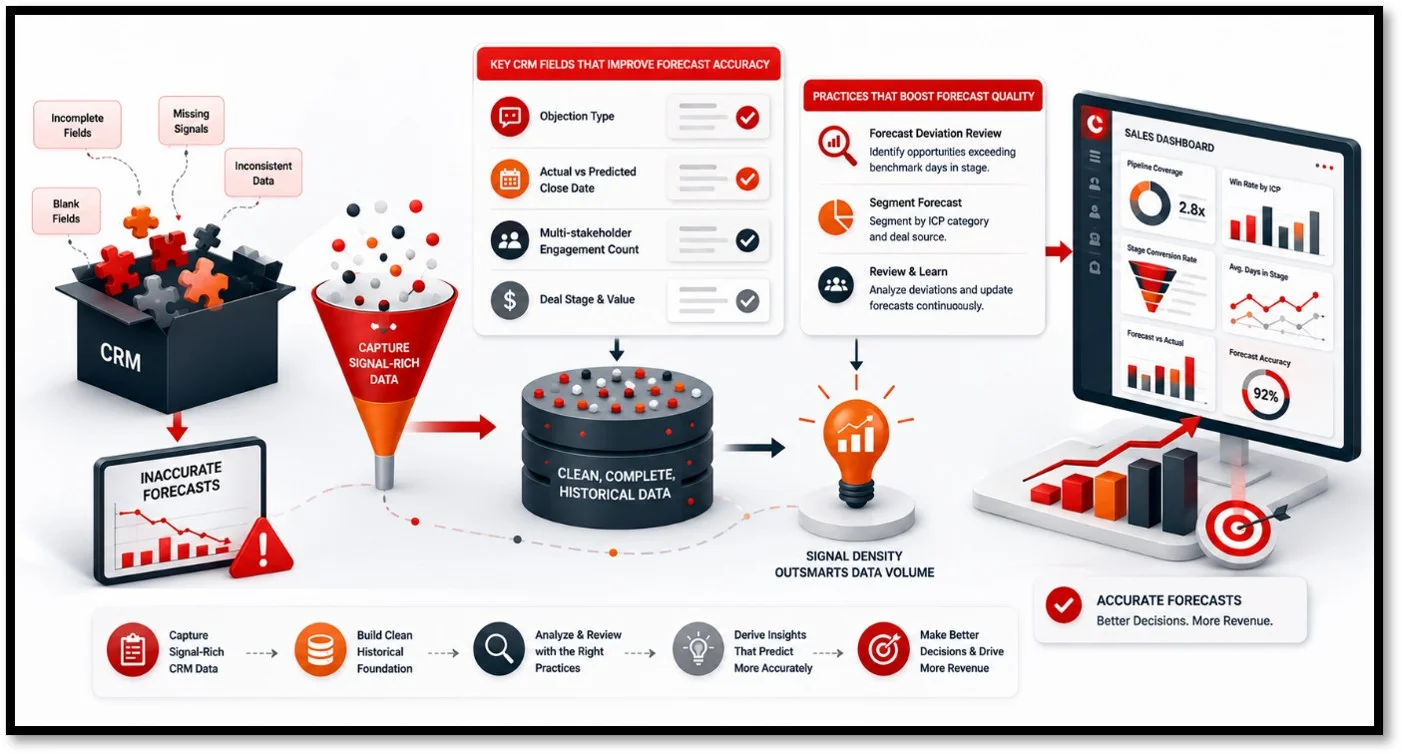
Forecast deviation review identifies opportunities that remain in a stage longer than historical benchmarks. Segmenting the forecast by ICP category and deal source is the last practice.
A sales dashboard built on selective signal-rich fields performs better than the one built on multiple incomplete parameters. This is because signal density outweighs data volume while determining forecast quality.
What Are the Benefits of Sales Analytics for B2B Companies Beyond Forecast Accuracy
Although revenue analytics is positioned as a forecasting tool, it becomes more valuable when treated as a resource allocation mechanism. As the data improving forecast quality describes where pipeline investment generates the highest ROI, it determines revenue growth rate.
The real ROI comes from consistent and accurate decision-making rather than investing in sales data analysis. Here are three key benefits of these decisions:
- Pipeline Risk Identification: At-risk deals can be identified early, creating intervention lead time that pipeline reviews are incapable of producing.
- ICP Refinement: Customer segments generating the highest commercial ROI can be identified, enabling B2B enterprises to allocate resources accordingly.
- Precision in Rep Coaching: Identifying the underperforming reps relative to the team benchmark, stage-level coaching can be employed. Zipdo’s research finds that coaching increases the rep response rate by 60% with a 28% higher session completion rate.
Which Sales Analytics Tools for B2B Businesses Can Be Considered the Best
The best sales analytics platform is often the one with the highest adoption across the sales team, and choosing the correct tool is a change management decision.
Here are three questions that determine the success of analytics tools:
- Does the model detect real-time deviation or summarize historical benchmarks?
- Does the platform learn from historical results to improve future forecasts?
- Does the model integrate with existing workflows to improve sales reporting effort?
Sales analytics software that improves forecast quality from existing data is the best choice for B2B enterprises. A tool the entire sales team uses is superior to an analytically sophisticated tool power users employ. This is because accurate functioning of the analytical layer needs consistent signal capture across the team.
Final Thoughts: How Sales Analytics Reduces Forecasting Errors and Builds a Compounding Revenue Advantage
Sales performance analytics replaces subjective signals with observable inputs to elevate forecasting accuracy. It describes where resources should be allocated, where reps require dedicated coaching in the pipeline, and which ICP segments to pursue to compound its commercial value.
B2B enterprises developing their analytical capability are bolstering the data foundation, making the future forecast even more accurate than the previous one. Maturing AI-driven forecasting will widen the gap between enterprises with the richest, cleanest, and most consistently captured commercial signals, and those with cutting-edge algorithms.
Marketboats will help you shift from rep-driven optimism to buyer behavior-led forecasting to maximize revenue growth.
FAQs
1. Why is forecasting accuracy important?
Along with the improvement in revenue planning, accurate forecasting enhances pipeline prioritization, executive decision-making, and resource allocation, and this is where forecasting accuracy becomes important.
2. How do you measure forecasting accuracy?
Using forecast variance, compare forecasted revenue with actual figures, forecast accuracy percentage, pipeline conversion trends, and win-rate consistency.
3. What metrics improve sales forecasting?
The most valuable metrics that improve sales forecasting include historical win rates, opportunity aging, forecast variance, pipeline velocity, stage conversion rates, and buying committee engagement.