
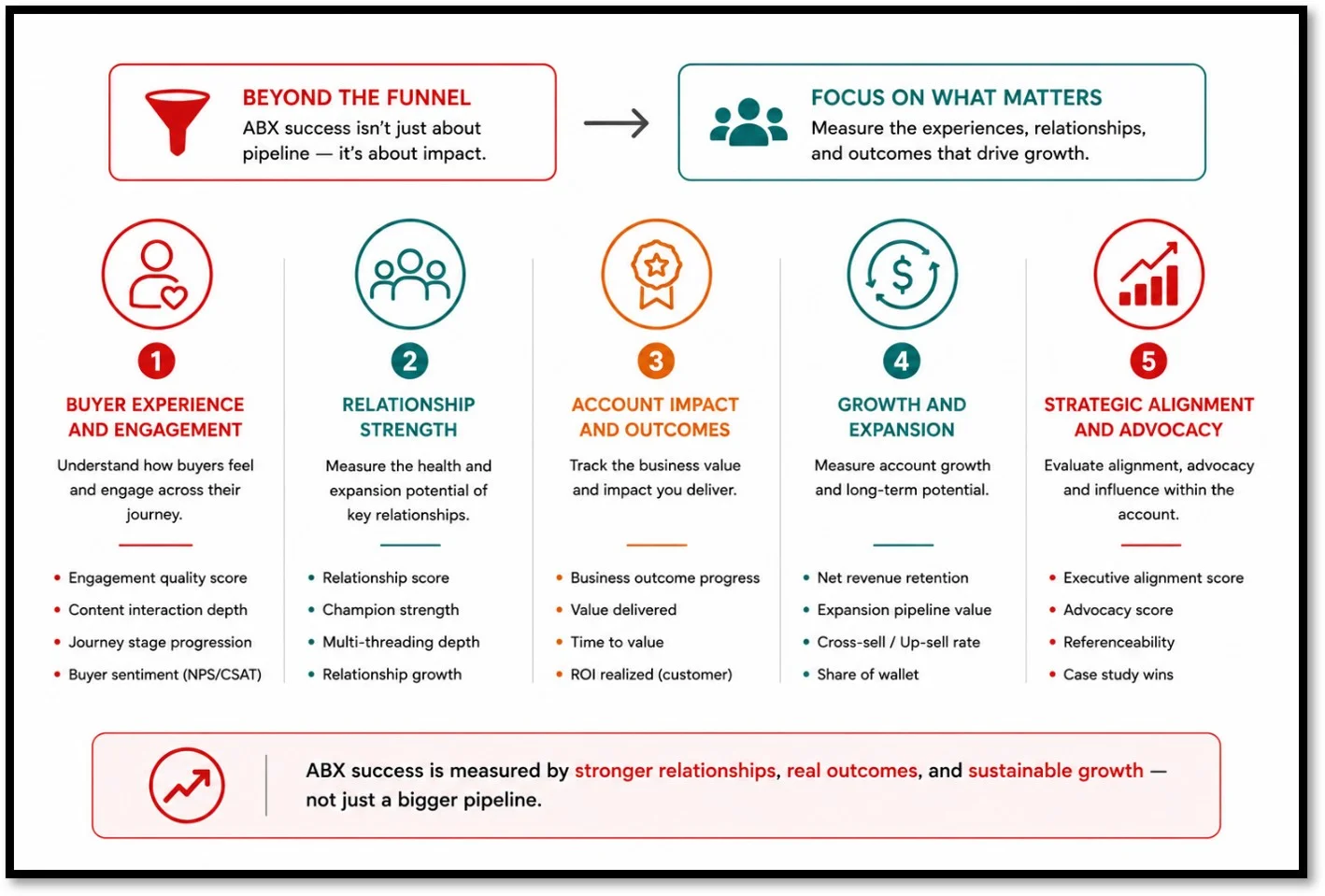
ABX metrics’ success is measured through revenue expansion, account continuity, and tracking relationship progression rather than monitoring siloed lead-stage conversions.
Most B2B teams measure campaign activity rather than account experience quality. This measurement does not evolve, though the program changes, and this is where most revenue pipelines quietly break.
The CMO Club finds that 42% of B2B teams find measuring ABM effectiveness a hurdle. The measurement model is the core problem, not the program.
Traditional metrics can only track MQL volume, pipeline-stage entries, and campaign response rates. However, they fail to describe post-sale growth or account-relationship quality. As a result, they cannot explain the commercial value to the leadership.
How Is ABX Different from ABM
| Parameter of Comparison | ABM | ABX |
|---|---|---|
| Primary Goal | It aims to generate pipelines and acquire a new logo. | It caters to the full-lifecycle account relationship. |
| Values Measured | Pipeline entry, MQL volume, and deal volume. | Pipeline velocity, expansion revenue, and NRR. |
| Measurement Scope | Top of the funnel. | Throughout the funnel. |
| Unit of Measurement | Campaign response and individual contact. | Account relationship stage and buying group. |
| Revenue Model | Acquisition-oriented revenue model. | Retention-led and expansion revenue growth model. |
| Post-sale Coverage | Limited to handoff to customer success. | It provides integral coverage, and post-sale is part of the same program. |
| Measurement Horizon | Quarterly pipeline growth. | Account lifetime progression. |
While ABM is extremely precise at monitoring account reach, ABX’s objective is to measure relationship quality across expansion, acquisition, and retention. Further, MQLs explain the campaign response, and ABX metrics describe account movement.
B2B teams that fail to defend their ABX KPIs are running a good program against the wrong scoreboard. The inherited measurement model is the core problem, not the program itself.
What KPIs Matter in ABX, and Where B2B Teams Get Them Wrong
The majority of B2B companies still prefer low-signal activity metrics, including email open rates, content downloads, and individual contact engagement rates. These commonly tracked metrics only describe touchpoint activity.
High-signal account-based experience metrics track account engagement score, multi-stakeholder engagement depth, and pipeline velocity. These metrics describe account health, which matters more than campaign response volume, yet many B2B teams still under-track it.
Effective ABX programs, beyond lead velocity, are optimized for account durability. Forrester’s research finds that 13 stakeholders are involved in the decision-making process in B2B buying.
Thus, an account engagement score that captures only one stakeholder’s behavior will generate partial signals, misleading the evaluation of buyers in the buying process. ABX considers the entire buyer group’s activity as the buying committee drives commercial decisions.
What Is Net Revenue Retention, and Why It Matters More
Net revenue retention (NRR) measures account relationship quality that traditional funnel metrics could not. It monitors the percentage of revenue retained from existing buyers after considering churn, expansion, and downgrades.
When NRR increases beyond 100%, the existing buyer base grows without new acquisitions. However, most B2B teams don’t own NRR, and they report only on metrics that their revenue attribution model can read.
This structural gap does not allow ABX to be measured end-to-end, and marketing teams must own accountability for post-sale account health to fix it. The success of ABX depends on continuity between pre-sales and post-sales experiences.
NRR must be seen as a commercial outcome of relationship programs on which ABX operates instead of treating it as a customer success metric.
What Is Pipeline Velocity, and How It Measures ABX Program Impact
Pipeline velocity describes the speed with which accounts move through evaluation stages, weighted by conversion probability and deal size. The metric is more comparative than absolute in the ABX domain.
Here are three structural decisions that increase the reliability of pipeline velocity as an ABX performance measurement metric:
- Segment the pipeline data by ABX participation. Accounts receiving orchestrated experience must be separated from those who did not.
- Beyond the pipeline stage, track the velocity at the buying group stage. It describes where the buying committee is in the evaluation process. It also reveals whether the experience actually simplifies the decision-making.
- Audit accounts that exited and did not convert. It helps teams understand where the engagement depth dropped and which committee member disengaged from the process.
Pipeline velocity explains how the accounts receiving coordinated experience moved differently in the funnel, and this is what a healthy pipeline indicates. Stagnant accounts with high lead volume indicate a measurement failure.
Final Thoughts: How to Measure ABX Success in B2B Marketing Without the Wrong Scorecard
Most B2B teams apply ABM metrics to an ABX program, and the measurement model fails. The scorecard is built on account-based experience metrics like pipeline velocity differential, NRR, and account engagement depth.
B2B teams that emphasize only funnel metrics often misread long-term growth potential and account health. Post-sale revenue becoming a larger share of the B2B revenue will make the full-funnel measurement models mandatory.
Marketboats can help you identify measurement gaps in your current program and devise a strategy to overcome shortcomings to maximize pipeline growth.
FAQs
1. How to measure ABX success in B2B marketing effectively?
Measure expansion revenue, relationship progression, lifecycle movement, and buying-group engagement depth, and cut reliance on lead-stage conversions.
2. What are the best ABX metrics for revenue growth?
Pipeline velocity, expansion revenue, customer retention quality, and NRR are some key metrics that offer better ABX visibility.
3. How B2B companies measure customer experience?
B2B teams track engagement consistency, monitor account continuity, retention signals, coordinated lifecycle progression, and expansion behavior across different departments.