
The best-performing B2B lead nurturing workflows move leads closer to a buying decision faster at the right moments. B2B enterprises do not automate progression; they focus on communication. Prospects receive emails without moving through the funnel.
Instead of building email automation around behavior, most B2B teams construct it around time, and this is the core problem. Mailercloud’s study reveals that triggered emails show 70.5% higher open rates over time-based drip sequences.
Adding more emails to workflows does not add relevance, increases message fatigue, and reduces performance. Automation must make the decision-making faster, beyond maintaining visibility.
What are the Best Email Automation Workflows for B2B Companies
Most email automation workflows are treated as delivery systems. B2B teams design sequences to send material instead of focusing on reading behavior and subsequent routing.
While the traditional content delivery sequence sends the same asset to every contact, qualification systems track prospects’ interaction with emails, including clicks, opens, and ignores, to employ signal-based routing.
Prospects clicking the pricing page are different from contacts ignoring emails, and yet many workflows treat both equally. Ideally, lead nurturing email workflows should analyze what buyers’ behavior has revealed and, subsequently, trigger logic, instead of preparing a content calendar.
Which Workflows favor Lead Nurturing Automation for Long Sales Cycles
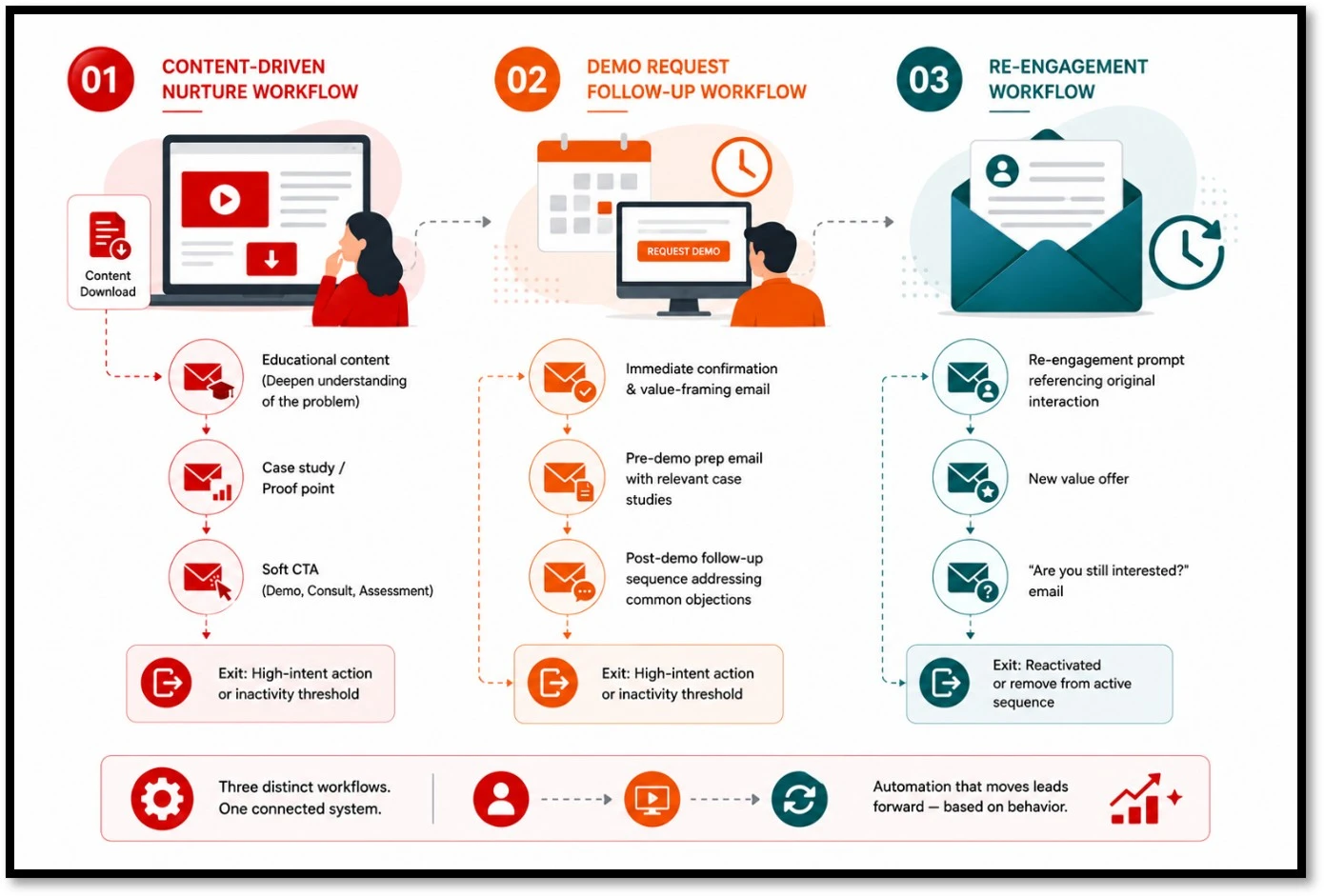
1. Content-driven Nurture Workflow
Most lead nurturing email campaigns under-educate but over-promote. Content-driven workflow caters to prospects who engaged but did not take any high-intent action, and is triggered by a report download, newsletter subscription, or webinar registration.
Effective automated email sequences are those that answer the next buying question, rather than promoting their offerings. The ideal sequence triggers from educational content explaining the root issue, to proof-oriented case studies, followed by soft conversion offers, and exits once the prospect reflects high-intent behavior.
2. Demo Request Follow-up Workflow
Although the pricing page visits or demo requests represent strong buying signals, many B2B teams treat them and follow-up workflows as administrative processes.
Automated follow-up emails workflow begins with a value-framing email, moving to a pre-demo prep email that includes case studies, and ends with a post-demo follow-up request.
The buying decision is made within 48 hours after a demo, and a follow-up request appearing within that window either advances the deal or loses it. Beyond confirming attendance, the real objective is to maintain evaluation momentum. Demo requests should emphasize stakeholder confidence instead of logistics.
3. Re-engagement Workflow for Inactive Leads
The workflow distinguishes genuinely exited prospects from leads that have gone quiet. It begins with a direct re-engagement email, followed by a new value proposition, and finally, an “are you interested?” email that either re-engages the contact or offers a clean exit.
According to Bouncer’s 2025 analysis, re-engaged prospects reflect 10% higher average order values. Inactivity must change behavior rather than sending more follow-up emails. Silence becomes an effective nurturing decision in a few cases, as triggering multiple unanswered emails might seriously damage the sender’s reputation.
How to Create a Lead Nurturing Email Workflow
A lead nurturing email campaigns workflow constructed around a content delivery schedule becomes a scheduled broadcast having conditional formatting at its core. Here are three design decisions that make behavior-driven workflows stand out:
- Define exit and escalation conditions before you build the content. Lack of clear exit instructions develops a content loop instead of building lead qualification workflows.
- Develop branching logic at each content touchpoint. The workflow must differentiate the contact that engaged with an email from the prospect who ignored the same email.
- Employ AI-powered send time optimization. Integration of individual send-time optimization with behavioral branching will help in adapting every contact’s engagement patterns. Individual engagement patterns often outperform fixed delivery schedules.
Final Thoughts: How to Build Email Automation Workflows That Increase Conversions
B2B Marketing automation workflows become effective and compound the pipeline when they precisely read contact behavior, followed by relevant routing, and escalate the high-intent leads at the right stage and at the correct time.
B2B teams that treat email engagement automation as a qualification and routing system will compound the pipeline advantage. AI-supported behavioral personalization is becoming more accessible, and that is where the gap between time-centric and behavior-driven automation will increase.
With Marketboats, you can bridge this gap and reduce the compounding cost of staying on time-based sequences. Conduct a lead-nurturing workflow audit with our team, and identify how behavioral automation can accelerate pipeline progression.
FAQs
1. What are the lead nurturing workflow best practices for B2B marketers?
Emphasize clear exit criteria, progression logic, buyer-stage relevance, and behavioural triggers over fixed email schedules.
2. How do automated email campaigns for B2B lead generation improve conversion?
Automated email campaigns offer timely content delivery based on engagement signals, which allows leads to travel through their buying journey more seamlessly.
3. What is the role of personalized email automation for B2B marketing?
Personalized automation not only increases engagement quality but also ensures leads receive buying stage-relevant communication, and as a result, it improves relevance.