AI email personalization becomes more effective when relevance is improved rather than increasing the automation volume. Emails that work are tailored for a specific person, arrive at the correct time, and have the right context.
Most B2B teams limit personalization to adding names in the subject lines, and this is why many email campaigns fail. It is still a mail merge dressed as personalization. B2B buyers ignore AI-generated email content more than ever, yet marketers emphasize scaling volumes, and this is the core problem.
SQ Magazine’s research finds that genuinely personalized emails increase open rates by 50%, and they are not using just name-based personalization. Inbox competition is about an attention-allocation issue, rather than a content problem.
Despite using AI, successful B2B marketers are doing things differently. The gap between the two approaches is evident in every campaign report.
Why Personalized Emails Get Higher Open Rates
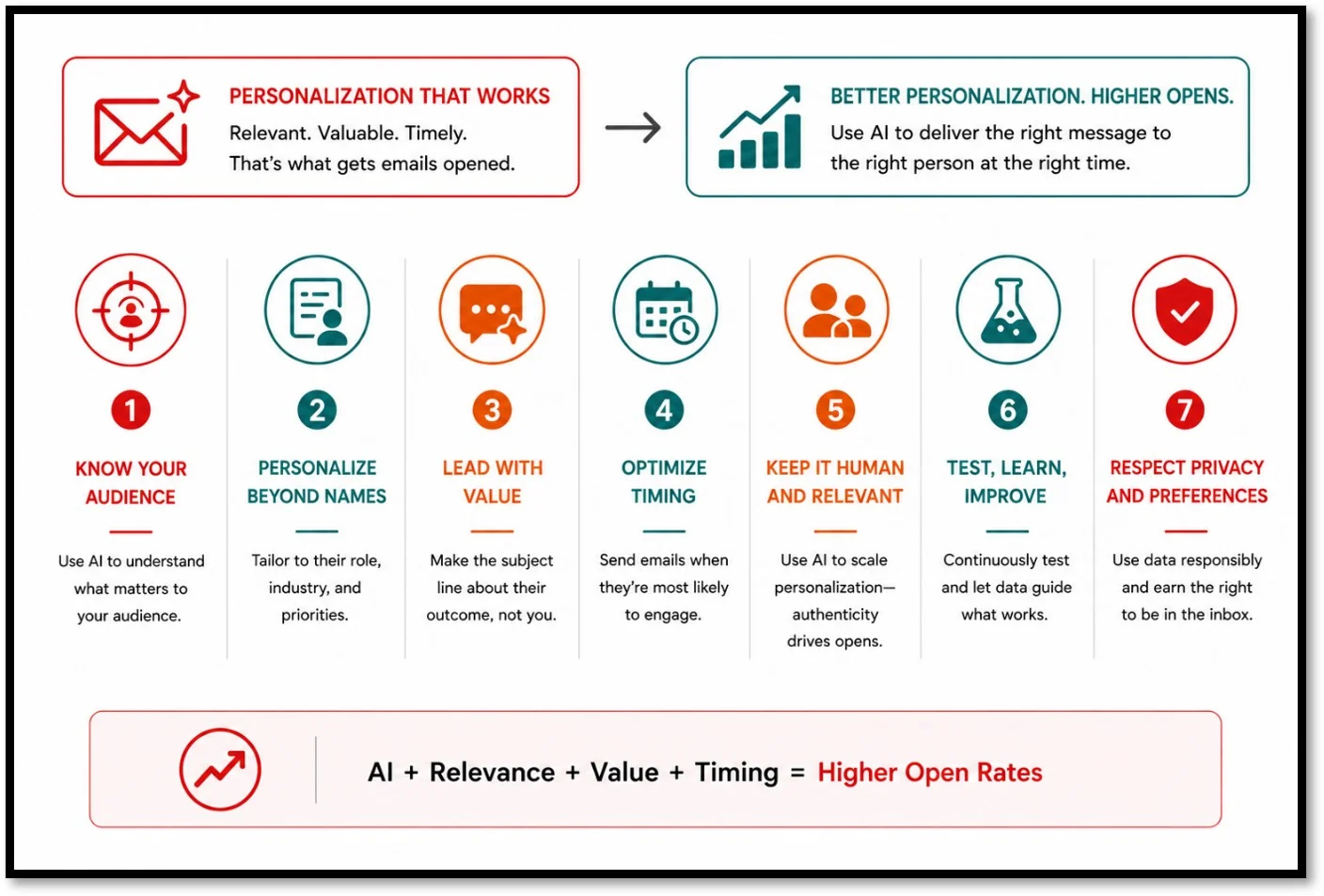
Personalized email marketing increases open rates because it provides relevance even before the email is opened. The subject line referring to an actual buyer activity, like the content download or a page visit, is more credible than a generic one.
The recipient decides to open or ignore the email within two seconds purely based on its relevance, not on its quality. Within this window, behavioral specificity becomes the strongest relevance signal that captures the buyer’s attention.
Low open rates usually indicate a relevance-architecture problem, but many B2B teams keep fixing personalized email subject lines without optimizing the relevance signal. Instead of profile fields, relevance and timing of behavioral signals govern the effectiveness of email personalization.
How to Personalize Emails Using AI Beyond Subject Lines
Most email personalization strategies emphasize the subject lines, and the ideal solution lies beyond that. Here is the three-dimensional framework that matters more:
- Dynamic Body Content Assembly: Based on the buyer’s position in the buying journey, behavioral history, and the contact’s segment, AI builds the email body content from modular blocks. Different recipients receive different messages via the same template.
- Customer Segmentation with AI: It shifts the segmentation from firmographic grouping to behavioral clusters. The contact who downloaded a comparative guide belongs to a different sequence than an account that visits the pricing page.
- Send-time Optimization: AI tracks the specific window in which the account is most likely to engage based on the historical click and open behavior. HubSpot’s research finds that the recent engagement of a contact’s email clicks and opens is calculated from the past 90 days of data.
More than writing polished emails, AI eliminates averaging that hampers email marketing effectiveness at scale.
AI Email Subject Lines That Improve Open Rates
The core advantage of AI-driven email campaigns lies in identifying the resonating subject lines that help B2B teams engage more buyers. These campaigns rate behavioral specificity higher than categorical relevance, emphasizing buyers’ recent activity over the generic topic of interest.
The preference for subject lines also varies, which machine learning in email marketing identifies at the individual level. Urgency signals lose their effectiveness over quarters-over-quarter, and AI models weigh these signals continuously, which static A/B tests cannot.
Subject line optimization does not compensate for weak audience targeting. Although AI identifies engagement patterns, relevance is what drives buyers’ actions. It optimizes subject line personalization for each contact, while A/B testing optimizes for the average of a segment.
Email Personalization Tactics for Higher Open Rates
Email deliverability and personalization are not independent and separate streams. Despite high relevance, if a highly personalized email ends up in the spam folder, it will have a 0% open rate. Personalization must develop with evolving buyer behavior.
High engagement strengthens the sender’s reputation over time, and future emails end up in the inbox. As a result, trusted signals create positive inbox placement, resulting in higher open rates.
Here is the three-layered practical decision framework that nurtures the deliverability layer:
- Remove inactive contacts before they hurt the sender’s image. Suppress contacts who have not opened the email for 90+ days. AI suppression models avoid a deliverability penalty by identifying disengagement early.
- Employ AI segmentation to avoid the incorrect send window. Sending emails to contacts that are unlikely to engage reduces the engagement rate, and customer segmentation with AI identifies this low engagement window.
- Track segment-level personalization quality. An underperforming personalization sequence indicates a wrong input signal. Data quality behind the personalization model controls the engagement rate ceiling.
Final Thoughts: AI Email Marketing Tips for Better Engagement That Compound Over Time
AI in email marketing does not make emails more creative to improve open rates, but it makes emails more relevant to achieve the objective. AI makes relevance at scale possible, which human-built segmentation cannot.
Instead of making emails feel more automated, AI must make them feel more human. B2B teams that treat AI subject line optimization, behavioral personalization, and send-time intelligence as a connected system will increase their campaigns’ open rates.
The recipient attention windows are shrinking as inbox competition increases. In these conditions, the gap between personalized and generic email performance will continue to widen and compound with every send cycle.
Marketboats can help you understand this gap and devise email marketing campaigns that will compound engagement, not only increase open rates.
FAQs
1. What are the AI email personalization best practices for B2B teams?
Emphasize behavioral segmentation, send-time optimization, AI-supported subject line personalization, and dynamic content to avoid reliance on demographic data.
2. Which are the best AI tools for email personalization?
HubSpot AI, Bloomreach, 6sense, Twilio Segment, and Salesforce Marketing Cloud are some of the best AI tools that offer advanced personalization, predictive engagement capabilities, and precise segmentation.
3. Why personalized emails get higher open rates than generic campaigns?
Personalized emails create immediate relevance signals for recipients. As a result, they are more likely to view emails as worth opening, and this is what makes personalized emails stand out.