
A multi-platform content strategy in B2B marketing eliminates isolated publishing and builds authority via constant contextual presence. The B2B thought leadership strategy is built on the pillars of the content ecosystem, rather than on a single channel, where each platform supports the authority signals of other channels.
DigitalApplied’s research suggests that B2B buyers consume 13.4 content pieces before contacting a vendor. Buyer interaction through ecosystems generates better engagement than a B2B company relying only on a single channel.
Instead of prioritizing ecosystems, most B2B teams publish content, and they lack the connective architecture that reinforces brand authority, which is the core problem B2B companies face. Fragmented publishing weakens authority accumulation, while also affecting memory formation.
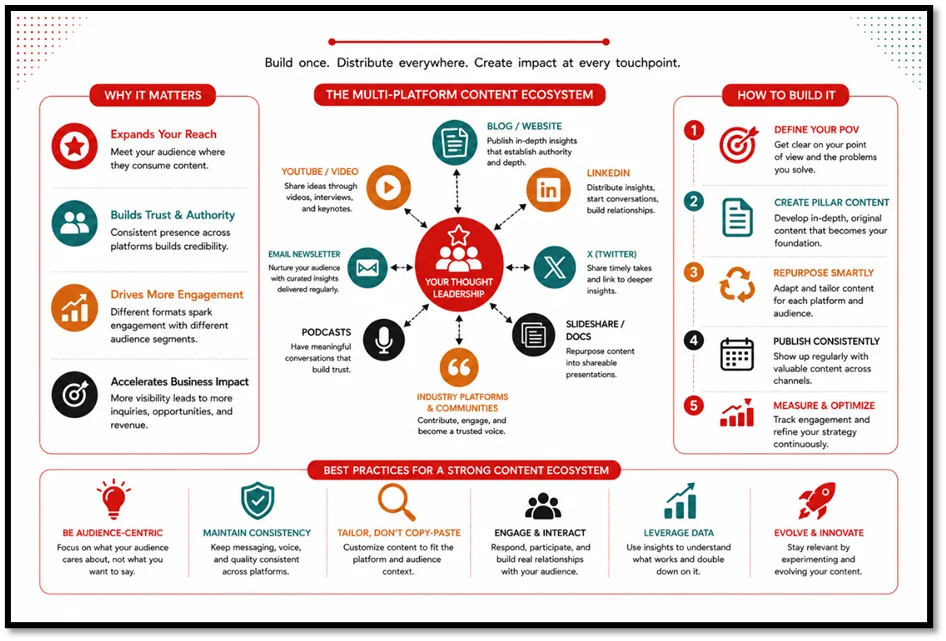
What is a Multi-platform Content Ecosystem in B2B and Why Single-channel Publishing Fails
The content ecosystem strategy enables every platform to act as a distinct function in building and reinforcing authority, where content transits between these platforms with a structural logic. Single-channel publishing fails due to insufficient reinforcement.
A buyer coming across a B2B company only on LinkedIn creates platform-specific credibility. However, when the same buyer interacts with a long-form article, a podcast discussion extending the LinkedIn post, and the data report, the credibility increases.
The difference in these two cases is how many contexts the buyer encounters during the interaction, and content ecosystem marketing transforms these contexts. B2B buyers accumulate trust gradually via repeated contextual validation rather than consuming it all at once.
While single-channel publishing is a content production approach, authority building needs an ecosystem strategy. Most B2B teams expect the latter, while they measure the first.
How to Build a B2B Content Ecosystem Where Each Platform Earns Its Place
Platform role assignment acts as a design decision and makes the B2B brand authority-building ecosystem functional. Every platform has a unique function, and it serves a different buyer relationship.
Worldmetrics’ 2026 report claims that multichannel marketing and content ecosystems increase brand favorability by 24% compared to single-channel marketing.
The long-form content, including newsletters, owned blogs, and research reports, first demonstrates depth of expertise. LinkedIn distils and distributes sharp POV-driven versions of this expertise to professional audiences.
While podcasts develop brand familiarity over time through relevant discussions, community platforms create a two-way engagement, validating authority through dialogue, and close the loop. The process condenses authority into trust with the help of sustained attention.
Most teams repurpose the same asset across every platform, and as a result, B2B brand positioning strategy fails. Multi-context authority signals are built by adapting the content format and the angle that the platform’s audience expects.
How to Repurpose Content Across Platforms Without Losing Thought Leadership Depth
Most B2B companies incorrectly assume that repurposing means content reformatting, and they transform a blog post into a carousel instead of changing the core argument to fit different platforms and environments. This is why the pillar-to-platform approach matters.
For instance, the long-form asset, like a research insight, becomes the core argument for LinkedIn. Downstream platforms express the core argument differently. The methodology behind the research becomes a topic for podcast discussion, and its commercial implications are adapted into short-form videos.
Instead of duplicating the format, the content must evolve based on platform behavior. Repurposing is about transforming the context and not recycling it.
How to Create a Content Distribution System to Build Brand Authority
A strong cross-platform content strategy serves as an ecosystem sequence rather than a publishing calendar. The primary structural decision for rethinking content distribution is to pivot the ecosystem around one long-form asset to build credibility. This anchor transforms discoverability into credibility.
Instead of publishing the schedule, building a distribution sequence is the next structural step. Each asset, which has a planned platform sequence, develops multi-context exposure to build authority over time.
The performance of the ecosystem, rather than platform engagement, must be measured by authority signals. External references, citations, and derivative discussions upon the content via external sources measure the GEO retrieval and authority.
A multi-channel content distribution system is the architecture that governs whether the thought leadership of B2B teams will compound or reset with each publishing cycle. The distribution creates authority recall across touchpoints. By reinforcing the positioning of platforms, brand visibility compounds.
Final Thoughts: How B2B Brands Build Thought Leadership in 2026
Compounding thought leadership needs an ecosystem over a calendar. Architecture-driven publishing stands at the core of the B2B content marketing strategy 2026, where every asset has a specific platform role that is connected to the next platform.
Every subsequent asset builds on the authority that the preceding platform establishes. B2B teams that produce assets with no connecting logic are generating impressions, whereas companies prioritizing ecosystem development are reinforcing authoritative memory.
AI surfaces authority signals over traffic signals, which makes the content ecosystem GEO retrieval-driven and bolsters the buyer trust mechanism.
Want to develop a sound B2B brand positioning strategy, which will compound across multiple platforms? Connect with Marketboats and identify where your current content architecture fails and how you can improve the shortcomings.
FAQs
1. How to build thought leadership using content marketing?
Use connected content systems so that every platform can reinforce the same brand positioning across multiple buyer contexts to build thought leadership authority.
2. How to increase B2B content visibility across multiple channels?
Focus on external amplification, repeated contextual positioning, which can bolster authority recall across buyer touchpoints, and use platform-specific distribution to increase B2B content visibility.
3. How to scale content across multiple platforms without increasing production costs?
Scaling content across multiple platforms requires adapting one core thought leadership asset into platform-native formats. Avoid creating separate content for every channel independently.