
Domains that inbox providers already trust reach the inbox, and that is a key way to avoid the spam folder in 2026. Email deliverability is actually a trust infrastructure issue, but many B2B companies treat it as a content problem.
Email Tool Tester’s analysis finds that 16.9% of legitimate emails never reach the recipient’s inbox. Spam trigger words alone hardly ever cause delivery failures. The majority of failures are due to weak sender reputation signals. Whether emails are delivered depends on what happens before sending them.
Organizations commonly respond to the deliverability failure by changing the email, while the correct solution is to assess the sender infrastructure.
Why Emails Go to Spam Instead of Inbox, and How to Protect Deliverability
In email marketing, list size has become a vanity metric and is replaced by the hygiene of the list, which is commercially more valuable. B2B marketers ignore engagement decay and prioritize only spam words.
The list with numerous inactive, disengaged, or invalid contacts damages the email sender reputation, increasing the bounce rate and spam complaints. Mailpro’s analysis finds that the threshold complaint rate is 0.3%. Inbox providers prefer to assess how recipients historically responded to emails rather than evaluating the content.
Here is the three-layered list hygiene decision framework that protects deliverability:
- Verify new contacts before they enter the data. Invalid email addresses increase bounce rate, affecting the sender’s reputation.
- Remove contacts who have not engaged for 90+ days. The contact that remained idle for more than three months is an invitation for a spam complaint.
- Emphasize reengagement before suppression. Reengagement activity improves the sender’s credibility more than preventing the damage by removing the contact.
How to Configure SPF, DKIM, and DMARC for Email Deliverability
Email authentication is not a one-time setup task, but is an ongoing governance responsibility. B2B enterprises often treat it as an IT responsibility, but in reality, it is a revenue protection task.
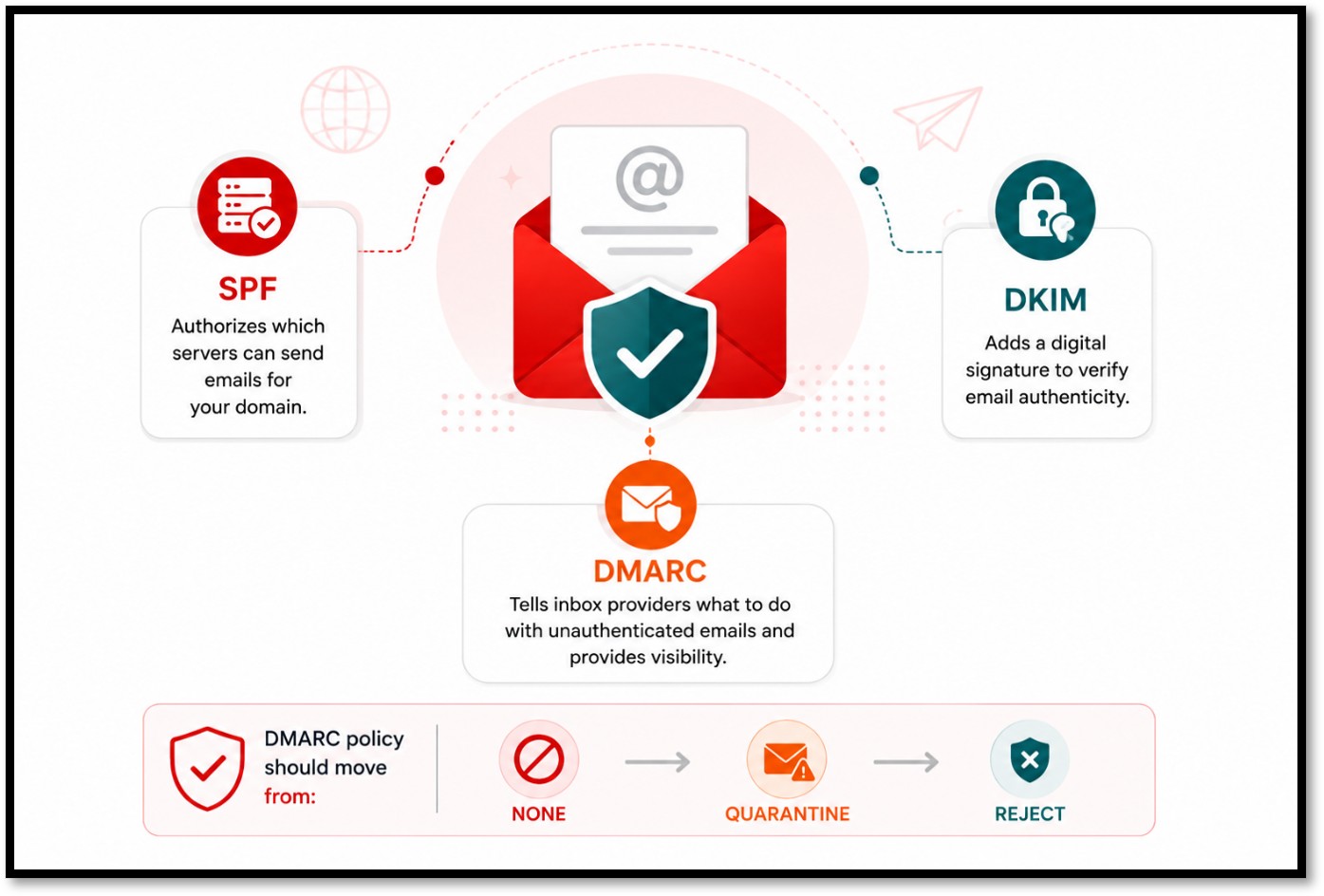
While the SPF record setup determines which IP addresses are allowed to send an email from a domain, DKIM embeds a cryptographic signature in every email, allowing receiving servers to verify its authenticity.
DMARC guides inbox providers on handling messages that skipped authentication checks and offering visibility into unauthorized sending activity. The domain that has SPF and DKIM installed with DMARC set to ‘none’ reflects an undefended system.
DMARC policy must shift from ‘none’ to ‘quarantine’ to ‘reject’, depending on how the domain’s sending infrastructure is mapped. Authenticity validates identity, and it governs inbox trust.
How to Improve Sender Reputation
The growing list damages deliverability if its quality declines. Domain authentication for email is a static infrastructure that cannot produce the dynamic layer of authentication, and only establishes identity.
Sender’s credibility acts like a credit score, where damage piles up gradually, impacting performance instantly. Email spam complaints rate, engagement rate, and bounce rate are the three components that govern this reputation.
At the inbox level, sender reputation is account-specific, and this is the detail most B2B teams miss. The reputation-damaging sending pattern with one provider might not affect the other, but the recovery program must address every provider’s signals individually.
A domain built with consistency and engaged sending values more than a new domain, as trust history is hard to replicate. Sender reputation is a commercial asset to manage, which compounds based on how it is maintained.
How to Improve Inbox Placement Rate through Engagement-driven Deliverability
Email inbox placement reflects whether an email has landed in the inbox, a filtered folder, or in the spam section. It is highly misunderstood as a campaign metric, but in reality, it is a trust metric.
Inbox providers’ placement decisions for sends depend on every recipient’s interaction, including clicks, opens, and replies, creating a feedback loop. Low open rates, high spam complaints, and deletions without opening indicate that emails are unwanted. Improving these engagement signals helps B2B teams achieve spam score reduction. One effective way to improve engagement signals is through AI email personalization, which helps marketers tailor content, timing, and messaging based on recipient behavior and intent.
Segmenting recipients to improve relevance, controlling sends to chronically disengage contacts, and tracking segment-level engagement patterns are three structural decisions that strengthen placement performance. Many organizations are also using AI in B2B email marketing to personalize content, improve engagement rates, and strengthen inbox placement over time.
Deliverability optimization starts days before the first campaign mail. Inbox placement reflects whether your audience trusts you.
Final Thoughts: How to Avoid Spam Folder in 2026 by Building Credibility
Beyond content audit and fixing the subject line of the email, deliverability is about the infrastructural decision that resides under every sequence, automation, and campaign. B2B teams with the highest inbox placement rates are building a better sending infrastructure, which compounds in value with every engaged send.
Deliverability is a sender’s credibility problem, not an email issue. The gap between trusted and untrusted senders will continue to widen, as inbox providers raise engagement and authentication standards.
Marketboats can help you identify hidden infrastructural gaps that limit your inbox placement and campaign performance.
FAQs
1. How to stop emails from going to spam?
To avoid emails going to the spam folder, the domain must be authenticated properly. You will also have to monitor sender reputation, continuously remove disengaged contacts, and maintain strong list hygiene.
2. What are the best ways to avoid spam filters in 2026?
Prioritize engagement quality, audience relevance, authentication, and reputation management over reliance on content-level spam avoidance tactics.
3. What should be included in an email deliverability checklist for businesses?
DMARC configuration, sender reputation monitoring, bounce management, complaint tracking, inbox placement auditing, DKIM, and SPF are mandatory checkpoints for your email delivery checklist.