
Beyond just following industry trends, choosing the correct GTM strategy for B2B teams revolves around matching the commercial motion to revenue goals, buyer behavior, and product complexity.
According to the Product-led Growth Benchmarks report, 58% of B2B SaaS enterprises have deployed PLG motion, and 91% plan to increase their investments in it. More than being identities or philosophies, SLG and PLG are execution contexts.
The sales-led vs product-led growth debate involves the discussion of how one model outperforms the other, but conversely, choosing the incorrect motion for the enterprise, more than following a wrong trend, generates poor GTM output.
However, choosing one because it worked for competitors by overlooking the ICP-fit will often cause enterprises to underperform, and this is the biggest GTM mistake.
What Is the Difference Between Product-led and Sales-led Growth for B2B Teams
Although B2B teams define themselves as product-led because it sounds good, if their product needs a demo, a discovery call, and a rep deployment, they are often sales-led, having a product component.
The absence of product architecture supporting the PLG identity hardly produces benefits to either motion. The real difference between the two extends beyond just asking who closes the deal faster to who is the first in creating the buying confidence.
| Basis of Comparison | Product-led Growth (PLG) | Sales-led Growth (SLG) |
|---|---|---|
| Primary Qualifier | Product. Analyzed based on activation signals and usage behavior. | Sales reps. Analyzed based on conversation, demo, and discovery. |
| Key Lead Metric | PQLs | MQLs and SQLs |
| How It Scales | Users adopting more products helps it scale. | Adding more reps to inflate the pipeline scales SLG. |
| Best Fit | Self-service, low-ACV, and rapid time-to-value. | Multi-stakeholder, high-ACV, and high-complexity. |
| What It Optimizes for | Time-to-value and activation rate. | Close rate and sales cycle quality. |
| CAC Profile | Front-loaded in onboarding and product. | Front-loaded in sales headcount. |
When to Use Sales-led Growth Strategy, and When to Use Product-led Growth Model
Many B2B enterprises assume that PLG automatically reduces customer acquisition cost (CAC), but this is only true when the activation rate is high and translates engagement into paying buyers.
Choosing between PLG and SLG begins with deal complexity and checking the price point. While the sales-led growth strategy suits high-complexity, high-ACV products, PLG fits self-service, low-ACV products.
When buyers meaningfully interact with products in their first interaction, PLG becomes successful. The buying architecture requires human engagement, which is why a product whose ICP operates through formal procurement cycles that include IT, finance, and legal stakeholders will struggle.
The product-led growth model becomes successful because buyers find value before interacting with sales. While the product is the starting point of the buying journey, sales later accelerate the expansion.
What Are the Product-led Growth vs Sales-led Growth Pros and Cons in a Hybrid GTM Model
More than being a sophisticated version of either SLG or PLG, the hybrid go-to-market execution model is a more demanding version of the two, as it asks for product discipline from PLG and sales execution quality from SLG at the same time.
Although this model is the most dominant in B2B go-to-market strategy 2026, it is often executed incorrectly. Defined PQL thresholds are prerequisites for handoffs to work, without which the sales team either keeps contacting high-cost-low-conversion users or waits for inbound enquiries.
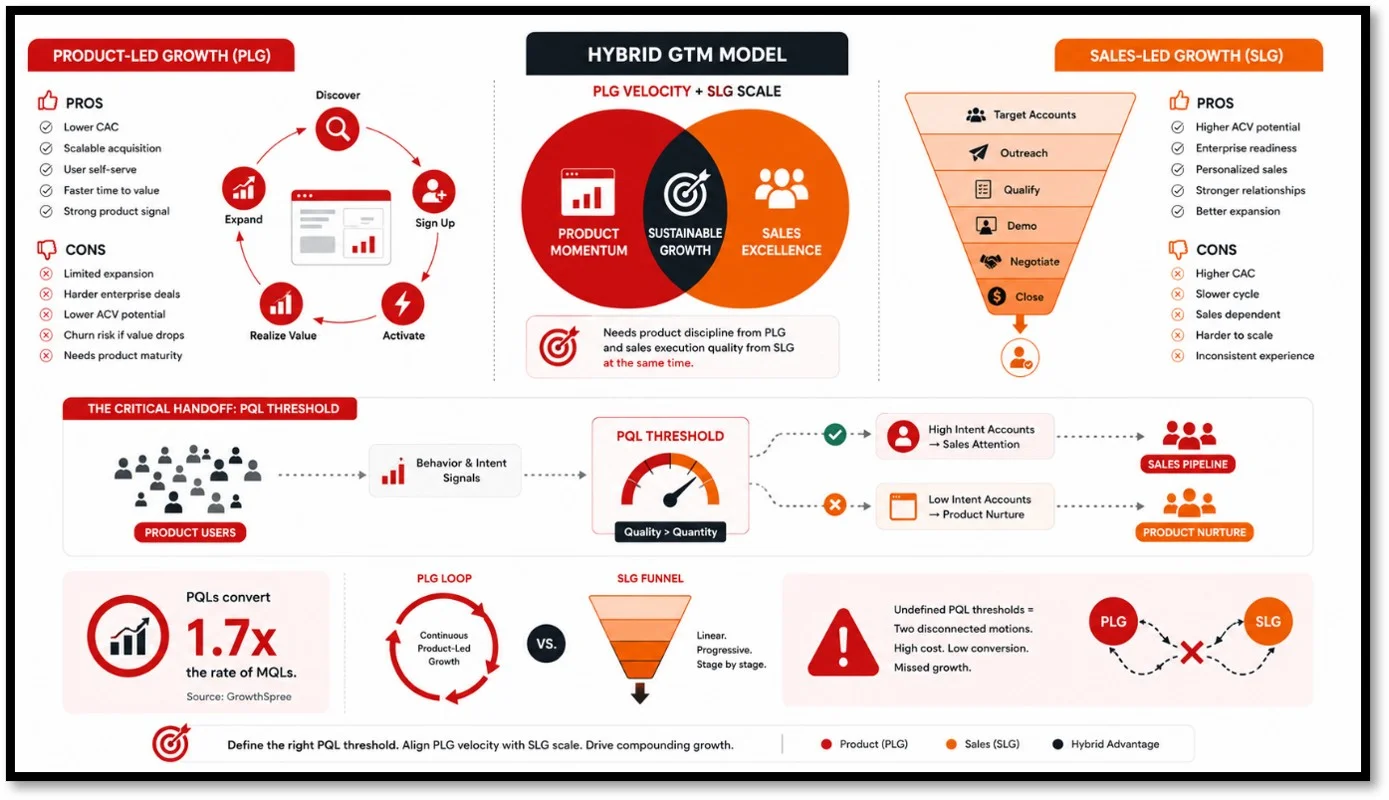
GrowthSpree’s analysis finds that PQLs convert 1.7x the rate of MQLs. While the PLG growth loop is circular, the SLG funnel is linear, and this distinction matters the most.
PQL thresholds are extremely important because it determines whether accounts need product nurture or sales attention. The SaaS GTM strategy with undefined PQL handoff thresholds often acts as two disconnected and uncoordinated GTM motions that run simultaneously.
How to Transition from Sales-led to Product-led Growth Without Breaking the Revenue Engine
B2B enterprises that redesign GTM motion before restructuring the product experience often see SLG-to-PLG transitions failing. The ideal sequence to ensure a successful transition includes the following steps:
- Product-market Fit at the Self-serve Level: The customer must understand the product proposition without sales explanations in initial interactions.
- Onboarding Experience Design: While SLG focuses on reps bridging product gaps through demonstrations, PLG emphasizes closing them at the experience level.
- Metric System Redesign: Analyzing PLG motion with SLG produces misleading inferences, and this is why rebuilding metrics for the product-led growth strategy is important.
B2B enterprises that shift to PLG without validating self-serve activation rate reduce sales headcount, hoping product adoption compensates, rather than transitioning to the PLG model.
Final Thoughts: How to Choose Between Product-led and Sales-led Growth Models
More than a trend decision, the selection from PLG vs SLG analysis includes product, ICP, and measurement decisions made in that order. B2B enterprises answering all questions precisely will have an edge over those who only adopt GTM motions based on what their competitors use.
Only those go-to-market strategy frameworks will succeed through 2026 that match motion based on ICP’s buying architecture, the product’s time-to-value, and are devised to predict when the strategy performs well and when it drifts.
If you choose your GTM motion only because it worked for your competitor, it is time to rethink the strategy, and Marketboats will help you find the framework that fits your product, ICP, and revenue stage.
FAQs
1. How to implement product-led growth strategy?
The first step is to validate self-serve product-market fit, followed by redesigning onboarding for faster activation and defining PQL criteria, and then aligning sales involvement with product engagement.
2. How to build a sales-led GTM strategy?
Building a clear ICP, along with developing a compelling value proposition, is the first step in building an SLG GTM framework. Then, align marketing with pipeline objectives, establish qualification criteria, and track performance using revenue-centric metrics.
3. How to improve GTM performance?
Optimizing the commercial motion based on buying behavior, followed by product and sales alignment, and refining GTM decisions with the help of real customer and revenue data can help you improve GTM performance.