
B2B buying networks not only reduce sourcing risk but also improve supplier discovery and enhance the quality of purchasing decisions. However, enterprises often rate procurement platforms based on features and ignore the supplier intelligence quality, long-term procurement ROI, and network strength they offer.
Deloitte WSJ’s report finds that 72% of B2B teams emphasize cost reduction, while 68% of them prioritize operational efficiency through better procurement model selection.
A buying network with dense, verified data in the sourcing category will outperform a network with better features but limited supplier activity. The right evaluation weighs a strategic sourcing platform’s proven sourcing track record against its promised capabilities.
What to Look for in a B2B Buying Network to Maximize Sourcing Value
Supplier breadth has become a vanity metric because a large supplier pool with unverified vendors is far less valuable than a smaller pool that has audited performance histories.
Supplier count, software integration, and pricing are the three criteria that matter for buying network evaluation, but none of them describe sourcing success. Here are the invisible criteria that practically determine procurement outcomes-
Category-specific data density reflects the volume of verified transactions in a buyer-sourcing category, which matters more than the total number of suppliers.
Supplier verification monitors how suppliers are vetted for onboarding and maintains this verification over time. A platform that fulfils these two criteria with auditable data demonstrates stronger data rigour and enables better sourcing decisions.
Why Governance Model in the Buying Network Evaluation Checklist Matters More
Instead of treating governance as a parameter for commercial evaluation, most teams treat it as a legal review; therefore, identical procurement platform features produce structurally different risk profiles.
Governance must be evaluated before procurement software selection because it describes the consequences of things going wrong in complex supplier relationships. Zeiv’s analysis finds that B2B enterprises ensured 92% PO compliance via procurement automation.
Every evaluation must include the following three questions:
- What processes are followed when the supplier fails to meet contract terms?
- How are underperforming and non-compliant suppliers managed?
- What are the compliance verification criteria for the platform?
If a platform cannot answer how many suppliers have been eliminated from the list in the past year, along with reasons, it lacks an effective governance mechanism.
How Modern Procurement Platforms Work
Digital procurement platforms connect supplier intelligence to procurement decision-making. Instead of evaluating as a technical capability, the integration must be evaluated based on business capability.
The most underutilized integration dimensions include CRM and ERP connectivity, and analytics and reporting output. The former checks whether supplier intelligence flows directly to ERP, while the latter assesses if the supplier intelligence platform offers meaningful procurement analytics.
Procurement platform integrations often promise more than they deliver in real-world implementations. Evaluating the capabilities of integration is more relevant than finding whether the platform can be integrated with the ERP.
Instead of requesting a live demo of a sourcing interface, one must ask for the reporting layer’s demo, which reveals what it has really developed.
What Is the Procurement Platform Selection Framework That Produces a Defensible Decision
Procurement teams require a structured framework for evaluation rather than only asking for demonstrations or feature comparisons. Here is a practical procurement platform checklist:
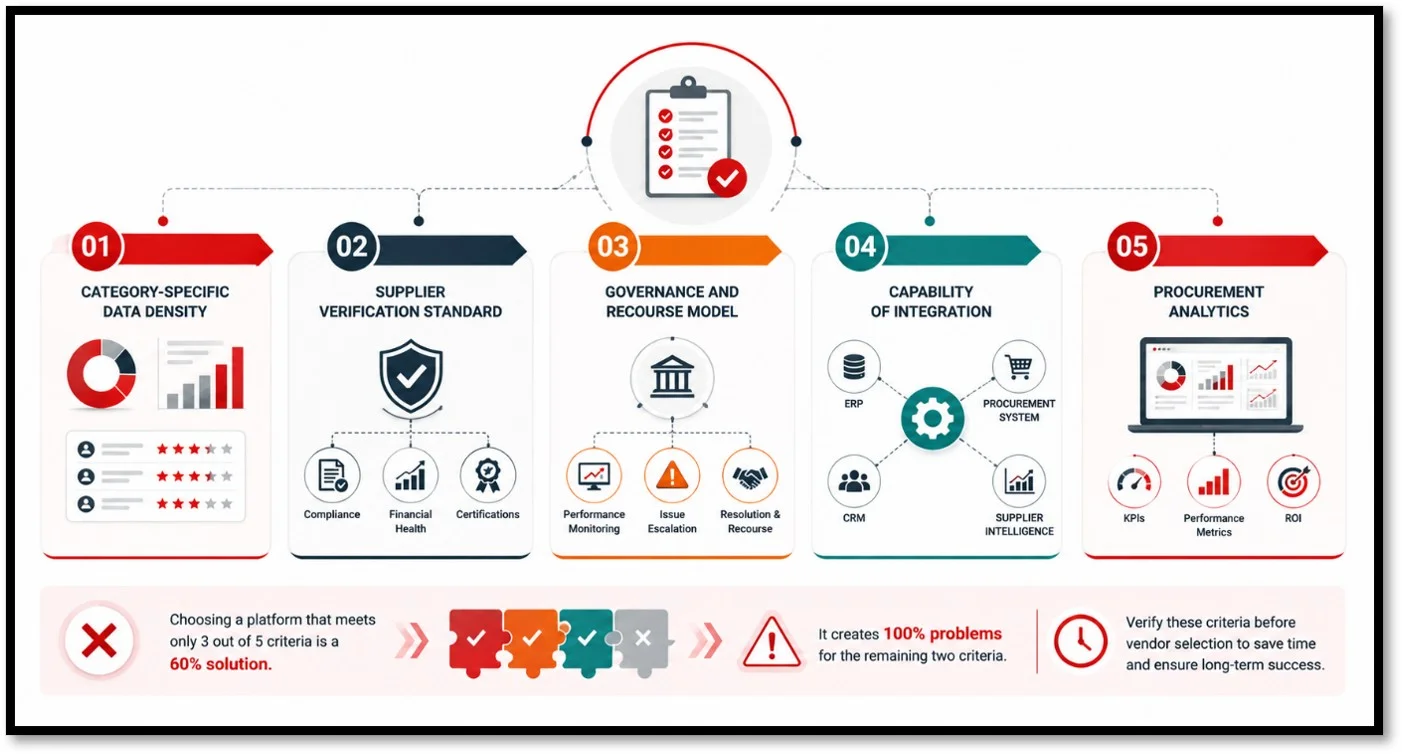
- Category-Specific Data Density: Begin with the analysis of transaction depth, and check for performance distribution in buyer-centric sourcing categories.
- Supplier Verification Standard: Scrutinize how suppliers are onboarded and maintained. A strong B2B sourcing platform continuously validates compliance status, financial health, and supplier certifications.
- Governance and Recourse Model: Review how platforms handle the post-award failure of supplier performance.
- Capability of Integration: Evaluate how supplier intelligence is integrated with the existing ERP, procurement systems, and CRM, which will improve decision-making beyond simplifying data transfer.
- Procurement Analytics: Analyze how procurement KPIs connect to ROI metrics that buyers often track.
Considering a platform fulfilling three out of five criteria to be a 60% solution is the most common mistake B2B teams make. It is a platform that creates 100% problems for the remaining two criteria. Verifying these criteria before procurement vendor selection is much more time-saving than managing a poorly performing platform.
Final Thoughts: How to Choose the Right Procurement Platform
The ideal buying network is the one with the highest data density in buyer-specific categories, defensible analytics output, and the most enforceable governance model.
Evaluating buying networks based on long-term supplier sourcing solutions instead of measuring short-term supplier sourcing software capabilities often generates sustainable and stronger ROI.
Contact the Marketboats team to find the best procurement software for supplier sourcing solutions for your business.
FAQs
1. How do I choose a procurement platform?
Select the procurement platform depending on category expertise, supplier intelligence, measurable procurement outcomes, governance, and integration capabilities instead of focusing on features.
2. What features should a B2B buying network have?
Continuous risk monitoring, seamless integrations, supplier intelligence, AI-powered supplier discovery, governance support, and procurement analytics are some key features that buying networks must have.
3. What procurement metrics should businesses track?
Total procurement ROI, supplier diversity, competitive bidding rates, supplier risk incidents, sourcing cycle time, and contract compliance are some metrics beyond vanity parameters that your business should track.