
While B2B marketing attribution connects activity to revenue and pipeline, the RevOps strategy provides the process layer and data that make these connections usable, thereby constructing a scalable revenue engine.
The core problem is unreliable reporting caused by incomplete touchpoint capture, disconnected CRM data, and inconsistent revenue definitions.
Connected campaign attribution data gives marketing teams a clearer basis for budget and pipeline decisions. Medium’s research cited Gartner’s analysis stating that 73% of B2B buyers complete decision-making outside vendors’ touchpoints.
B2B revenue attribution is an architectural decision, and enterprises that treat it as a marketing analytics project often run pilots that rarely produce quality data necessary to influence budget decisions.
The attribution model’s quality depends on the underlying revenue data, which is why operations and attribution should be designed simultaneously.
How Does B2B Marketing Attribution Work
The B2B marketing attribution strategy performs better if credit is assigned to the deal-influencing touchpoints and connected to revenue and pipeline stage progress. More than a technical initiative, selecting an attribution model is a philosophical decision.
Why B2B Marketing Attribution Is Harder Than B2C
The attribution model influences how teams evaluate channel performance and allocate marketing investment. The wrong choice of attribution model often produces incorrect budget allocation decisions.
First-touch and last-touch models can oversimplify complex B2B journeys by assigning all credit to a single interaction. The following elements make B2B attribution more difficult than B2C:
- Long Sales Cycles: Attribution models are designed to measure transactions spanning a few hours or days, while sales cycles last for a few weeks or months.
- Multiple Decision-makers: Different stakeholders engage at different stages with different content.
- Multiple Attribution Sources: The same deal might simultaneously possess touchpoints across different sources, which needs a model capable of distributing credit across multiple touchpoints rather than awarding it to one.
How B2B Multi-touch Attribution Strategy Is Different Than B2C Approach
| Parameter | B2B Attribution | B2C Attribution |
|---|---|---|
| Sales Cycle | Weeks to months | Hours to days |
| Touchpoint Volume | High. Multiple touchpoints across stakeholders, devices, and channels. |
Low. Very few digital interactions. |
| Buying Committee | Includes 6-11 stakeholders. |
Might involve only one decision-maker. |
| Attribution Challenge | Identity resolution across SDR and offline touchpoints, and stakeholders. |
A straightforward cross- channel tracking. |
| Recommended Model | Multi-touch with full- funnel capture. |
Time decay or last-touch models. |
More than reconstructing the buyer’s journey, attribution measures observable and connectable interactions, and the best attribution model for B2B SaaS should reflect how buyers progress through buying jobs.
How to Build a B2B Marketing Attribution Strategy, and What to Decide Before Selecting a Framework
The answer to how to set up B2B marketing attribution lies in the following questions: which data does CRM hold, which question must the system answer, and which decision-makers will depend on attribution output.
B2B enterprises often decide how to attribute marketing to revenue even before auditing the data quality that the attribution model needs. Despite its sophistication, the model running on incomplete CRM data is often more dangerous than the framework directly acknowledging the measurement gap.
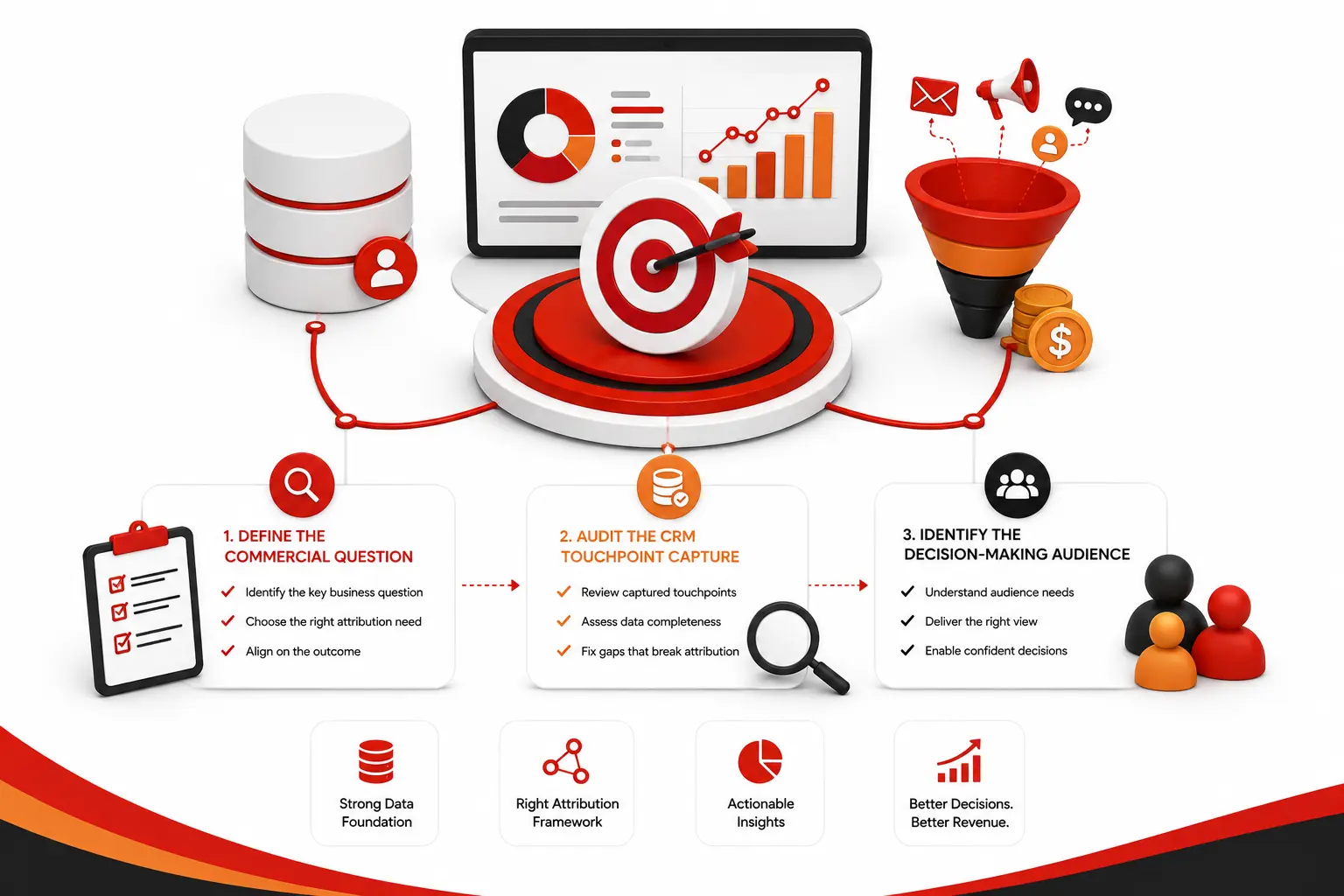
The following decisions determine the usability of the marketing attribution strategy:
- Define the Commercial Question: To find channels producing pipeline, pipeline and channel attribution are essential, while identifying interactions driving deal progression needs multi-touch attribution.
- Audit the CRM Touchpoint Capture: The accuracy of attribution models depends upon touchpoint data that feeds them. An attribution model cannot recover touchpoints that were never captured in the first place. The audit is commercially valuable, yet many enterprises rarely employ the practice.
- Identify Decision-making Audience: Different organizational functions require different views, and serving them accordingly might make the attribution model successful.
Marketing LTB’s research finds that successful implementation of the marketing revenue attribution strategy can produce 15-30% higher ROI. Data infrastructure is the ideal starting point for attribution, while the framework fitting the available data quality is the correct model.
How Does Multi-touch Attribution Work in B2B, and Which Multi-touch Attribution for Long Sales Cycles Fits the Best
Rather than awarding all credit to a single touchpoint, multi-touch marketing attribution distributes credit across multiple recorded interactions using a defined weighting model. Linear attribution distributes that credit equally across touchpoints. The addition of touchpoints is rarely a solution to weak opportunity association or identity resolution.
| Model Type | Distribution of Credit |
Best Fit For | Key Limitations |
|---|---|---|---|
| Linear | Equally across all touchpoints. |
Full-funnel attribution. |
It fails to reflect the few touchpoints that drive more pipeline movement. |
| W-shaped | 30% each to first touch, lead creation, and opportunity creation, with the remaining 10% distributed across other touchpoints. |
Complex B2B deals with defined deal stage transitions and MQLs. |
It requires cleaner stage and touchpoint data. |
| Time Decay | More credit to touchpoints appearing later. |
Shorter sales cycles. |
It can under-credit awareness channels in long sales cycles. |
| U-shaped | 40% each for first touch and lead creation, while 20% is distributed. |
B2B teams focused on lead generation and early-funnel demand creation. |
It gives minimal credit to mid- funnel nurture events. |
Time decay models often under-credit channels at the awareness stage. Compared to a W-shaped attribution framework operating on incomplete data, a linear marketing performance attribution model running on clean touchpoint data will produce more useful decisions. Incomplete data rarely makes model sophistication perform better.
How to Build a B2B RevOps Strategy That Makes Attribution Accurate and Actionable
A B2B RevOps strategy standardizes recording touchpoint data, marketing and sales alignment, and definitions of pipeline stages, making attribution more accurate. This ensures that attribution receives complete and consistent inputs.
Revenue operations become more commercially valuable when data consistently flows through a shared CRM rather than developing shared dashboards based on inconsistent data.
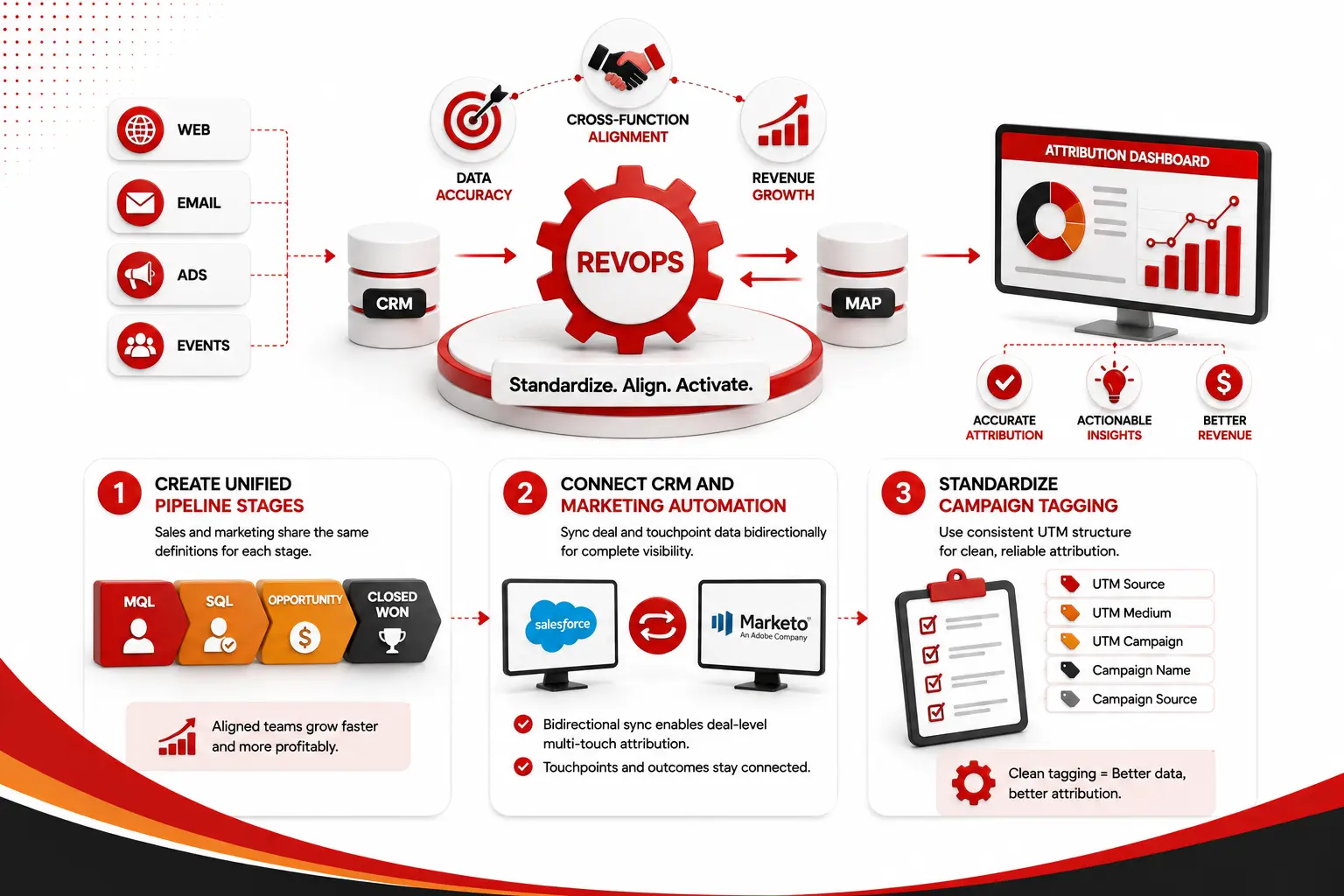
Implementing the following infrastructural decisions is how RevOps improves marketing attribution:
- Create Unified Pipeline Stages: Sales and marketing functions need to share the definitions of MQLs, SQLs, opportunities, and closed-won attribution. Dream Factory’s research finds that aligned sales and marketing functions achieve a 24% faster growth rate and 27% higher profit growth.
- Connect CRM and Marketing Automation: CRM and marketing automation platforms must exchange deal and touchpoint data bidirectionally using tools like Salesforce-Marketo and HubSpot-Salesforce. Bidirectional CRM-to-MAP sync makes deal-level B2B multi-touch attribution possible, without which marketing touchpoints and deal outcomes are stored in MAP and CRM, respectively.
- Standardize Campaign Tagging: Each campaign must consistently define, document, and enforce UTM source, UTM parameters, campaign name, and campaign source fields, creating a cleaner marketing attribution model. Consistent UTM standards and CRM campaign-field audits can improve attribution data quality with minimal effort.
How to Prove Marketing ROI in B2B, and How to Measure Marketing Impact on Revenue
The answer to how to measure B2B marketing attribution and its impact on revenue lies in the following process:
- Connect Campaign Spend to Pipeline Influence: Identify campaigns appearing as touchpoints before entering the pipeline for every active deal.
- Link Pipeline Attribution to Closed-won Revenue: Calculate closed-won revenue value attributable to marketing-influenced pipeline for closed deals, a number belonging to a budget review.
- Calculate the Contribution of Marketing to Revenue Growth: Compare the current quarter’s marketing-influenced closed-won revenue with the previous year’s same quarter’s figures. The metric connects attribution to commercial performance over time.
Marketing-sourced and influenced revenue statistics should be reported separately, explaining the attribution rules behind them. GrowthSpree’s 2026 research finds that B2B SaaS benchmarks place both at 25-45% and 60-85% of the total pipeline, respectively.
Though the pipeline influence rate is a key metric for determining the ROI of the marketing operations framework, CRM capturing marketing touchpoints consistently is an important prerequisite. Aligning CRM and marketing automation data produces a single source of truth essential for reliable attribution.
Key Takeaway: How to Build a Scalable Revenue Engine, and How to Scale Revenue Operations
Connecting RevOps infrastructure to marketing attribution data is the answer to how to build a scalable revenue operations function. The gap between B2B teams using clean and connected data and enterprises with fragmented data will continue to widen as AI-powered B2B attribution models mature.
More than relying on sophisticated models, B2B enterprises that follow disciplined CRM field standards, capture touchpoint data consistently, and establish a connected marketing-to-sales data infrastructure can build a scalable revenue engine in 2026.
Marketboats can help you build clean and connected CRM data to develop a marketing performance measurement system with the fewest gaps.
FAQs
1. Why is marketing attribution important for B2B?
It allows B2B teams to understand how marketing interactions contribute to revenue, opportunities, and pipeline across complex buyer journeys.
2. What is the best attribution model for B2B?
Although there is no single model identified as the best, Linear, time-decay, W-shaped, and U-shaped models are some frameworks that suit different data quality levels, sales cycles, and commercial questions.
3. How do you attribute revenue to marketing?
Connect engagement and campaign data to accounts, contacts, closed-won revenue, and opportunities. Further, apply a well-documented attribution framework.
4. How do you measure marketing ROI in B2B?
Weight marketing investment against measurable outcomes like influenced pipeline, revenue growth, or closed-won revenue.
5. What is the role of marketing operations in RevOps?
Marketing operations cover a wide canvas, where they maintain automation, reporting processes, governance, data quality, and integrations. This allows RevOps teams to operate on a reliable data source.