
Rather than emphasizing theoretical sophistication, B2B marketing attribution models that align with sales cycle lengths and the available data quality often perform better. Many enterprises choose B2B attribution models based on industry conventions rather than their sales cycle structure and CRM data completeness.
Without data completeness, even the most sophisticated models fail. A W-shaped model operating on incomplete data underperforms a linear model that runs on clean data. The Starr Conspiracy’s 2026 analysis finds that the average B2B deal includes 27 interactions across the buying group.
The choice of B2B attribution strategy and model is a commercial philosophy decision, and it becomes commercially valuable when it transforms pipeline or budget decisions. Teams operating their models on clean data can make more reliable decisions than those running their strategies on partial data.
Which Are the Best B2B Attribution Models, and Which Fits Each Sales Cycle
Although the choice of the best attribution model for B2B enterprises depends on the sales cycle structure, U-shaped, time decay, linear, W-shaped, last-touch, and first-touch architectures are some important attribution models.
| Attribution Model | Credit Distribution | Sales Cycle Fit | Key Limitation |
|---|---|---|---|
| U-shaped | 40% each for first- touch and last- touch, while 20% is distributed across the middle touchpoints. |
B2B SaaS teams focused on lead generation and early-funnel demand creation. |
It might undervalue nurturing events, and mid-funnel activities gain less credit. |
| Time Decay | Later touchpoints receive more credit than earlier interactions. |
Shorter sales cycles where recent touchpoints are more closely tied to conversion. |
Assigns less credit to awareness channels in long sales cycles. |
| Linear | Assigns credit equally to all touchpoints. |
It can provide a simple view of contribution across the full funnel. |
It inaccurately assumes that all touchpoints contribute equally. |
| W-shaped | 30% each for first- touch, lead creation, and opportunity creation, while 10% is distributed. |
Complex B2B with defined MQL and SQL stage transitions. |
It might not fit for all GTM motions, and it assumes some touchpoints matter more. |
| Last-touch | 100% to final pre- conversion interaction. |
Short journeys, not suitable for multi- stakeholder B2B journeys. |
It ignores touchpoints that created buying readiness. |
| First-touch | 100% to initial interaction. |
Early-stage pipeline analysis. |
It does not consider touchpoints that drove buyers to the purchase stage. |
While the first-touch attribution can lead teams to over-invest in awareness, the last-touch model overemphasizes BoFu activities, which is why these models are inaccurate for complex buyer journeys. W-shaped attribution assumes that opportunity creation and first-touch require more credit, but this assumption might fail in some revenue motions.
Because linear revenue attribution does not assume that specific touchpoints matter more than others, it can provide a practical baseline when teams have clean but limited attribution data.
Which Is the Best Marketing Attribution Model for Long Sales Cycles
To ensure accurate credit distribution in long sales cycles, W-shaped and linear multi-touch attribution models can be the best choice, as they can distribute credit across multiple recorded touchpoints throughout a longer buying journey.
Though time decay is often recommended, it can under-credit awareness touchpoints that build the initial buying intent. According to HubSpot’s Attribution Report, cited by KEOMarketing in 2026, B2B teams implementing multi-touch attribution improve ROI measurement accuracy by 37%.
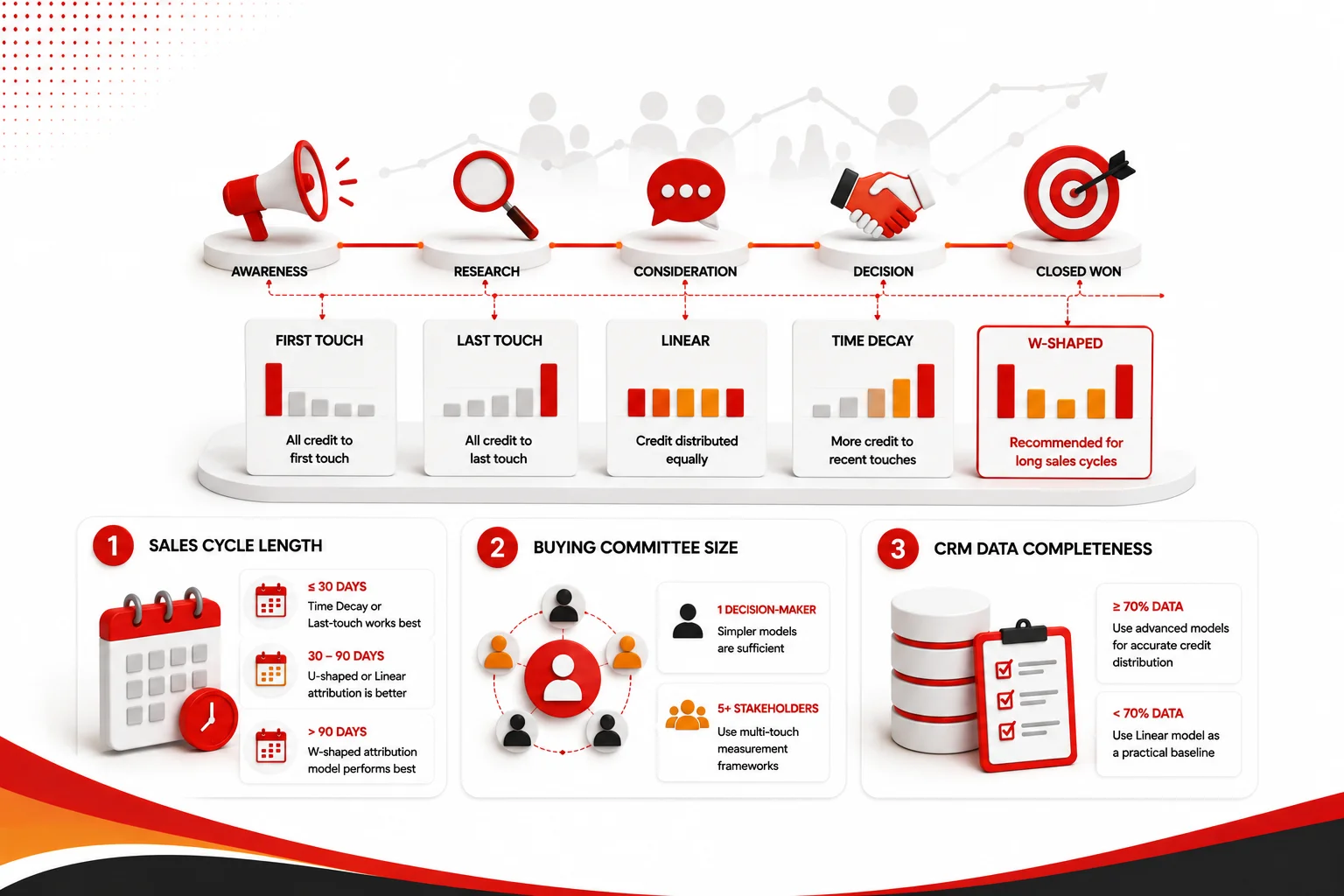
Here are some key criteria to determine the best attribution model for B2B enterprises:
- Sales Cycle Length: For shorter sales cycles, time decay or last-touch attribution can provide a simpler view of recent conversion influence, while longer sales cycles may benefit from a W-shaped revenue attribution model, as it distributes credit across multiple touchpoints.
- Buying Committee Size: While simpler models are sufficient for a single decision-maker, an increasing number of stakeholders introduces buyer journey attribution challenges, which can be addressed using multi-touch measurement frameworks.
- CRM Data Completeness: When campaign touchpoint coverage is incomplete, a simpler model, like the linear marketing revenue attribution model, can provide a more practical baseline than a highly weighted framework.
Final Thoughts: How to Choose an Attribution Model for Revenue Measurement
More than model sophistication, the real answer to which marketing attribution model is best depends on three criteria, including CRM data completeness, size of the buying committee, and the length of the sales cycle.
The first step in deciding which attribution model is best for B2B enterprises is measuring average sales cycle length based on historical CRM data. Further, audit CRM touchpoint completeness, followed by selecting the B2B marketing attribution strategy that fits both the sales cycle and available data.
The chosen model can be upgraded as data completeness improves, and selecting B2B revenue attribution models is a commercial decision that connects cleanly to broader RevOps strategy.
Marketboats can help you answer how to measure marketing contribution to pipeline using the attribution model that fits your current CRM data quality and sales cycle.
FAQs
1. Which attribution model is best for long sales cycles?
W-shaped and linear attribution models perform better for long sales cycles, as they can distribute credit across multiple touchpoints.
2. What is the difference between first-touch and last-touch attribution?
While the first-touch attribution model assigns credit to the initial recorded interactions, the last-touch attribution framework gives credit to the last interaction before conversion.
3. What attribution model works best for B2B SaaS?
Though there is no universal winner, W-shaped, U-shaped, and linear attribution models might perform better for B2B SaaS depending on buying complexity, data quality, and sales cycle length.