
B2B buying networks strengthen procurement outcomes, improve supplier intelligence, and reduce sourcing friction, and that is why B2B enterprises adopt these frameworks to increase ROI.
While procurement performance measured by cost savings underestimates ROI gaps, metrics like risk incident frequency, supplier quantity, and sourcing cycle time give a holistic picture. However, many enterprises measure the wrong inputs to reach incorrect conclusions, making them invest in the wrong infrastructure.
Procurement ROI metrics are more about making the right sourcing decisions than about measuring how cheaply companies procure.
Why Understanding Traditional Procurement Is Important
Traditional procurement ignored market complexity and was optimized for stability. It assumes three core principles: Due diligence is conducted within the stipulated cycle time, incumbent vendor performance is the baseline of alternatives’ evaluation, and supplier relationships are stable.
While stable supplier relations compress competitive tension, manual due diligence consumes resources and time. Incumbent vendor performance means comparing against benchmarks, which themselves are suboptimal.
SAP Community’s research finds that traditional procurement has an average sourcing cycle of 90+ days, while digital procurement has an average sourcing time of 11 days.
The highest costs in traditional procurement that affect procurement efficiency often remain hidden in unevaluated supplier alternatives, weak competitive tension, and sourcing decisions that are never explored.
What Is a B2B Buying Network?
Instead of replacing procurement expertise, B2B buying networks often amplify it. They first eliminate the supplier discovery cost by offering a pre-vetted supplier list to change sourcing economics.
Then, by embedding supplier intelligence directly into the network, they lower the due diligence cost. Further, they ensure the existence of multiple qualified supplier choices per category before evaluating, and create the structural competitive tension.
Worldmetrics’ data states that these procurement initiatives reduce the cost by 9-12%. Procurement cost savings often begin with competitive tension, and yet, this is the least discussed but the commercially significant aspect of a buying network.
Cost Comparison: How Buying Networks Reduce Procurement Costs vs Traditional Sourcing
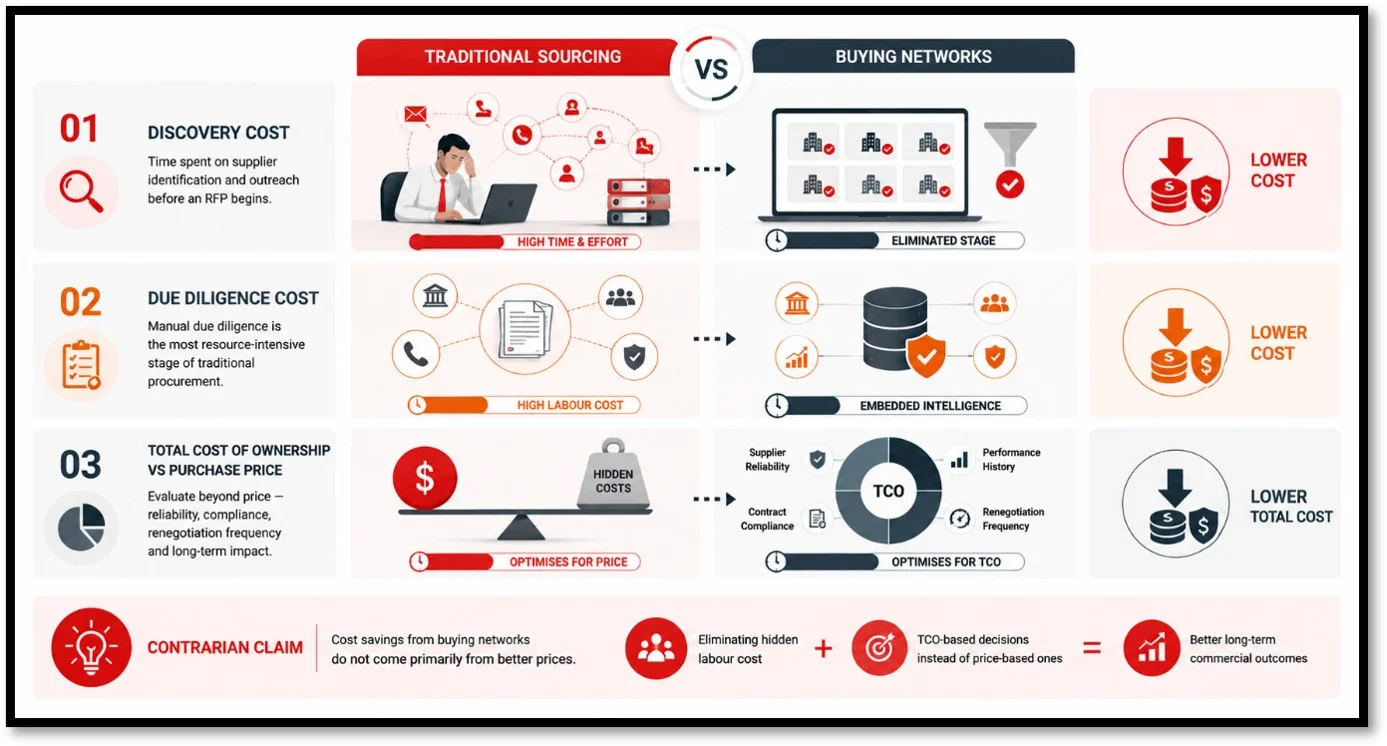
Cost-effective procurement can be achieved by eliminating the hidden labor costs of traditional sourcing, instead of focusing on better pricing, along with making TCO-based decisions. Here is a three-layer mechanism that allows buying networks to reduce costs-
- Discovery Cost: Before beginning RFP, traditional procurement frameworks invest more time in supplier identification and outreach. Buying networks, with the help of a verified supplier pool, eliminate these efforts.
- Due Diligence Cost: Manual due diligence, the most resource-intensive stage of the procurement, is eliminated, and pre-event labor costs are cut down, as networks embed this intelligence.
- Total Cost of Ownership (TCO): While conventional procurement frameworks emphasized purchase price, networks embed performance history data to evaluate TCO, changing the selection decision, and producing long-term commercial outcomes.
How Supplier Quality Comparison Can Help B2B Teams Generate Better ROI
Using procurement benchmarking, B2B teams often compare suppliers against incumbent vendor performance or alternatives found through manual research, but neither of these produces a complete picture of the market.
Buying networks expand qualified suppliers and improve supplier quality. Evaluating the same suppliers better does not produce better outcomes, but producing competitive options does.
Supplier risk assessment is a pre-selection step for traditional procurement, implying it depends on signals that suppliers provide, while buying networks surface real-time supply chain concentration signals, compliance changes, and financial instability.
Expanding access to qualified suppliers is one of the key reasons buying networks outperform traditional sourcing models. Learn more about how organizations leverage buying networks to source and purchase at scale across categories.
How Speed and Efficiency Comparison Develop a Better ROI Model
The ideal procurement ROI model never follows a one-size-fits-all approach. In cases where incumbents outperform available alternatives, traditional relationship management suits best, while buying networks work better where competition and supplier discovery add more value.
| Metric | Traditional Procurement Framework | Buying Network |
|---|---|---|
| Supplier Pool Size | 3-5 known vendors | 10-50+ pre-verified pool per category |
| Sourcing Cycle Time per Event | 34 days | 11 days |
| Supplier Risk Incident Rate | Reactive | Proactive |
| First-year Contract Competitive Tension Rate | Variable | Higher |
| Competitive Tension Rate | <40% of events have 3+ qualified bidders | Enforced structurally across every category. |
The procurement technology ROI gap reduces where enterprises already have better supplier relationships, and widens where supplier discovery from scratch is the only choice available.
Final Thoughts: Which Approach Delivers Better ROI?
Instead of replacing existing processes entirely, identifying categories where supplier discovery has become a bottleneck, network data density is higher, and competitive tension ceases to exist, becomes more important while shifting from traditional to digital procurement platforms.
The strongest ROI opportunities often emerge in categories where traditional procurement carries the highest hidden costs. Marketboats can help you identify these opportunities and devise strategic sourcing solutions tailored for long-term value.
FAQs
1. What are the benefits of a B2B buying network?
Along with improving supplier discovery, buying networks also reduce sourcing efforts and develop better procurement outcomes by strengthening supplier intelligence.
2. How do buying networks reduce procurement costs?
Buying networks automate due diligence, cut down supplier discovery costs, and offer better TCO decisions.
3. What metrics should procurement teams track?
Supplier quality, contract compliance performance, supplier risk incidents, sourcing cycle time, and competitive tension rates are the important metrics that must be tracked to measure ROI.