
B2B enterprises that frequently appear in AI search engines might not have the largest content libraries, but certainly have structured content directly answering specific user queries.
Most B2B teams still write content to rank in SERPs, but AI search visibility responds to claims rather than pages. In reality, publishing more content hardly implies better visibility, but well-structured content with stronger claims can boost retrieval.
B2B vendor shortlisting is increasingly happening through AI searches, and most teams remain invisible by not preparing for answer engine optimization. Geisheker’s research finds that 94% of B2B buyers use AI while buying.
AEO for B2B needs a different content architecture, along with a new competitive strategy and success metrics. Teams that structure the content better but publish less often rank higher in AI searches.
What Is Answer Engine Optimization in SEO, and Why It Needs a Different Approach
How Do You Define AEO, SEO, and GEO
While AEO optimizes content to become the retrieval source for a specific question, SEO ranks webpages in human-navigated results. Generative search optimization, on the other hand, emphasizes citation across LLMs.
Resourcera’s 2026 research finds that Google’s AI overviews reflect in over 55% of total search results.
Most B2B enterprises treat AI search optimization as a mere formatting exercise and edit after publishing. However, the AEO architecture decisions are made before devising the content. AEO changes SEO’s destination instead of replacing it.
What Are the Key AEO vs SEO vs GEO Differences
| Parameter | AEO | SEO | GEO |
|---|---|---|---|
| What Is It Optimized for | Retrieving the source answer | Ranking pages on SERPs. | Citation across LLM responses. |
| What Does it Retrieve | A specific answer or claim. | A ranked webpage. | A cited source or passage. |
| What Are the Success Metrics | Answer inclusion and AI citation frequency. | Organic traffic and keyword rankings. | Brand mentions in AI answers. |
| Which Content Format Wins | Structured, question-answer, and claim-centric. | Keyword-rich, long-form, and comprehensive. | Entity-rich, authoritative, and cited. |
| Which Are the Primary Platforms | Perplexity, ChatGPT, and Google AI Overviews. | Bing and Google. | Copilot, Gemini, and Claude. |
While AEO optimizes for authority, SEO optimizes for discovery. However, despite ranking in SERPs, a web page might never reflect in an AI-generated answer. B2B enterprises that write to answer often outperform teams that write to rank.
How to Rank in AI-Generated Answers
Which Signals Determine Visibility
Rather than retrieving pages, AI search results optimization retrieves claims. It often operates on the following three retrieval signals:
- Answer Specificity: A direct answer to a specific question often outperforms a comprehensive guide that talks on multiple topics at equal depths. Content formatting for AI answers includes writing the first sentence that directly answers the question, which is often an impactful AEO change any B2B team can make.
- Source Credibility: AI-driven content discovery validates multiple trusted sources before surfacing answers, and this is why Forrester, Gartner, or HubSpot research appears more than any other unsupported view.
- Content Structure: Comparison tables, numbered lists, headers, and schema markups reduce ambiguity, improving retrieval accuracy.
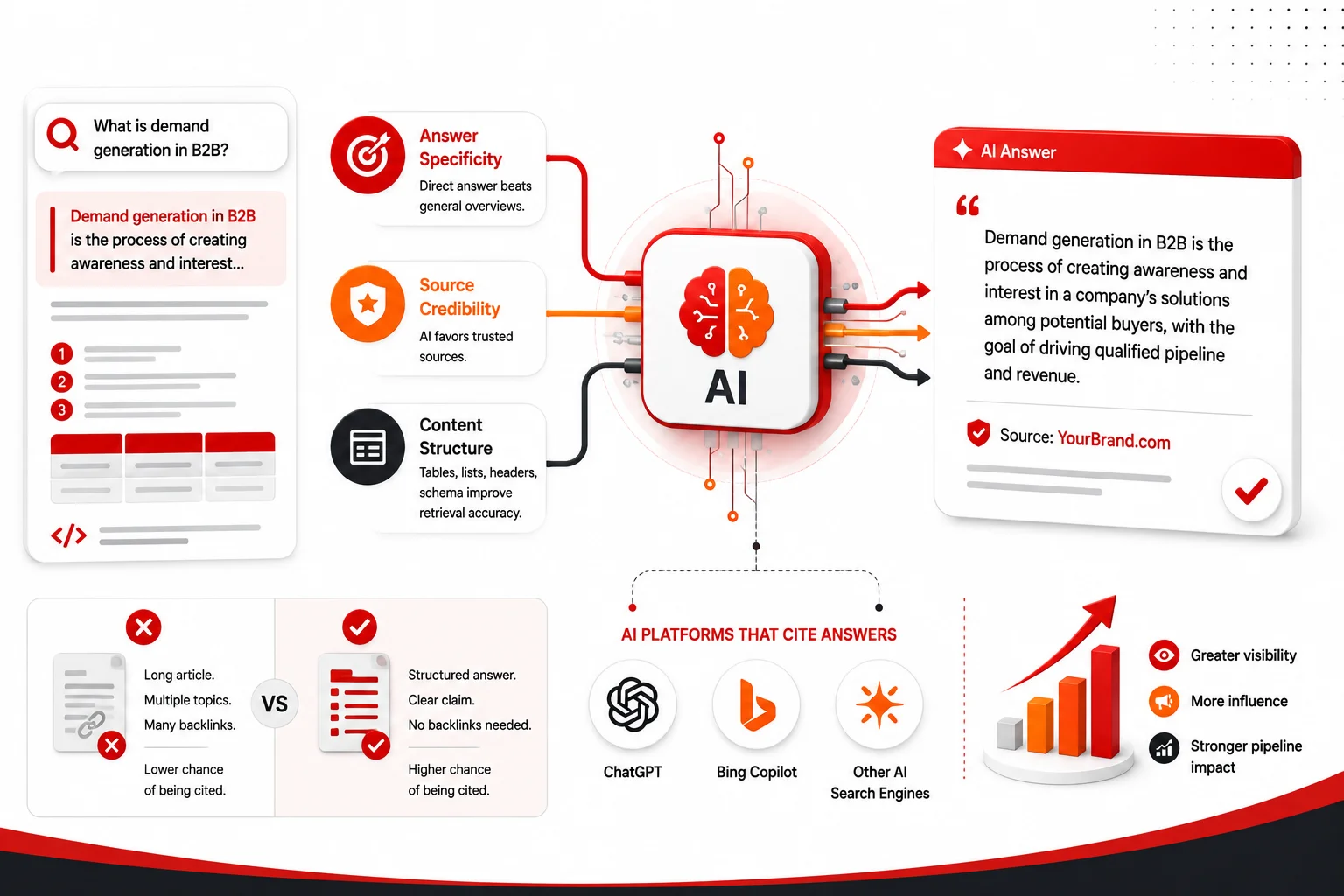
Why Structured Content for AI Answers Is Better than Long-form Prose
Backlink authority becomes irrelevant to AI retrieval despite being the most important signal in traditional SEO. Despite having no backlinks, a well-structured answer often outperforms content having multiple backlinks but addressing a topic ambiguously.
AI models parse instead of skimming. Parsing-centric content often reflects better retrieval across platforms like ChatGPT or Bing Copilot. Rather than topical breadth, AI search always prefers claim precision, and this logic often contradicts what most B2B enterprises follow.
How to Structure Content for AEO in the Formats That Get Cited in AI Answers
Rather than making the content short, AEO architecture makes the solution trackable in the opening sentence of every section, as it focuses more on structured data rather than keyword density.
The following four content formats increase the likelihood of AI retrieval:
- Question-based Content Strategy: AI models retrieve better when the content appears as the direct answer under the heading designed as a question. As it simultaneously meets the retrieval criteria of several AI platforms, the structural change offers the highest leverage.
- Bullet and Numbered Lists: Information retrieval systems extract the content more reliably from bulleted and numbered lists than prose sections.
- Comparison Tables: It is the highest-cited format because it answers several interrelated questions directly through a single extractable unit.
- Definition Blocks: A precise and well-constructed category term definition helps in content authority building and consistent cross-platform citation.
According to Cicéro’s 2026 research, 68% of Google searches never turn into clicks, and B2B enterprises that hardly appear in these searches are because they are deeply buried under long-form content.
What Is the Best Schema Markup for AEO, and Why Structured Data Improves AI Search
Schema markup for AI search transforms quality content architecture into machine-readable authority signals. Employing schema without content structure enhancement is as good as advertising a package that does not contain the product.
B2B enterprises can validate structured data using platforms like SEMrush, Google Search Console, Rank Math, and Schema.org Validator.
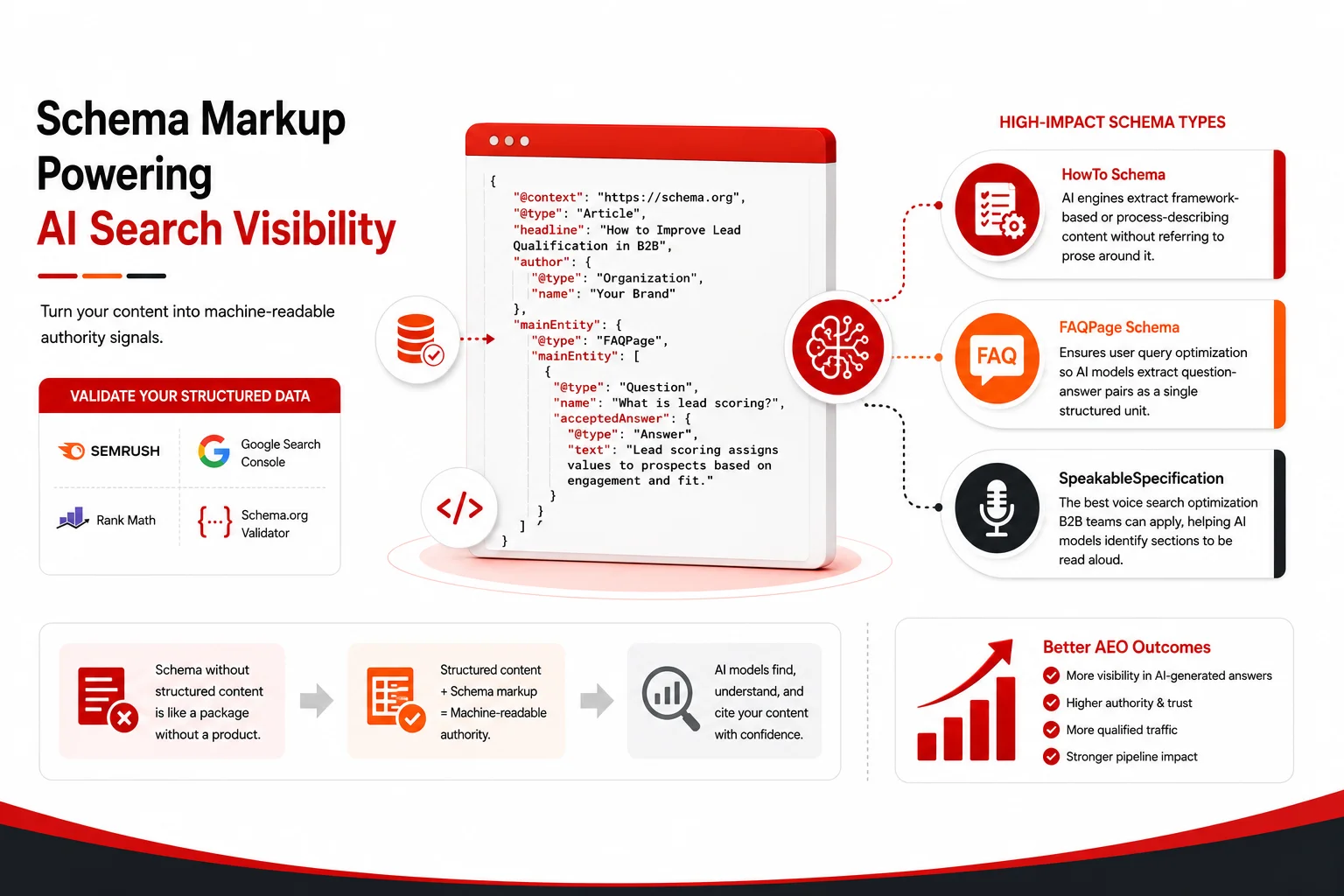
Here are the high-impact schema types:
- HowTo Schema: AI engines extract the framework-based or process-describing content without referring to prose around it.
- FAQPage Schema: It ensures user query optimization so that AI models extract question-answer pairs as a single structured unit.
- SpeakableSpecification: It is the best voice search optimization B2B teams can apply, which helps AI models identify sections to be read aloud.
Despite its necessity, schema markup might not be enough because, rather than identifying the worthiness of citing the content, the schema model can only identify where the answer lies. B2B teams can integrate FAQPage schema into high-specificity Q&A to produce the most reliable AEO implementation outcome.
How to Improve AI Search Visibility for B2B Brands in 2026
Although the majority of B2B teams aim for awareness queries through AEO investments, the real commercial value comes from procurement-level questions, where AI retrieval can influence buyers’ decisions even before the sales conversion starts.
Currently, teams only compare categories, validate claims, and shortlist vendors before converting, and enterprises that remain invisible at the procurement AI search level are often excluded from shortlists. Forrester’s 2026 research finds that 94% of B2B buyers use GenAI while buying. That is why AEO acts as a pipeline protection.
Every B2B organization must devise its digital visibility strategy for:
- What is the difference between [vendor A] and [vendor B]? It needs head-to-head positioning content.
- What are the top [category] platforms for [use case]? It needs articulated and well-structured comparison datapoints that have specific capability claims.
- What should I look for when evaluating [category]? It demands an evaluation framework guiding buyers to the decision.
This is the most cost-efficient solution for fixing low AI search visibility, and B2B teams that appear in such AI searches often cross this first sales touchpoint seamlessly.
What Is the Answer to Why Content Is Not Showing in AI Search Results
Beyond issues with content quality, even the best strategies for AI search visibility fail due to poor content architecture, and the real solution lies in restructuring rather than rewriting.
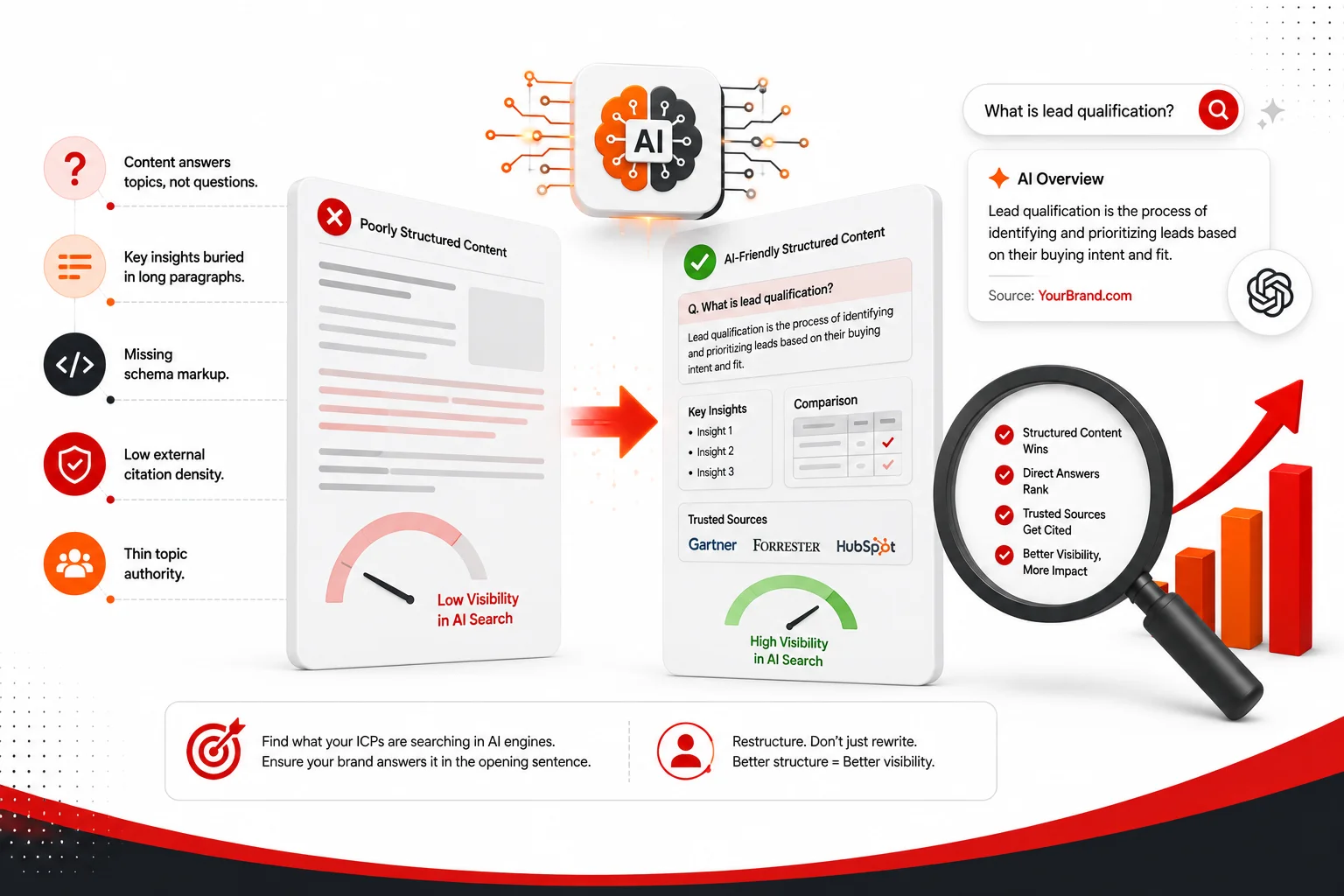
The following table reflects the core challenges in AI search optimization and how to optimize content for AI search engines:
| Why Content Never Appears in AI Searches | How Can It Be Fixed |
|---|---|
| Instead of questions, the content answers topics. | Frame section headings as questions, while opening the sentences as direct answers to those questions. |
| Key insights buried inside long paragraphs. | Fragment important insights and information into tables, bullet lists, and definition blocks. |
| Missing schema markup. | Using platforms like SEMrush or Schema.org Validator, employ HowTo and FAQPage schema. |
| Low external citation density. | Use references and hard data from trusted sources like Gartner, Forrester, or HubSpot. |
| Thin topic authority. | Consistently publish the content across topic clusters, enabling AI models to find cross-document content relevance signals. |
Publishing new content that continues to possess the same structural flaws as the previous content will always underperform a single restructured high-quality page.
Finding what ICPs exactly search in AI engines and analyzing if your brand directly answers the question in the opening sentence is the fastest way to diagnose if your brand has correctly achieved zero-click search optimization.
Key Takeaways: How to Get Cited in AI Answers, and What Are the Best Strategies for AI Search Visibility
Building Q&A architecture, developing evaluation and comparison frameworks, employing AEO schema, building third-party citation credibility, and covering procurement-level queries are the steps that enable B2B teams to optimize for AI search engines.
AEO has induced a present pipeline risk, and it has become a key commercial demand for B2B teams. The answer to how to optimize for zero-click searches lies in a framework that flows from findability, understandability, citability, and trustworthiness.
B2B enterprises investing more in this framework now will eventually bolster organic visibility and increase their probability of being discovered in early vendor shortlisting. Marketboats can help you find structural gaps in your current strategy to overcome the problem of content not ranking in featured snippets.
FAQs
1. How is AEO different from SEO?
While SEO emphasizes webpage ranking improvement in conventional search engines, AEO enhances the probability of content retrieval in AI search engines when users search for a specific query.
2. How do AI search engines rank content?
AI search engines rate the content based on topical authority, semantic relevance, structure, how clearly the page answers the user’s question, and structured data.
3. How can B2B brands improve AI search visibility?
To improve AI search visibility, B2B enterprises must employ structured headings, create question-based content, answer procurement-stage search questions with explicit proofs, publish original research, and implement schema markup.
4. What is the role of schema markup in AEO?
AI systems can easily understand the page structure and recognize vital information more accurately using schema markups. HowTo, FAQPage, and other structured data forms can support richer AI retrieval and enhance machine readability.
5. How do you get featured in AI-generated answers?
When the content answers a specific question directly using a structured format, uses schema markup, and demonstrates strong topical authority with trusted external sources and authoritative statistics, the content is more likely to appear in AI-generated answers.