
Effective B2B email marketing campaigns are those that shift from attention metrics to outcome metrics, and the question now is whether an email helped a prospect reach a commercial decision.
Most B2B teams prioritize open rates over other email marketing metrics, despite open rates being highly unreliable due to automated email prefetching or privacy updates, which is the core problem. Beehiiv’s research finds that after Apple MPP rolled out, open rates suddenly jumped from 28% to 55%.
Although the metric unveils exposure, it fails to reveal the commercial outcome. Most B2B marketers optimize their reporting systems for visibility instead of revenue contribution, as they are obsessed with open rates.
Which are the Key Email Marketing Metrics That Matter in 2026
The open rate only monitors whether the email was opened by triggering an image pixel, but fails to track whether the content was relevant or any commercial outcome was generated.
High open rates, coupled with a weak pipeline, hint at a failed measurement. Click-to-open rate (CTOR) is the fundamental metric that measures the percentage of recipients who clicked after opening the email, indicating that the content generated interest and a prompt action.
HubSpot’s 2025 analysis finds that while the average open rate is 38.58%, the average CTOR is 4.62%, which highlights the gap between what CTOR suggests and what open rate tells about the performance. Email engagement metrics become more valuable and authentic when they govern decision-making rather than populating the dashboard.
What are the Most Important Email Marketing Metrics for B2B Companies
The email conversion rate monitors how many recipients took a defined action downstream, including booking a demo, downloading a content asset, or starting a free trial, and connects email performance to the pipeline.
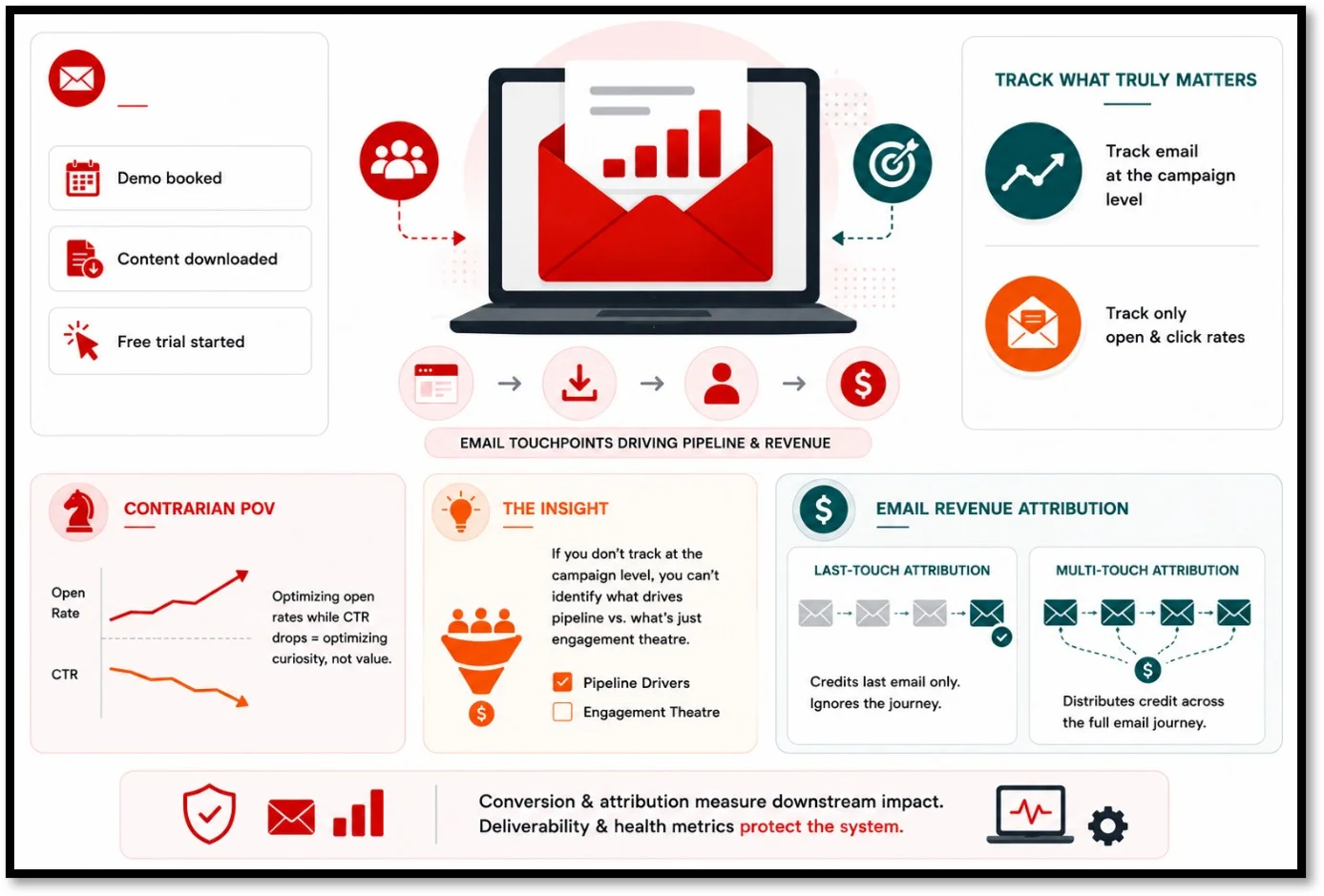
Connecting attribution infrastructure to downstream conversion is way tougher than firing a pixel, and that is why most B2B enterprises overlook the metric. As a result, teams often optimize for curiosity rather than value by ignoring click-through rate (CTR) to celebrate improvement in open rate.
Organizations that fail to monitor conversion rates cannot distinguish between pipeline-generating and engagement-generating emails. Email revenue attribution extends the concept further, where last-touch attribution credits the last email, while multi-touch attribution influences actions by crediting across interaction sequences.
How Can Measuring Email Campaign Performance After Open Rates Improve Deliverability
More than being vanity metrics, Email deliverability parameters indicate the performance of future campaigns, as they check if future emails will reach the inbox. The sender’s reputation, which determines inbox placement, is based on unsubscribe rate, spam complaint rate, and bounce rate.
An increasing unsubscribe rate indicates a relevance problem, not a creative problem. A higher unsubscribe rate is commercially more valuable than a lower rate, as it masks silent disengagement. Unsubscribing contacts mark themselves unworthy of nurturing.
A contact ignoring without unsubscribing not only damages the sender’s reputation but also suppresses the inbox placement rate, while producing no outcome. Clean suppression carries more value than apparent retention.
How Should Email KPIs for B2B Marketing Teams be Monitored to Build the Right Dashboard
A B2B email marketing analytics dashboard built on commercial outcomes describes and supports decision-making, and it has three layers:
- Engagement Layer: It emphasizes response rate and CTOR as relevance indicators.
- Pipeline layer: It monitors email-attributed pipeline contribution and email conversion rate.
- Health Layer: Along with bounce and inbox placement rate, it monitors spam complaint trends.
Here is the three-step decision framework that shifts the dashboard from being decorative to actionable-
- Define conversion event before a campaign is launched. It makes the metric more trackable from the first day of the campaign.
- Integrate email platforms with the CRM. This ensures that downstream conversions are attributable to a specific touchpoint.
- Review health and engagement metrics together. It will reflect issues beyond visible dashboard problems.
B2B teams building on the best email performance data measure the right events, along with connecting them to the correct downstream outcomes.
Final Thoughts: What are the Metrics to Improve Email Marketing ROI Beyond Open Rates
Email marketing measurement relying only on open rates is not only incomplete but also misleading, as optimization efforts are diverted toward metrics that Apple MPP has made unreliable.
The future of email performance measurement belongs to those who dare to shift from familiar metrics that do not reflect reality to metrics that really matter. Evolving privacy standards continue to widen the gap between B2B teams tracking conversion outcomes and those monitoring exposure metrics.
Contact Marketboats to uncover how open rate optimization masks issues of pipeline performance and identify how you can maximize email ROI by overcoming these blind spots.
FAQs
1. How to measure email marketing success in 2026?
Track conversion performance, engagement quality, deliverability health, and revenue contribution to replace open rates.
2. What are the key email metrics for marketing automation programmes?
Response rate, spam complaint trends, bounce rate, conversion rate, CTOR, attributed pipeline value, and inbox placement rate are important metrics that measure marketing automation program performance.
3. What are the best email marketing KPIs beyond open rates for B2B teams to track?
Prioritize email conversion rate, CTOR, email-attributed revenue, complaint rates, and inbox placement rate over vanity metrics, while measuring email marketing performance.