
AI has made it easier than ever to send cold emails. Ironically, that is exactly why cold email performance is declining. Most B2B teams still optimize for activity metrics like the emails sent, sequences launched, and prospects contacted rather than the conversations and opportunities those emails create.
BizXpand’s analysis finds that cold email reply rates have dropped to 2-3%, which were between 15% and 25% a few years ago. This is because AI email writing generates grammatically perfect but contextually generic content.
Though Gen-AI makes generic cold outreach convenient, it is equally easy to ignore. If AI improves decision-making before writing an email, it generates effective cold outreach campaigns.
How AI Is Changing Cold Email Outreach in 2026, and Why Volume Is Not the Answer
Recipients’ belief that the sender understands their business situation determines whether a cold email starts a conversation. Specificity develops this belief, which comes from deep research about the recipients’ problems rather than running a mail merge.
While AI-powered cold emailing has become commoditized, the relevance of emails is becoming a key differentiator. Cold emails that work deploy artificial intelligence to know what signals justify the contact and who deserves it, even before deciding the content.
A successful B2B cold email strategy uses AI-driven research to uncover insights that would be impossible to identify consistently at scale. Recipients immediately distinguish such emails from generic outreach.
Why AI Prospect Research for Cold Emailing Is Important, and How It Is Carried Out
Manual research generates the most commercially effective input to cold emails, but it could never scale. AI prospecting tools, on the other hand, aggregate signals from different sources, including LinkedIn activity, job postings, product updates, and recent funding announcements.
Every signal gives a reason to start a relevant conversation, and emails developed on those signals become structurally different from those that are templatized. Email personalization attempted with no research produces inconsistent outcomes, and prospects can detect this distinction in the first line itself.
After personalizing with research, developing an AI email outreach that does not sound generated is the next challenge that B2B teams must address.
How B2B Teams Can Create AI-generated Cold Emails That Convert
Instead of calibrating for a conversational register, AI often writes emails that sound polished but say too much, which is a detectable failure mode.
A cold email that observes a specific and relevant problem and asks a direct question on it, instead of covering all relevant points, converts. AI-generated emails covering all value propositions are marketing assets dressed as outreach.
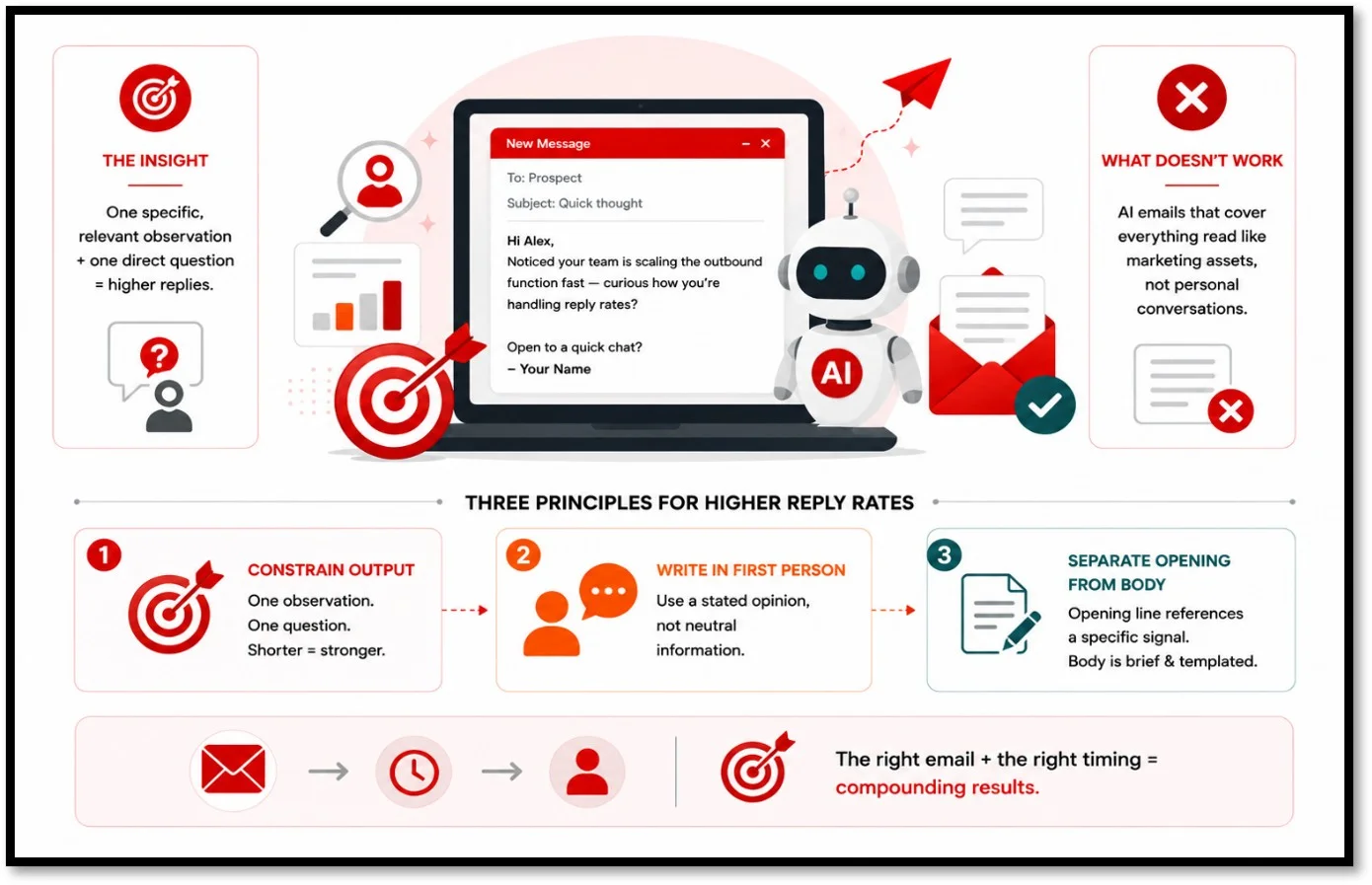
Here is a three-step framework that can generate higher reply rates to cold emails:
- Restrict the AI output to a single observation and question. Belkins finds that emails with 6-8 sentences and messages under 200 words generate 9% reply rates, higher than the average of 5.8%.
- Prioritize opinion-driven writing. Instead of providing neutral information, writing perspective-driven emails in the first person reads as human.
- Distinguish personalization from templating. The opening line must reference a specific signal, while the body can be templatized.
What Is Personalised Cold Email Outreach With AI
Beyond research and generation, AI also enhances send-time optimization and follow-up sequencing. More than treating follow-up emails as reminders, they must be considered as a separate piece of evidence of the sender’s POV, which most B2B teams overlook.
A follow-up, introducing a relevant observation, creates a new chance to show that the sender understands the recipient’s situation.
AI in cold email outreach tracks company signals between sends and automatically identifies new triggers for engagement. It also identifies when every contact has historically engaged with emails to optimize send times.
Final Takeaway: What Is the Future of Cold Email Outreach in 2026
The future of cold emailing belongs neither to automated nor to manual outreach, but it belongs to intelligently automated outreach. While AI for cold email campaigns caters to sequence intelligence, signal interpretation, and research aggregation, the manual layer handles commercial factors and introduces stated POV, making emails worth reading.
Generative AI will become more universally accessible in the future, and that is why commercial understanding and signal interpretation will drive strategic differentiation.
B2B teams writing a specific and relevant opening line by understanding their recipients will outperform enterprises writing generic and irrelevant emails that generate clutter instead of conversations.
As AI-generated outreach becomes ubiquitous, competitive advantage will come from signal interpretation, commercial judgment, and relevance at scale over volume. Marketboats will help you build an AI-driven cold email marketing strategy that will generate conversations.
FAQs
1. What are the AI cold email outreach best practices for B2B teams?
Emphasizing AI-assisted research, thought sequencing, personalizing contextually, and prioritizing human oversight over maximizing email volume are a few best practices for AI cold email outreach.
2. What do the best AI tools for cold email outreach do differently?
Best AI tools integrate personalization capabilities, engagement analytics, prospect research, and sequencing intelligence with a single workflow.
3. How to automate cold email outreach using AI?
Using AI, you can identify prospects, followed by gathering relevant signals. Further, generating contextual opening lines is followed by optimizing timing and improving follow-up sequencing, while maintaining human review.