
Enterprises that build strong contrarian positions, distribute content AI and buyers can easily retrieve, and publish proprietary data will shape B2B thought leadership in 2027. The core challenge will be the gap between where B2B buyers search and where B2B teams publish their content.
TopRank Marketing’s 2026 research finds that 32% of B2B professionals discover thought leadership through GenAI tools, including Claude and ChatGPT. This creates an opportunity for B2B teams to strengthen their presence across AI-powered discovery channels.
Although AI can simplify content publishing, it can increase duplicated content that competes for attention. In these scenarios, industry expertise, proprietary campaigns, and distinctive research can form the foundation of credible thought leadership.
Making content citable and giving buyers verifiable evidence can shape B2B thought leadership in the AI era. B2B teams that appear in AI-powered answers often strengthen their citation signals, such as external references, structured content, and original data.
What Is the Future of B2B Thought Leadership, and What the 2026 Data Shows
B2B thought leadership is shifting toward surfacing intent, and the 2026 data reveals three signals: GenAI discovery can outpace distribution platforms, zero-click research has not affected reader intent, and original research-based content can outperform many generic editorials.
| What Data Says | Source | Year | Commercial Outcomes |
| 97% of B2B marketers find thought leadership important for achieving full-funnel success. | Ascend2 | 2026 | Instead of treating thought leadership at this seniority level as a discretionary investment, B2B teams should treat it as a strategic, full-funnel investment. |
| 93% of B2B professionals find research-based original content effective in driving engagement and leads. | Ascend2 | 2026 | Proprietary data can help distinguish commodity content from thought leadership that offers original, citable insights. |
| ChatGPT draws 90% of citations from webpages ranked 21st and beyond in organic search. | SEMRush | 2025 | AI citations do not always follow traditional organic rankings, so B2B teams should evaluate AI visibility separately from SEO position. |
AI can summarize industry updates quickly, so frequent industry updates may not strongly differentiate B2B enterprises. Content with clear structure, attributable evidence, and extractable insights may be easier for AI engines to interpret and cite, while remaining useful to human readers.
Marketboats recommends evidence-based thought leadership and publishing insights that help decision-makers understand changing practices and what to do next.
What Are the Top B2B Thought Leadership Trends to Watch in 2027
The main trends to watch in 2027 are the rising importance of original research, executive voice replacing brand voice, AI-assisted workflows being replaced by AI-orchestrated ones, GenAI acting as a distribution channel, and the emergence of prescriptive content.
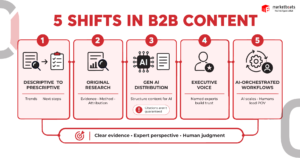
1. Content Shifts from Descriptive to Prescriptive
Content that guides B2B buyers on what to do next can offer more practical value than generic descriptive trend summaries.
AI engines can extract concrete claims, and buyers have a specific reason to attribute the idea to a source because prescriptive content can produce a specific next action, which is why this shift can be commercially more significant.
2. Original Research Becomes a Stronger Citation Advantage
Original research can consistently produce an attributable finding, a named source, and a specific methodology. These signals are hard to replicate, which is why AI engines can evaluate them more effectively.
3. Gen AI Emerges as a Distribution Channel
Although YouTube and other video platforms and LinkedIn remain top-performing distribution channels, many distribution platforms haven’t updated to cope with the emergence of GenAI. Clear structure, attributed statistics, and direct answers to buyer questions make content easier for AI systems to interpret. However, these elements do not guarantee citations.
4. Executive Voice Replaces Brand Voice
Buyers have started shifting from brand-owned content to practitioner or named executive voices. As a result, B2B thought leadership programs routing their ideas through a brand blog without a named expert may make expertise and accountability less visible to readers and AI systems.
5. AI-orchestrated Workflows Replace AI-assisted Workflows
B2B thought leaders will shift from using AI to draft and edit work to using AI for distribution management, performance analysis, and repurposing. At the same time, human judgment still produces original POV and proprietary data. AI might not generate the authentic contrarian POV humans can, which is why human involvement can give enterprises a decisive edge.
Though AI-generated content cannot and will not replace human judgment, it will outplay thought leadership content with no named author, verifiable data, or proprietary angle. So, the qualification benchmark for genuinely original thinking has, in fact, risen.
The compounding thought leadership content architecture should connect original research to AI-orchestrated distribution to GenAI citation to buyer trust, with each step feeding the next and requiring a human judgment layer AI cannot replicate.
Does Zero-click Search Hurt B2B Thought Leadership, and How Should B2B Teams Respond
Rather than eliminating B2B thought leadership’s value, zero-click search shifts the value captured from a search-result click to citations in AI-generated answers. B2B buyers can read and attribute these answers to a source.
PRSA’s 2026 report finds that zero-click searches account for about 80% of Google searches, while 90% of B2B buyers click through to citations behind AI overviews.
AI citation patterns often differ from traditional rankings, and AI citations can provide an additional visibility signal alongside organic rankings, referral traffic, and downstream conversions.
This implies that thought leadership content may appear in AI-generated answers even when it ranks lower in traditional search results. Conversely, a high organic ranking does not guarantee an AI citation.
B2B enterprises that assume zero-click as a natural threat to thought leadership content reach often measure the incorrect metric. While CTR is a proxy metric, citation frequency monitored against the ICP’s actual research queries can be a commercially more useful metric.
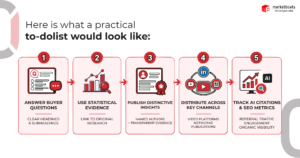
The content formatting decisions for organic search rankings and AI citations are converging. Here is what a practical to-do list would look like:
- Clearly answer buyer questions under clear headings or subheadings.
- Use statistical evidence and link it to original research.
- Publish distinctive insights with named authors and produce transparent evidence.
- Distribute the content through relevant video platforms, professional networks, and industry publications.
- Track AI citations along with SEO metrics such as referral traffic, engagement, and organic visibility.
AI citation frequency can show whether thought leadership content reaches buyers where they make buying decisions. Many B2B teams struggled to build presence and get cited in AI searches in 2026; to prepare for 2027, enterprises should invest more in AEO-structured content instead of producing more content.
Final Thoughts: Is B2B Thought Leadership Still Worth Investing in with AI Search in 2027
AI search has raised the qualification benchmark for citable content, which is why B2B thought leadership will still be worth investing in 2027. However, many enterprises are still publishing below that threshold.
B2B enterprises that invest in AEO-aware content structure, prescriptive insights, and original research can build stronger citation visibility over time. Companies that keep producing descriptive trend summaries without a proprietary angle will be hard to retrieve and may be invisible to buyers in AI searches.
Rather than treating thought leadership as a content production function, B2B teams that use it as a positioning and data function will have a structural advantage. In 2027, prioritize developing a distinctive point of view, backing it with verifiable evidence, and distributing the content where buyers actually make decisions.
Marketboats can help you build a B2B thought leadership content strategy that remains structured for AI citations and grounded in proprietary data.
FAQs
1. Will AI-generated content replace human thought leaders?
No. AI can help B2B marketers draft, distribute, and research, but credibility still comes from sound judgment, accountable interpretation, and original expertise.
2. Why does original research matter for thought leadership?
Original research can offer B2B enterprises attributable findings, named sources, and a specific methodology that AI engines can evaluate to identify citable content.
3. What makes thought leadership trustworthy to B2B buyers?
Proprietary research data, a specific position the author can defend, named author expertise, links to original sources, and a verifiable methodology can make thought leadership trustworthy.
4. Does zero-click search reduce the value of thought leadership?
No. Zero-click search can reduce website visits for some queries, but thought leadership may still gain visibility when search results or AI-generated answers cite the source. B2B teams should track citations, visibility, downstream outcomes, and engagement separately.
5. Is thought leadership still effective in the AI era?
Yes. Thought leadership remains useful for helping B2B buyers understand problems and evaluate decisions. However, discoverability, source attribution, and content structure have become more important in AI-assisted research.