
The best AI tools for B2B lead generation teams fall into five categories: intent and signals, AI SDR and outreach, conversational AI, scoring and qualification, and data and enrichment. As organizations shift from volume-based sequences to signal-based outbound and AI-driven selling, their roles change.
Poor data quality, however, can create bottlenecks. More tools might not generate pipeline, but stacks built around human verification, a predefined signal set, and a clear ICP can be commercially fruitful.
Salesforce’s research found that 81% of B2B sales teams either fully implemented or experimented with AI. Instead of choosing AI tools based on the number of features, select them based on data quality, pipeline objectives, and ICP fit.
Here is what Marketboats has chosen to do: Combine AI sourcing through LeadsEye, CALS, and Boats.Eye with human verification. The right stack integrates automation with reliable data and human judgment.
What Are the Best AI Tools for B2B Lead Generation
The best AI lead generation tools are often categorized by function, and many enterprises need multiple categories working together. The most feature-rich platform might not be a perfect fit for B2B teams because overlapping tools add complexity and cost.
The following table can offer a practical framework to choose an AI tool for a specific use case:
| Category | What It Does | Tools to Consider | Best For |
| Data and Enrichment | It builds and enriches the contact list against ICP criteria using intent, technographic, and firmographic data. | Lusha, Apollo.io, ZoomInfo, and Clay | Enterprises enriching existing CRM records or building outbound contact lists from scratch. |
| AI SDR and Outreach | It can run intent signal-driven multichannel outreach sequences and autonomously book meetings. | Artisan and Qualified | It suits B2B teams that scale TOFU outreach without adding SDR headcount. |
| Scoring and Qualification | It can score accounts and leads against engagement signals and ICP fit using predictive models. | Salesforce Agentforce and HubSpot Breeze | It aligns with B2B teams that have existing CRM data and need to automate prioritization with minimal manual review. |
| Conversational AI | It can qualify inbound website visitors in real time and route meetings with minimal human intervention. | 1mind and Qualified | Enterprises can qualify inbound website visitors and route relevant conversations outside business hours. |
| Intent and Signals | It can identify accounts that research a category actively before they engage with vendors. | Demandbase, 6sense, and Bombora | Organizations can use tools to prioritize outreach to in-market accounts. |
| Managed AI + Human | It can integrate human verification with AI-sourced signals before leads reach sales. | Marketboats (LeadsEye or CALS) | B2B teams can prioritize lead quality through human verification. |
The intent and signals category can deliver better leverage when B2B enterprises have a clear ICP and reliable data, but its value depends on execution and signal quality.
Intent-based outbound can improve relevance by aligning outreach with buying signals. However, performance varies by campaign design, offer, audience, and signal quality, so teams should compare results against their own cold-outbound baseline.
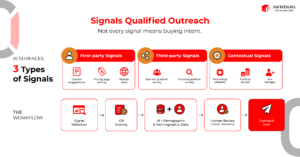
What Is Signal-based Outbound, and Why Are the Best AI Tools Built Around It
Instead of time-based sequences or static list membership, signal-based outbound can trigger sales outreach based on behavioral signals like competitor research, technology installation, or pricing page visits.
A signal might not indicate purchase intent, and weak, misinterpreted, and stale signals can make the outreach irrelevant. They are probabilistic, and their strength should be weighted against ICP fit before routing them. AI tools can surface the following signal types:
- First-party Signals: These include engagement with owned content, pricing-page activity, and website visits.
- Third-party Signals: These indicate activity across external platforms and topic-level intent research.
- Contextual Signals: Technology adoption, funding rounds, and job changes can indicate a relevant business need.
The workflow moves from signal detection to ICP scoring and an outreach brief. AI combines the signal with firmographic and technographic data, while human review checks whether the outreach is relevant before it is sent.
Autobound cited Instantly’s 2026 Benchmark Report, which states that signal-specific personalization can achieve 18% response rates, five times the generic average.
When B2B teams integrate first- and third-party intent signals with human verification, they can solve relevance and timing problems at once. B2B companies should therefore not focus on email volume alone; they should assess signal-based campaigns by tracking meetings and qualified replies.
Can AI SDRs Replace Human SDRs
AI SDRs should not completely replace human SDRs. While the former can outperform the latter for signal-triggered, high-volume, top-of-funnel outreach, human involvement in validation can improve meeting-to-opportunity and reply-to-meeting rates.
AI SDR platforms often look promising in a demo, but a first-contact reply rate tracked over a real campaign cycle is a better test. Increasing automated message volume might not lead to more qualified meetings or revenue.
| Dimension | AI SDR | Human SDR |
| Volume | High volume, with multiple personalized touches running simultaneously. | The volume is capped by individual rep capacity. |
| Speed | AI can fire sequences quickly, depending on integration setup and workflow. | Workload and rep availability can determine speed. |
| Contextual Judgment | AI judgment depends on the available data, configured signals, and ICP criteria. | Humans can navigate prior relationships, complex accounts, and multi-stakeholder nuance. |
| Meeting Booking | AI can book meetings automatically when calendar access, qualification rules, and scheduling integrations are configured. | Reps need to book meetings after the point of positive response. |
| Best Used For | TOFU, signal-triggered, and high-volume prospecting against clean ICP data. | Multi-threaded buying committee engagement, strategic accounts, and existing relationships. |
Gartner research found that reps who partner with AI are 3.7 times more likely to meet their quota than those who rely only on manual processes. Marketboats’ CALS integrates AI sourcing with human verification to ensure leads are verified before reaching sales.
What Replaced Drift, and How Should B2B Teams Choose an Alternative
Salesloft acquired Drift in 2024 and announced 1mind as its AI successor in 2026. B2B teams evaluating alternatives should compare more than chatbot features. Meeting-booking rates from ICP-fit visitors, qualification quality, CRM integration, and human handoff are stronger evaluation criteria.
| Platform | Core Function | Best For | CRM Integration |
| 1mind | Full conversation autonomy, AI-native conversational selling. | It suits enterprises that want AI-first replacements for Drift’s qualification and conversation layers. | Bidirectional integration with HubSpot and Salesforce. |
| Qualified (Piper) | Meeting booking, real-time visitor identification, and inbound AI SDR capabilities. | B2B teams that prioritize pipeline generation from high-intent website visitors and meeting-booking conversion can choose this platform. | HubSpot integration and native Salesforce integration. |
Rather than focusing on chatbot engagement, enterprises should emphasize meeting booking, human handoff, CRM integration, and qualification quality. Teams evaluating Drift alternatives should compare visitor qualification, meeting conversion, CRM integration, and the quality of human handoffs.
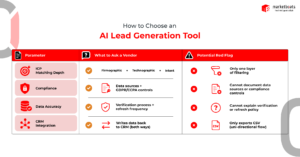 How to Choose an AI Lead Generation Tool
ICP matching depth, compliance documentation for CCPA and GDPR, CRM integration architecture, and data source accuracy and decay rate are the four criteria against which B2B enterprises should select AI lead generation tools.
The following framework can help you understand what you should ask a vendor and what the potential pitfalls are while selecting an AI tool:
| Parameter | What to Ask a Vendor | Potential Red Flag |
| ICP Matching Depth | Can the tool combine firmographic, technographic, and intent filters? | The tool supports only one layer of filtering, which may generate high volume with low precision. |
| Compliance | Can the provider document its data sources and GDPR/CCPA controls? | The provider cannot document its data sources, processing practices, or relevant compliance controls. |
| Data Accuracy | How are contacts verified, and how often are records refreshed? | The provider cannot explain its verification process or provide a clear record-refresh policy. |
| CRM Integration | Does it write data back to the CRM in both directions? | The system can only export CSV. Unidirectional data flow can prevent closed-loop reporting and break attribution. |
While pricing and features can influence tool selection, ICP matching depth, CRM integration architecture, and data quality can determine pipeline outcomes. B2B teams should test with actual ICP criteria before choosing the tool.
Free AI lead generation tools often limit export frequency, volume, and accuracy. As a result, enterprises must ask whether data quality can justify the price at the required volume.
Final Thoughts: How to Build an AI Lead Generation Stack
The AI lead generation stack that combines AI-powered outreach, human-in-the-loop verification, and intent-signal sourcing can produce a healthy pipeline. Complex B2B accounts require contextual judgment to drive conversions.
AI tools without a coherent stack often produce noise, while those with a well-defined ICP, a predefined human review step, and strong data hygiene deliver better results. Talk to Marketboats to understand how we achieve these results by combining AI lead generation with human verification.
FAQs
1. What should an AI lead generation stack include?
An ideal AI lead generation stack should include verification, CRM integration, intent signals, outreach automation, lead scoring, and prospect data enrichment, but the exact mix depends on existing systems and your ICP.
2. How accurate is AI lead scoring?
AI lead scoring accuracy depends on how well the model reflects real qualification and conversion outcomes, the scoring model, and input data quality.
3. Is AI cold outreach compliant with GDPR?
AI cold outreach is not automatically compliant or non-compliant. Its legality depends on the applicable jurisdiction, channel-specific rules, how personal data is obtained and used, and the relevant consent or other legal requirements.
4. Do AI SDRs hurt email deliverability?
Yes. AI SDRs can hurt email deliverability when you increase volume without proper domain configuration, list hygiene, bounce monitoring, and appropriate targeting. Track bounce rates, spam complaints, and engagement before scaling campaigns.
5. How do you verify leads from AI tools?
Confirm whether the contact is still an employee of the stated organization. Then check their role and business email, if possible. Validate company fit against the ICP, and review the data’s freshness and source to verify leads from AI tools. Human review is also useful for high-value accounts.