
Using AI’s processing power alongside human expertise and judgment is how human-AI collaboration improves business productivity. Instead of adding more AI tools, redesign your workflows around the human-AI collaboration split to ensure better results.
AI can automate parts of data collection and cleanup, helping employees become more productive without replacing the workforce. Gartner’s 2026 research finds that AI tools can help sellers save 4.8 hours per week, yet 72% of B2B teams report low reinvestment of those time savings back into high-value sales activities.
However, simply adding AI tools to existing workflows may not improve output or reduce your workload. Beyond tool adoption, AI productivity depends on how you design those workflows.
Marketboats brings operations, marketing, and sales functions together around shared metrics to follow an outcome-driven approach. You can get commercially sound results for AI-powered workflows when people own the outcomes.
What Are the Benefits of Human-AI Collaboration in Business Operations
Human-AI collaboration in business can distribute routine tasks and decision-making responsibilities between AI and humans to improve organizational productivity. The following framework explains how AI can improve employee productivity without replacing workers:
| What Benefit Can AI Bring | What Can the Benefit Change |
|---|---|
| Employee enablement | Employees can spend more time applying their expertise and making informed decisions. |
| Quality | Humans can identify context errors, while automation handles volume. |
| Operational capacity | AI can handle routine tasks at scale, freeing employees to focus on higher-value work. |
| Speed | AI can collect and organize information before employees need it. |
According to HubSpot’s 2026 report, 64% of surveyed reps said AI automation saved them 1-5 hours per week, showing how AI workflow optimization can return time to employees.
Even if task completion speeds up, it does not guarantee higher AI workforce productivity. Rather than simply increasing activity, AI task delegation should reduce operational friction. Don’t add AI tools without redesigning the workflow, because doing so may increase activity without adding capacity.
Increased organizational activity may indicate a weak foundational system. When you measure productivity, track it by outcomes, quality, and time saved rather than task volume alone.
AI can also improve how marketing and sales teams identify buying signals, prioritize accounts, and engage buying groups. Explore how AI is transforming B2B demand generation through automation and better buying-group engagement.
How to Build Human-AI Collaborative Workflows
Map tasks, delegate pattern work to AI, and manually review commercially consequential decisions to build human-led AI workflows in your business. Use these workflows where any wrong decision can be commercially costly.
Before implementing collaborative workflows, businesses should evaluate their existing processes, data readiness, and business objectives. Read our guide on how to approach AI adoption in business to understand how to identify the right AI use cases and build a strong foundation for implementation.
To understand how AI and employees can work together more effectively, use a practical checklist:
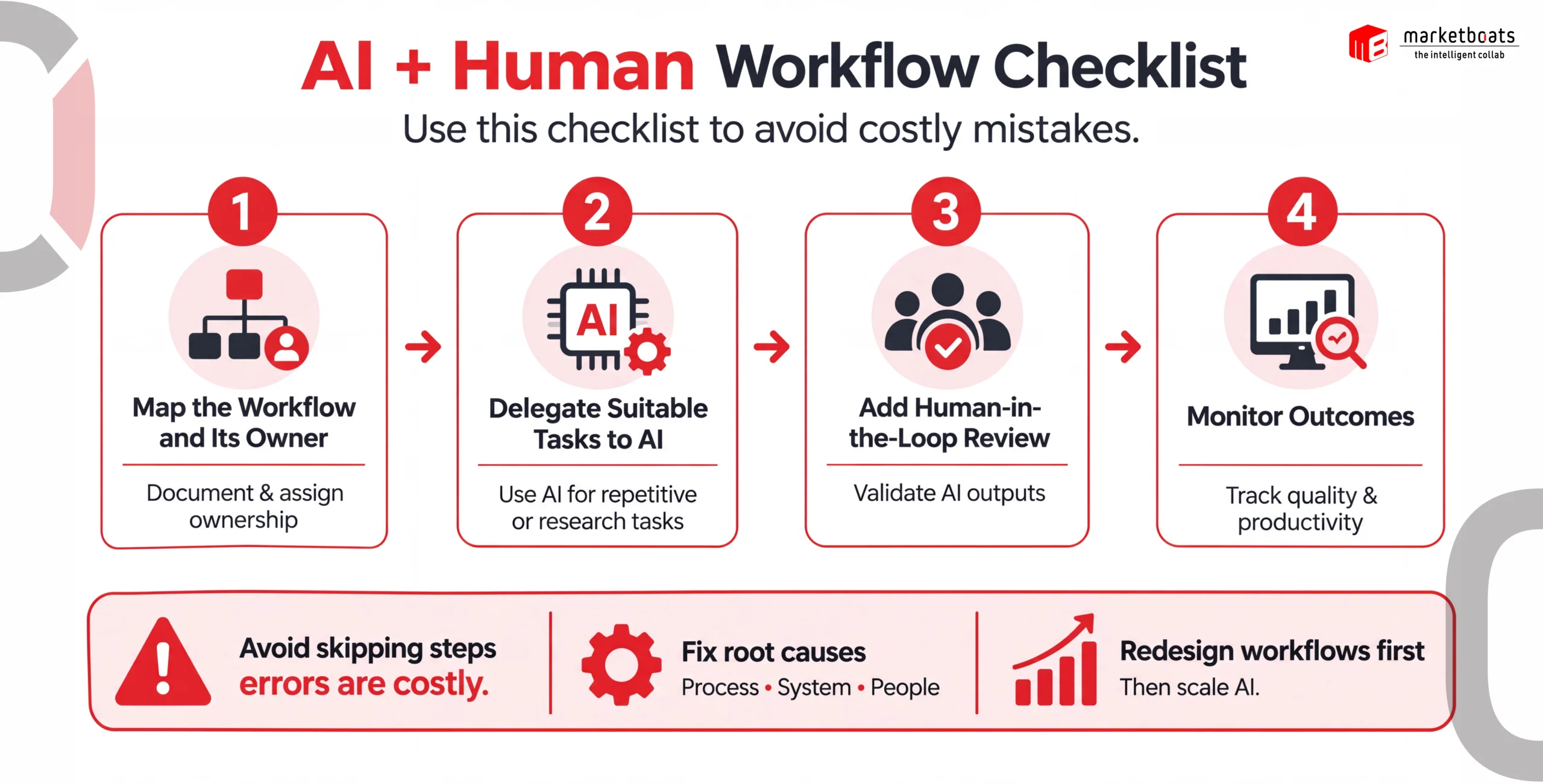
- Map the workflow and its owner. Document every delegated task and assign a specific owner to each.
- Delegate suitable tasks for AI-assisted decision-making. Use AI tools for repetitive, research-heavy, or pattern-detection tasks.
- Add a human-in-the-loop AI review step. Manually validate AI-generated outputs, buyer-facing communications, and lead qualification recommendations.
- Monitor outcomes. Assign quality and productivity metrics, then track them consistently.
If you automate each step, you might eliminate necessary checkpoints, making mistakes harder to track. When outcomes fall short, examine whether the problem originated in your processes, systems, or human decisions. Sameer Gujral shares how Marketboats applies this thinking in practice by making each of these elements collectively accountable for business outcomes.
Before optimizing AI workflows, prioritize workflow redesign and define escalation and ownership before scaling automation. Then, you can protect the human judgment and critical thinking these workflows rely on.
Why Human Judgment Is Important in AI-powered Workflows
While AI can recognize patterns, humans can ensure accountability, context, and critical thinking, which is why human-in-the-loop systems are important in AI-driven workflows. Use the following decision table to understand how to preserve organizational knowledge when adopting AI:
| Decision Type | Who Should Make the Decision |
|---|---|
| Buyer context, qualification, and claims | Humans, supported by AI-generated insights. |
| Scoring, drafts, and data collection | AI can assist, with human review where required. |
| Consequential approvals | Humans should retain final approval authority. |
Assign an owner who can explain the factors behind AI-assisted decision-making and take responsibility for how those decisions are used. Although you may save time initially by eliminating human involvement, you might lose the context needed to identify wrong suggestions.
Marketboats built its foundational workflow systems before the AI era. Organizational knowledge preservation starts with documented workflows. Instead of preserving human expertise in AI adoption as an informal backup, build it into the workflow.
Final Thoughts: How Businesses Can Combine Human Intelligence and AI
Delegate pattern work to AI while keeping review, ownership, and judgment with humans. This is how businesses can combine human intelligence and AI. However, adding AI tools without redesigning workflows can introduce unnecessary complexity into your systems.
Automating more tasks may not guarantee better operational capacity. Use AI for human intelligence augmentation, and judge its success by sustainable workforce productivity and business outcomes. Marketboats can help you build workflows that make human-AI collaboration more effective.
FAQs
1. How can businesses combine human intelligence and AI?
While AI handles pattern detection and research, B2B enterprises can assign relationship and decision ownership to humans. Automate repetitive tasks, while humans retain oversight of decisions that require contextual judgment and accountability.
2. Can AI improve productivity without replacing employees?
Yes. You don’t need to replace your employees with AI to improve your organizational productivity. AI can automate routine, repetitive tasks, allowing employees to focus on high-value work.
3. Why is human judgment important in AI-powered workflows?
Human judgment can identify poor recommendations, provide buyer context, and ensure accountability for commercially consequential decisions.
4. What tasks should businesses automate with AI?
B2B enterprises should automate data-heavy and repetitive tasks, including scoring, cleanup, drafting, and data collection. On the other hand, humans should own claims, consequential approvals, and qualification.
5. How can small businesses use AI to increase productivity?
The first step is to identify one repetitive workflow, such as drafting follow-ups or cleaning up data. Then, assign an owner and monitor hours saved before adding more automation.