
Most B2B enterprises overlook the majority of signals when measuring AI search visibility with Google Analytics. As AI search tools rarely pass reliable referral data, Google Analytics can classify AI-referred sessions as direct traffic, and this structural gap in measurement is hardly a configuration issue.
AI search performance metrics often require a different measurement architecture, which many B2B teams are not operating on. The addition of AI referral filters to GA4 hardly resolves the traffic measurement issue.
Before a click reaches its destination, AI tools strip the referrer header, which is why most AI-referred sessions appear as direct traffic. AuthorityTech’s 2026 research finds that AI-referred visitors convert at 11x the rate of search traffic.
Pipeline impact should follow search presence, and AI search visibility should connect them. Generative engine optimization KPIs monitor what AI systems retrieve and what happens after that exposure.
Why AI Search Traffic Is Hard to Track, and What Measurement Gaps It Creates for B2B Teams
Attribution challenges in AI search can rarely be solved by fixing UTM tagging, because for any click-based measurement system, zero-click interactions will always remain hidden. The problem in the measurement gap lies beyond tagging.
According to G2’s 2026 analysis, quoted by Demand Gen Report, 51% of B2B software buyers start their buying process with AI chatbots.
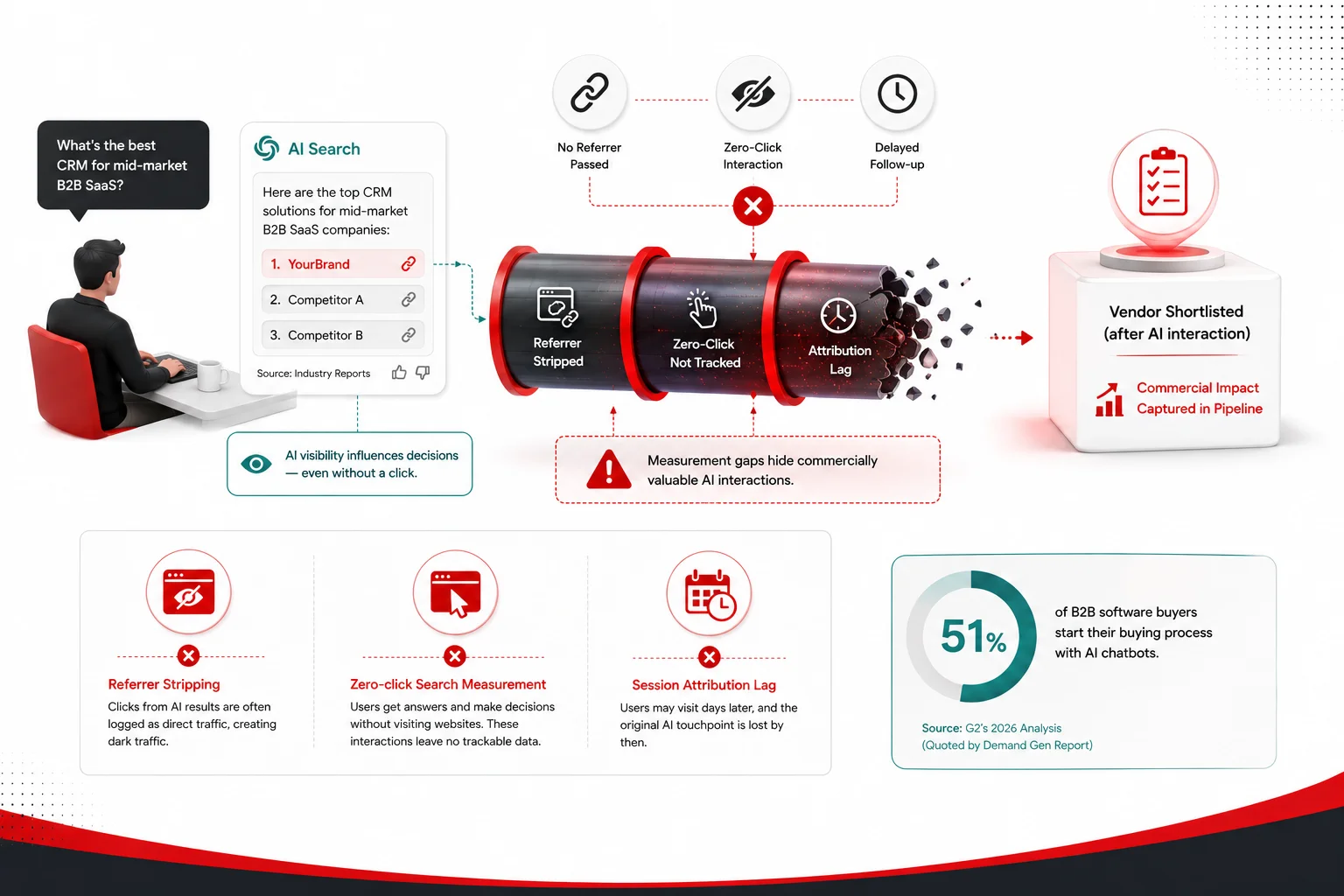
The following three reasons depict how AI search engines attribute traffic differently from conventional referral tracking:
1. Referrer Stripping
When the referrer header is unavailable, a click from an LLM response may be classified as direct traffic because the destination site might not always receive enough referral data to identify the original AI interaction. This gives rise to dark traffic in AI search.
2. Zero-click Search Measurement
The user might ask the AI search engine for a response and directly arrive at decisions without even visiting any vendors’ websites. As a result, these sessions generate very few trackable sessions, though they govern procurement decisions.
3. Session Attribution Lag
Despite discovering a vendor’s name in generative AI attribution models’ responses, the user might directly visit the vendor’s website after some days. By this time, the original AI attribution point is lost.
Beyond misattributed clicks, the commercially valuable measurement gap in AI search analytics for B2B teams lies in zero-click interactions. Although adding a vendor to the shortlist after seeing their name in AI-generated responses might not produce any clicks, sessions, or conversion events, AI visibility directly influences the pipeline.
What Metrics Matter in AI Search Optimization, and Which Are the Best KPIs for AI Search Visibility
Among different AI visibility KPIs, citation frequency is a commercially high-value metric, but it needs manual query monitoring instead of a standard AI-driven search analytics dashboard, which is why many marketing teams do not track it. B2B teams often track keyword rankings or organic traffic, but they hardly reflect AI search performance.
The hierarchy of generative engine optimization KPIs should travel from visibility to buyer engagement to pipeline influence. The following AEO KPIs and metrics function within the current attribution constraints:
| Answer Engine Optimization Metrics |
What It Tracks | How to Monitor KPIs |
|---|---|---|
| AI Citation Frequency | The frequency of the brand appearing in AI-generated responses targeting evaluation queries. |
Programmatically or manually check with Perplexity or ChatGPT with ICP evaluation queries, and monitor the brand mention rate monthly. |
| Structured Data Coverage Rate | The ratio of high-value pages with HowTo, Organization, or FAQPage schema implemented correctly. |
By using SEMrush Site Audit schema checker and Google Search Console Rich Results. |
| ChatGPT-attributed Sessions | Session volumes where ChatGPT appended the source parameter. | Use GA4 traffic source filter. |
| AI Search Share of Voice | The percentage of AI-generated category answers citing the brand against its competitors. |
Employ the same query monitoring process where competitors’ name-tracking is added. |
| AI-referred Direct Traffic Uplift | The change in direct traffic month-over-month following improvement in AI visibility. |
Use GA4 integrated with segment filtering for pages that receive AI referral. |
Using an imperfect measurement capturing the signal often outperforms waiting for a perfect attribution infrastructure that is yet to exist. The AI SEO measurement strategy that connects AI visibility to revenue outcomes instead of reporting a standalone awareness KPI often makes the measurement more meaningful.
Final Thoughts: How to Measure AEO Performance Step by Step, and How to Measure AI Search Visibility for B2B
Measuring brand visibility in AI tools needs a parallel tracking system that runs alongside the GA4 framework. AI search attribution B2B enterprises use should connect activity to pipeline influence and review KPIs monthly alongside conventional SEO metrics. The core objective is to identify if AI visibility creates a commercial edge.
Maturing AI attribution tooling will improve the measurement infrastructure, and B2B teams that employ this measurement practice regularly will extract AI-driven marketing intelligence faster than their competitors.
Marketboats can help you find how to measure visibility in generative AI answers by building a measurement framework that connects AI citations to revenue outcomes.
FAQs
1. How to track traffic from ChatGPT and AI tools?
Tracking UTM parameters, identifiable AI referrals, CRM outcomes, landing pages, and referral sources, and treating them as measurable referrals instead of total AI influence can help you track traffic from ChatGPT and other AI tools.
2. How to track zero-click search performance?
Monitor query coverage, brand mentions, AI citation frequency, and AI search share of voice, as zero-click interactions hardly produce any website sessions.
3. How to track AI-generated referrals?
Employ available UTM parameters, server logs, CRM attribution, and analytics referral data to compare referral data with AI visibility monitoring. This will help you identify a wider influence pattern.