
Instead of discussing the components of the AEO vs SEO vs GEO concept individually, B2B teams must optimize for all three simultaneously, because B2B buyers increasingly evaluate vendors through AI engines.
Most B2B teams devise their digital visibility strategy by investing only in SEO, which never boosts their visibility on AI overviews, ChatGPT, or Perplexity. HubSpot’s 2026 research finds that AI overviews have cut down organic CTR by 58%.
Queries that matter most are often answered via AI-generated responses, which is why SEO yields diminishing returns. Treating SEO, GEO, and AEO as concurrent streams that need separate content architecture is the best answer to how to future-proof SEO for AI search.
What Is AEO vs SEO vs GEO, and Why This Difference Matters to B2B Teams
Although SEO content demonstrates knowledge depth, AI information retrieval systems extract precision. A B2B team that is only SEO-equipped will often rank on Google but will hardly be seen in AI searches. Enterprises simultaneously optimizing for AEO, GEO, and SEO will be visible at every touchpoint.
The following table makes the GEO vs SEO vs AI search optimization debate clearer:
| Parameter | AEO | SEO | GEO |
|---|---|---|---|
| Definition | Answer engine optimization enhances direct answer retrieval. |
Search engine optimization improves webpage rankings. | Generative engine optimization increases AI-generated brand citations. |
| It Optimizes | Answer retrieval. | Position. | Citation. |
| Primary Platform | Perplexity, ChatGPT, or Google AI Overviews. | Bing or Google. | Copilot, Claude, Gemini, or GPT-4. |
| Unit of Retrieval | A verified specific claim. | A ranked webpage. | A mentioned entity. |
| Winning Content Format | Structured, question-answer format, or claim-specific. | Keyword-rich, comprehensive, and long-form. | Entity-consistent, cited, and authoritative. |
| Success Metric | AI citation frequency. | Organic traffic or keyword ranking. | Brand mention rate in AI-generated answers. |
How AEO Is Different From SEO
1. What Are the AEO vs SEO Differences in Terms of Content Decisions
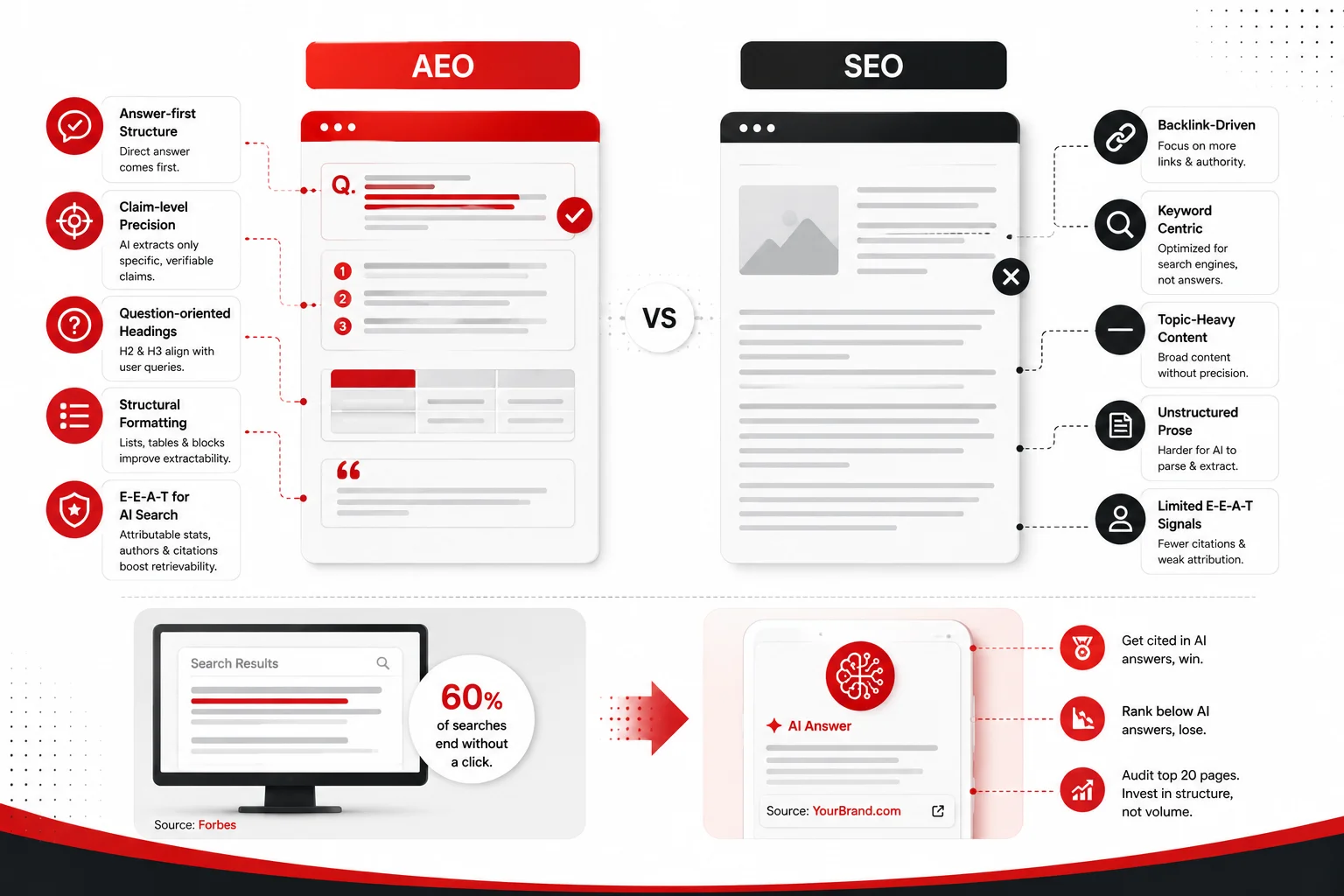
Reinforcing the content with more backlinks will never be the answer to how to rank in AI-generated answers. But restructuring the opening sentence of every section will become the best answer engine optimization strategy without substantial content investment, and this is where AEO differs from SEO:
- Answer-first Structure: Each section starts with a direct answer before explanation.
- Claim-level Precision: AI search engines only extract verifiable, attributable, and specific claims.
- Question-oriented Headings: AI engines retrieve from content whose H2 and H3s follow query-to-heading alignment.
- Structural Formatting: Numbered lists and tables can make the content more extractable in AEO.
- E-E-A-T for AI Search: Relevant and attributable statistics, named authors, and external citations boost retrievability.
2. Why Traditional SEO Is Losing Effectiveness
Zero-click search trends are causing traditional SEO to lose its effectiveness. According to Forbes, 60% of web searches end without a click. Those B2B enterprises that get cited in AI responses win, and teams that rank below these responses often lose.
Auditing the content of the 20 highest-traffic pages is the fastest response to this. Rather than volumetric investments, compounding AEO performance comes from structural investments.
How to Implement GEO Strategy, and What Is the Best Strategy for AI Search Visibility
Many B2B enterprises often dismiss generative engine optimization strategy, considering it too abstract to implement, creating an inclusion gap in LLM answers. Instead of direct citations or page rankings, GEO emphasizes entity and brand mentions within LLM-driven responses.
More than publishing frequency, AI citations arise from structured expertise. Here are three generative AI search optimization strategy decisions that build a better digital presence:
- Entity Establishment: Establish the brand uniformly across web platforms. It improves content discoverability, as AI engines build a uniform entity profile. It is equivalent to a backlinking profile in SEO, and it compounds over time, creating an edge that a single campaign can hardly replicate.
- Third-party Citation Building: LLMs retrieve citations from research firms, industry publications, or peer platforms.
- Structured Data Markup for Entity Signals: It enables AI engines to interpret brand information better.
Final Thoughts: How To Optimize for AI Search Engines in 2026
Simultaneous implementation of AEO, SEO, and GEO strategies is the ultimate response to content not appearing in AI answers, and it enhances visibility across all channels where B2B buyers actively evaluate vendors.
While SEO ensures discoverability, GEO emphasizes entity inclusion, and AEO drives answer retrieval. The Findability → Understandability → Citability framework offers a complete solution for how to improve AI search visibility.
B2B enterprises that aim to invest in answer engine optimization strategy should focus on three elements of their content architecture, including consistent entity signals, attributed claims, and precise answers. Teams that invest in this approach now will protect their pipelines against buyers increasingly relying on AI searches.
Marketboats can help you identify current challenges in AI search optimization and devise a suitable strategy for you that ensures better visibility across AI search platforms for your brand.
FAQs
1. Which is more important in 2026: SEO or AEO?
Both are equally important. While SEO enhances webpage discoverability, AEO improves visibility of B2B enterprises inside AI-generated responses. The ideal strategy must give equal importance to AEO, SEO, and GEO.
2. How do AI search engines rank content?
AI engines often match buyer intent and evaluate entity consistency, trusted citations, structured data markup, structured content, and topical authority to rank the content. They also analyze the clarity with which the content answers the user query rather than checking keyword placement alone.
3. How can B2B marketers adapt to AI search?
B2B enterprises can strengthen content authority signals, create question-based content, implement schema markup, publish original research, optimize content for both traditional search engines and AI retrieval systems, use comparison tables, and build consistent brand entities to improve their visibility inside AI search responses.