
Intent data for ABX pushes B2B teams to personalize engagement based on buying signals instead of assumptions. ABX programs that produce healthy pipelines feed intent signals into personalization engines at the right moment.
Most ABM teams build on the account list, run campaigns, and depend on the inbound confirmation signal of interest. However, by the time they observe any activity in the CRM, the buying group has already moved forward with competitors.
Businesswire’s 2024 report finds that by the time they engage with sellers, B2B buyers have already completed 70% of their buying journey. Buyer intent is visible long before form fills and direct outreach, narrowing the engagement window.
Intent data shifts this window upstream, where the decision-makers actively research problems, solutions, or vendors.
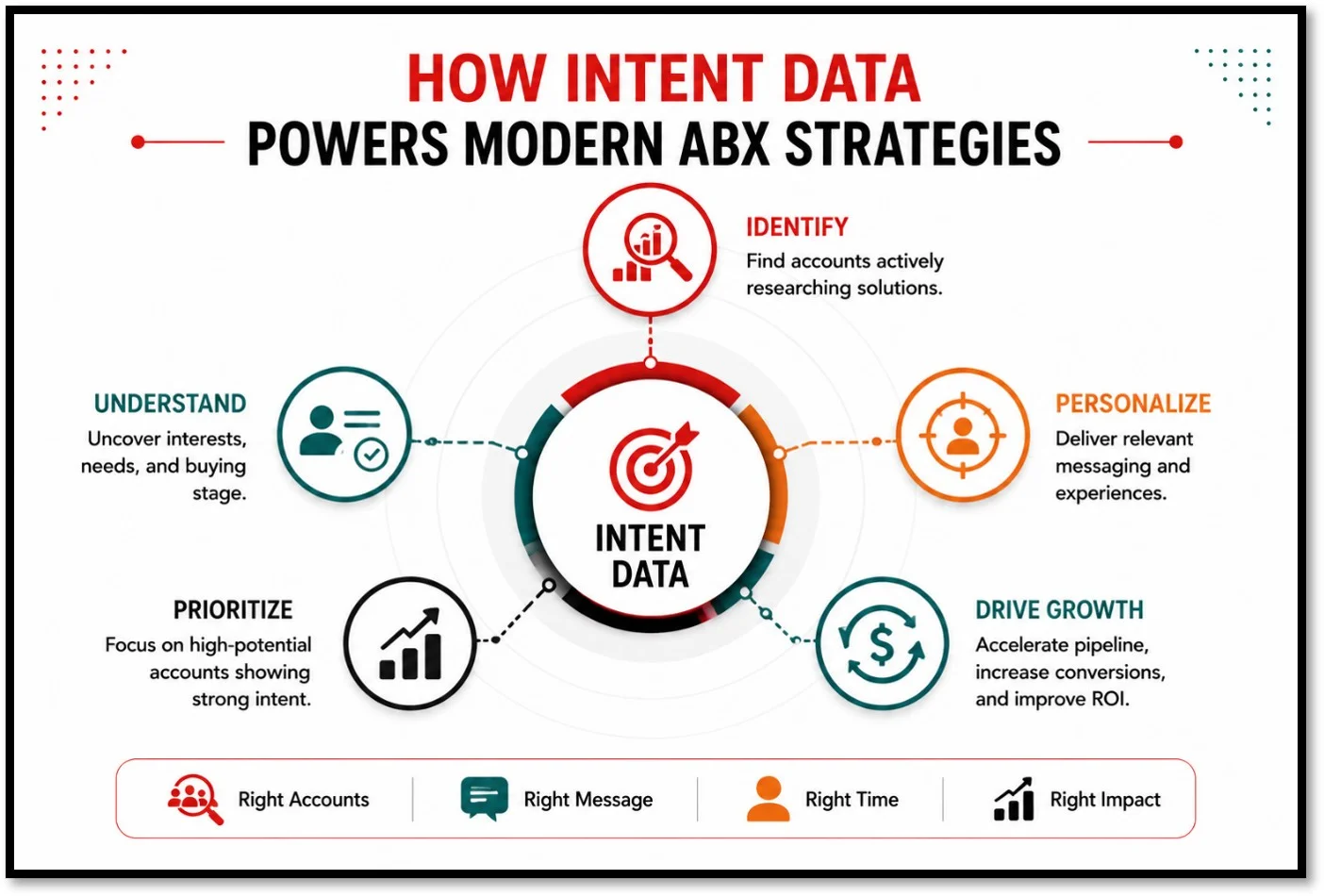
How Buyer Intent Data Powers Account-Based Experience
When buyer intent data shifts from isolated activity tracking to buying motion analysis, it becomes commercially valuable.
The first-party intent data layer explains account engagement with a company. It describes the existing interest through return engagement on the solution content, pricing page visits, or product comparison downloads.
Third-party intent data, on the other hand, measures competitive comparison activity, category research, and topic consumption across industry publications, indicating emerging account interest.
Neither layer is effective individually, but together they provide a complete account-level picture. On aligning experience with buyer momentum, the ABX framework succeeds. But static segmentation weakens the accuracy of personalization.
How Intent Data Improves ABX Campaigns Through Account Prioritization and Precision Timing
Intent data in B2B marketing adds value to the ABX framework through prioritization, more than personalization. The conventional ABX accounts list was built on ICP-fit criteria, which focused on the account’s buying capability.
Whereas intent data checks if the account is in the buying motion. The gap between these two fundamentally different questions is where ABX overspends.
The combination of the two layers produces a prioritization model, routing campaign spend and SDR time toward accounts that are in-market and fit. Industry reports find that B2B teams that use intent data report a 2x revenue growth and 70% higher win rates.
Experiences that are generic or personalized too early cause the ABX strategy to fail. Personalization becomes effective when tied to buyer context instead of persona assumptions.
How to Personalize ABX Campaigns with Intent Signals
Intent-based marketing is far more valuable than identifying in-market accounts, because it reveals account position in the evaluation journey. For instance, product-led messaging for accounts reflecting broad category research creates friction because the account is still framing the problem.
The correct engagement at this stage is achieved through educational content. Similarly, for accounts that reflect the combination of external research and a first-party pricing page visit, the right engagement is to address final-stage evaluation concerns like integration complexity, implementation risk, and commercial terms.
A personalized message that reaches an account at the incorrect buying stage makes it irrelevant. Intent-driven personalization is useful only when signals are contextualized. An activity that lacks progression creates noise.
How to Align Sales and Marketing Using Intent Data as a Shared Signal Layer
The disagreement between the marketing and sales teams about account readiness is where the ABX frameworks break down, as teams interpret buying readiness differently. Intent data for account-based marketing provides a shared and observable signal to eliminate disagreement.
The structural implementation of the framework starts by defining the intent threshold before accounts enter active buying motion. It ensures that the transition is more data-informed.
Going beyond lead records, providing sales visibility into the entire intent picture is the subsequent step. The lead record unveils the activity of one account, and the intent picture reveals the movement of the entire buying group.
Building a feedback loop is the last step, where the sales outcome against intent-qualified accounts refines the threshold over time. Intent data eliminates information asymmetry that strains the relationship, reducing friction across teams to improve sales and marketing alignment.
Final Thoughts: Identifying the Real-time Buyer Intent for ABX Strategies to Give B2B Teams a Competitive Edge
Modern ABX strategies focus on surfacing the correct signal at the right time and acting on it early enough to influence outcomes. Getting a competitive edge is more about understanding the buying momentum than chasing the account first.
The gap between the starting point of the buying motion and vendors identifying it will continue to widen with the growing buying groups and as anonymous research expands deeper into evaluation cycles.
Want to know which accounts in your target list are in-market and how to track them? Marketboats can help you carry out an ABX personalization audit and identify the current loopholes in your strategy.
FAQs
1. What are the best intent data practices for B2B marketing teams?
Integrate first-party intent signals with third-party data, emphasize accounts reflecting active buying momentum, and align sales and marketing around shared thresholds.
2. How to use intent data in B2B marketing?
Identify in-market accounts using intent data first. Then, focus on outreach timing, after which you can personalize engagement based on buyer-stage context.
3. How does real-time buyer intent for ABX strategies change the way campaigns are sequenced?
Real-time buyer intent ensures timing-based orchestration, shifting from static nurture flows to align with actual account buying progression.