
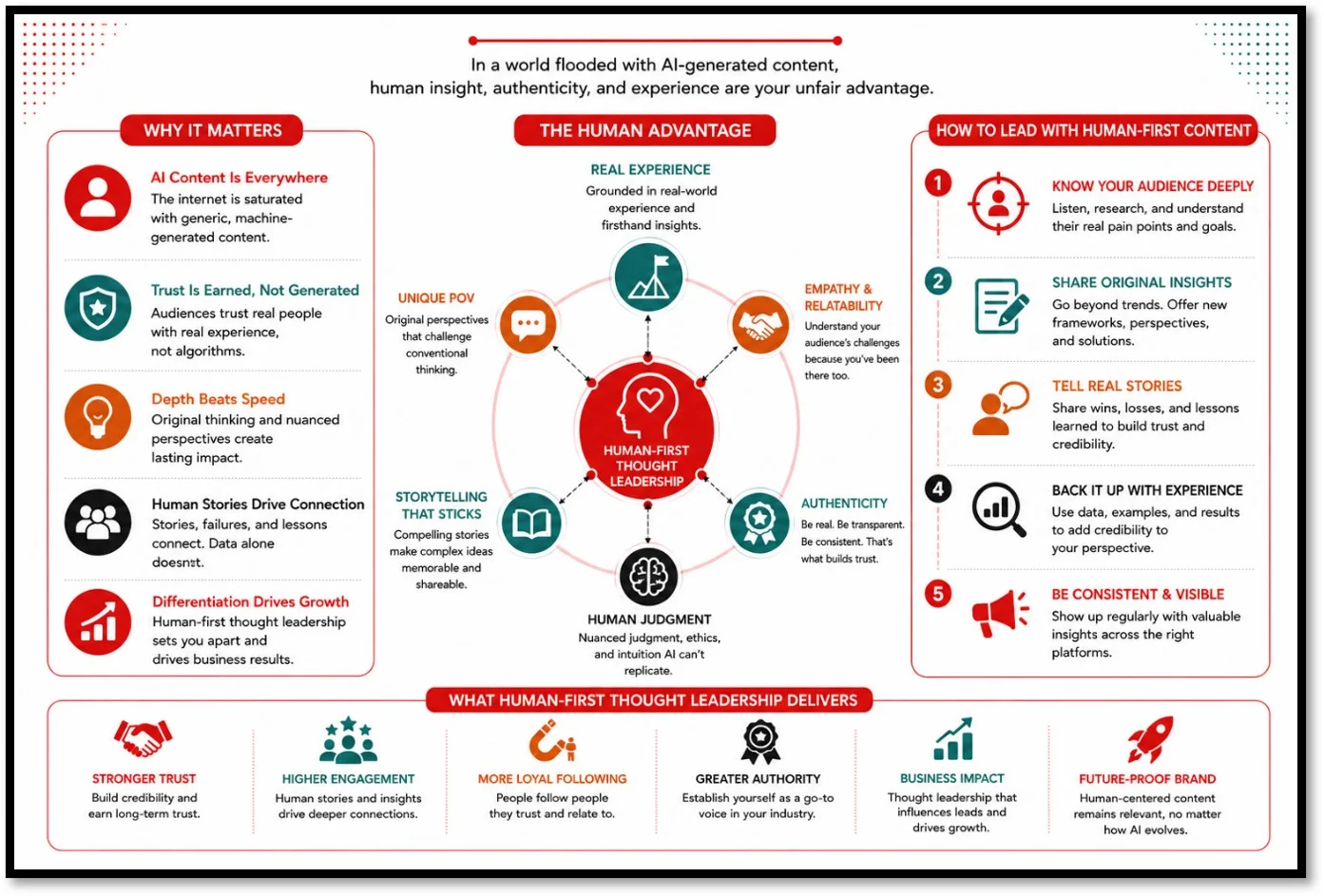
As AI-generated content scales, human-first thought leadership becomes more valuable, helping differentiate expertise from volume. Successful B2B teams are focusing on producing content that no AI engines can produce.
AI-generated content has created the problem of sameness rather than low-quality content production. Affinco’s 2026 analysis finds that nearly 76% of B2B marketers use AI-generated content.
As a result, the content itself never becomes the differentiator when every B2B team can produce well-structured and grammatically flawless content pieces in no time. It is the perspective and the human behind the content that become the real differentiators.
Although AI tools are excellent in scaling information, they fail to produce a live experience, commercial judgment, and conviction. This credibility gap reshapes how authority is formed.
Why AI-generated Content is Not Ranking and How the Credibility Gap Costs B2B Teams
Although AI-generated content covers a topic in-depth, is well-researched, and fluent, it fails because it cannot make a claim the reader trusts as earned. The content is neither tested against real accounts nor is it formed through experience.
Based on DigitalApplied’s 2026 analysis, content with the author’s bio can boost the webpage authority by 3x. Search algorithms have become capable of differentiating between real, attributable experience and assembled content.
EEAT in SEO (Experience, Expertise, Authority, Trust) surfaces this distinction. AI recognizes the pattern to approximate expertise, but it fails to produce epistemic authority, and this is the real problem.
What is Human-first Thought Leadership in B2B and How is it Structurally Different
Thought leadership in human-centric marketing is defined by the content that AI can never produce. This content is formed through direct experience, including a firsthand account of friction or failure, named specificity that arises from real-life situations, and a defensible perspective.
Beyond information access, interpretation provides more authority in the B2B content. All B2B teams have equal access to industry data, trend analysis, and research reports. The real differentiating factor is how the expert interprets the findings based on real-life experience.
Amidst the saturation of AI content, generic expertise collapses, and a new perspective can help B2B teams address the issue. However, the B2B content market has a shortage of perspectives, not the content.
All AI-generated content pieces reduce the signal value of existing articles, but the content that carries a perspective unavailable to AI models trained on generalized information resists this compression.
How AI is Changing Thought Leadership in Marketing
The obvious assumption that AI diminished the value of human-led content strategy is not true; in fact, the exact opposite is happening. The rising content quality floor raises the ceiling for differentiation.
Standout content now depends more on a human perspective than better research. As a result, storytelling in B2B marketing gains importance, where the story has friction, uncertainty, interpretation, and disagreement, along with the resolution to the problem.
Trust signals have pivoted toward perspective authenticity. While AI offers efficiency benefits, the human-first content provides credibility advantages that efficiency fails to buy, and these two serve different functions.
Apart from identifying the value of human signal, building the content strategy around it is where most B2B teams still struggle.
How to Build a Human-first Content Strategy in B2B Ecosystem
The fundamental decision in the human-first content marketing strategy is to identify the perspective holders in the company before plotting the topics. Subject matter experts in customer success, product, sales, or leadership develop perspectives through direct industry exposure that become content assets for the company.
Instead of covering topics that the company wants to cover, prioritize every thought leadership asset around a claim that the author wants to defend. The presence of a defensible argument is the real difference, as specificity increases authenticity perception.
AI must be used as a production layer, where it goes beyond researching, drafting, structuring, and editing the content, and the first-hand experience content brings named specificity and accountable POV in the picture. This collaborative model creates content that cannot be produced independently.
Final Takeaway: How to Improve Content Authenticity in the B2B Content Market
The B2B thought leadership strategy in the modern content market lacks perspective, more than lacking the content itself. B2B teams that curate human perspectives with clear content architectures to make them visible across different channels will build durable authority in the AI era.
The authentic human perspective will continue to gain more value as the AI-generated content volume grows. The future of thought leadership in AI era will belong to those with a recognizable perspective rather than focusing on scalable content production.
Want to know how you can develop perspective-driven content that no AI engine can replicate? Contact Marketboats and find out where you can bring your earned expertise in shaping the thought leadership.
FAQs
1. How to create authentic thought leadership content?
Develop your content to offer a firsthand experience, provide operational insights, and put forth defensible viewpoints that reflect real commercial decision-making, which can develop authentic thought leadership content.
2. How to stand out in AI-generated content market?
Include specificity in the perspective-led content while publishing, put forth clear opinions, and experience-backed interpretation rather than generalized summaries, which will help you stand out in the AI-generated content market.
3. Why human content matters in AI-generated content market?
Human content offers a live experience, possesses accountability, and interpretive depth that AI-generated content fails to deliver. As a result, human content still holds an important place in the content market.