
The future of B2B lead qualification will be more intent and account-level signal-driven, and will be built on revenue attribution. The model will move beyond form-filling. Measuring accounts’ readiness will matter more than measuring their activity.
MQL belongs to the era where one person’s one action through one handoff was sufficient to close the deal. The B2B buyer journey has moved past that time and now involves multiple decision-makers.
According to Forrester’s analysis, on average, one B2B deal involves 13 stakeholders. Each buying committee member brings a different perspective to the buying process, which increases its complexity.
Modern B2B buying processes require intent measuring over activity monitoring. MQL fails to predict the buyer’s intent.
Failure of data systems creates a revenue problem. It is an issue related to fragmented, missed, or delayed signals caused by the poor infrastructure. This is why moving beyond MQLs has become a necessity for B2B marketing.
Why MQLs Are No Longer Effective in B2B Marketing?
The traditional marketing model would score a contact if it downloads a whitepaper. It would then push the contact to the sales team, considering it as a qualified lead. But, in reality, the prospect showed curiosity, not intent.
MQL models never understand this difference. As a result, downstream systems, including pipeline prioritization and lead qualification, quietly break.
Beyond the nomenclature issue, the MQL vs SQL differentiation is about the definition of “readiness”. What marketing sees as ‘ready’ might be a non-qualified lead for sales. As per GTM 80/20’s analysis, only 13% of MQLs convert to SQLs.
More than a sales execution problem, low MQL to SQL conversion is due to an issue with the qualification system. If the lead is never worth pushing to sales in the first place, speed-to-lead becomes irrelevant.
These low-quality MQLs, despite being processed quickly, break lead routing as signals are weak and disconnected.
Fragmentation is another major issue. As customer success, sales, and marketing teams operate on different data streams, none of them can see the entire account picture. As a result, qualification decisions remain fragmented.
Why Sales Teams Don’t Trust MQLs? The Lead Quality vs. Quantity Trap
The emphasis on marketing qualified leads (MQL) volume ruptures the incentive structure. B2B teams only prioritize lead quantity and monitor webinar registrations, whitepaper downloads, or form fills. However, these metrics do not translate to the pipeline.
While the sales team wastes time disqualifying unproductive leads, marketing keeps on pushing quantity. Eventually, the pipeline is strained, and the discussion sticks to lead counts rather than striding toward revenue contribution.
Shifting to account-level engagement from individual lead signals is what will harmonize marketing and sales teams. If one contact downloads a whitepaper might be noise.
But when three contacts from a B2B team, including a VP, an IT manager, and the CFO, simultaneously attend a webinar, check for technical fit, and visit the pricing page, respectively, it is a signal worth acting on. However, when systems connect data in real time, only then does this become effective.
The Evolution of the Lead Scoring Model
The traditional model for lead scoring was a rule-based static system, which tried to cope with a dynamic reality. The modern lead qualification process, however, has evolved from rules to signals. It asks the buyers’ position in their journey instead of checking whether the contact opened an email.
This needs an engine built on real-time and connected data instead of a fragmented and batch-processed stream.
The machine learning lead qualification engine learns from historical conversions. It spots patterns like firmographic fit, timing that predicts sales opportunity, and behavioral sequences.
AI-driven lead qualification trends suggest that these engines simultaneously analyze different signals. They suppress leads that would clog the pipeline due to their misfit and push prospects that show real buying intent.
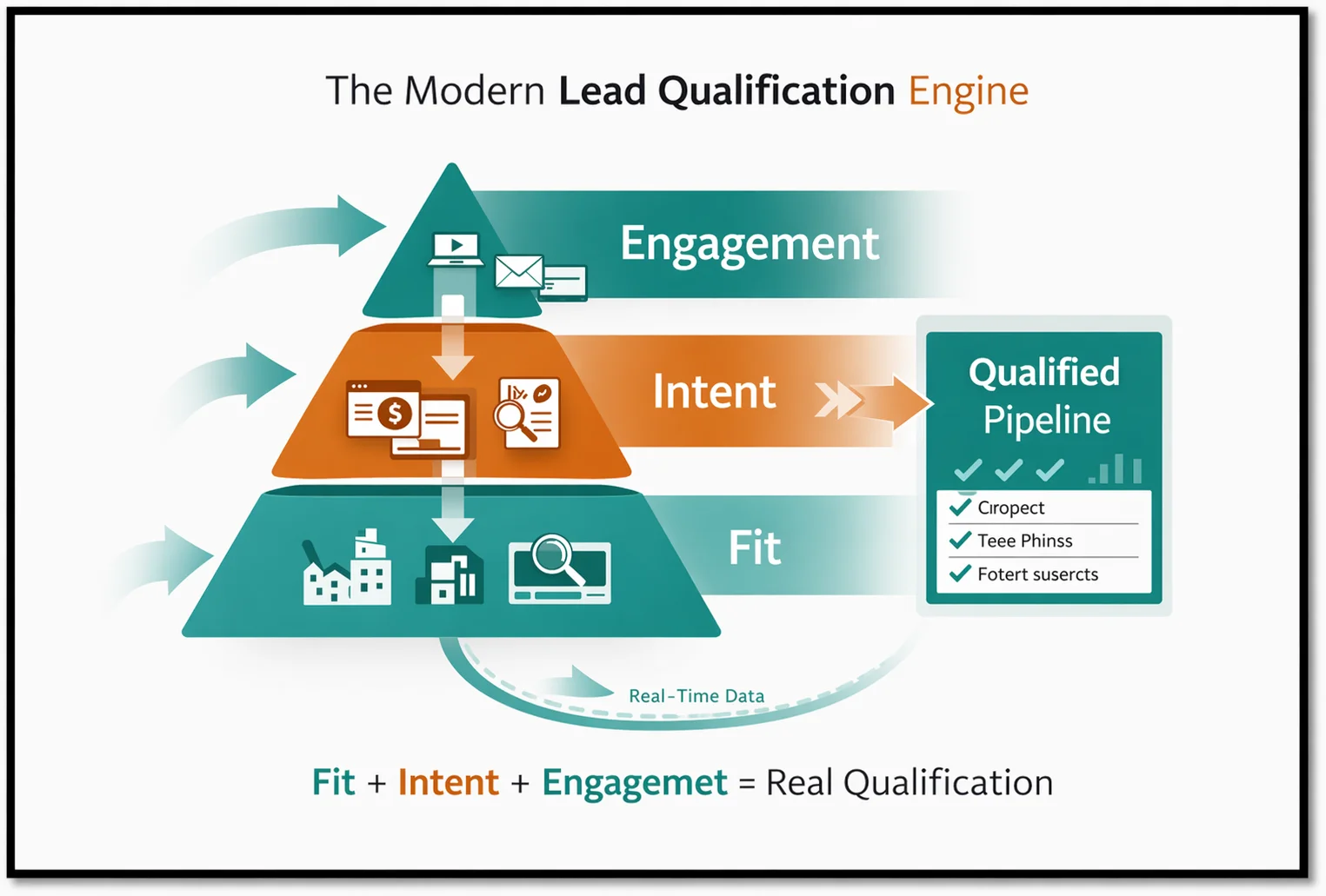
However, unified data forms the foundation for this shift to effectively work. Qualification becomes unreliable due to fragmented signals. As a result, reliance on just lead scoring is insufficient.
The data stack must evolve. If you do not shift to a scalable data architecture, you will receive incomplete signals, despite having an advanced model.
What Comes After MQL in Marketing?
The answer to the question of what MQLs should be replaced with lies in your go-to-market motion. Instead of relying on a single metric to replace MQL, B2B teams are developing layered qualification systems.
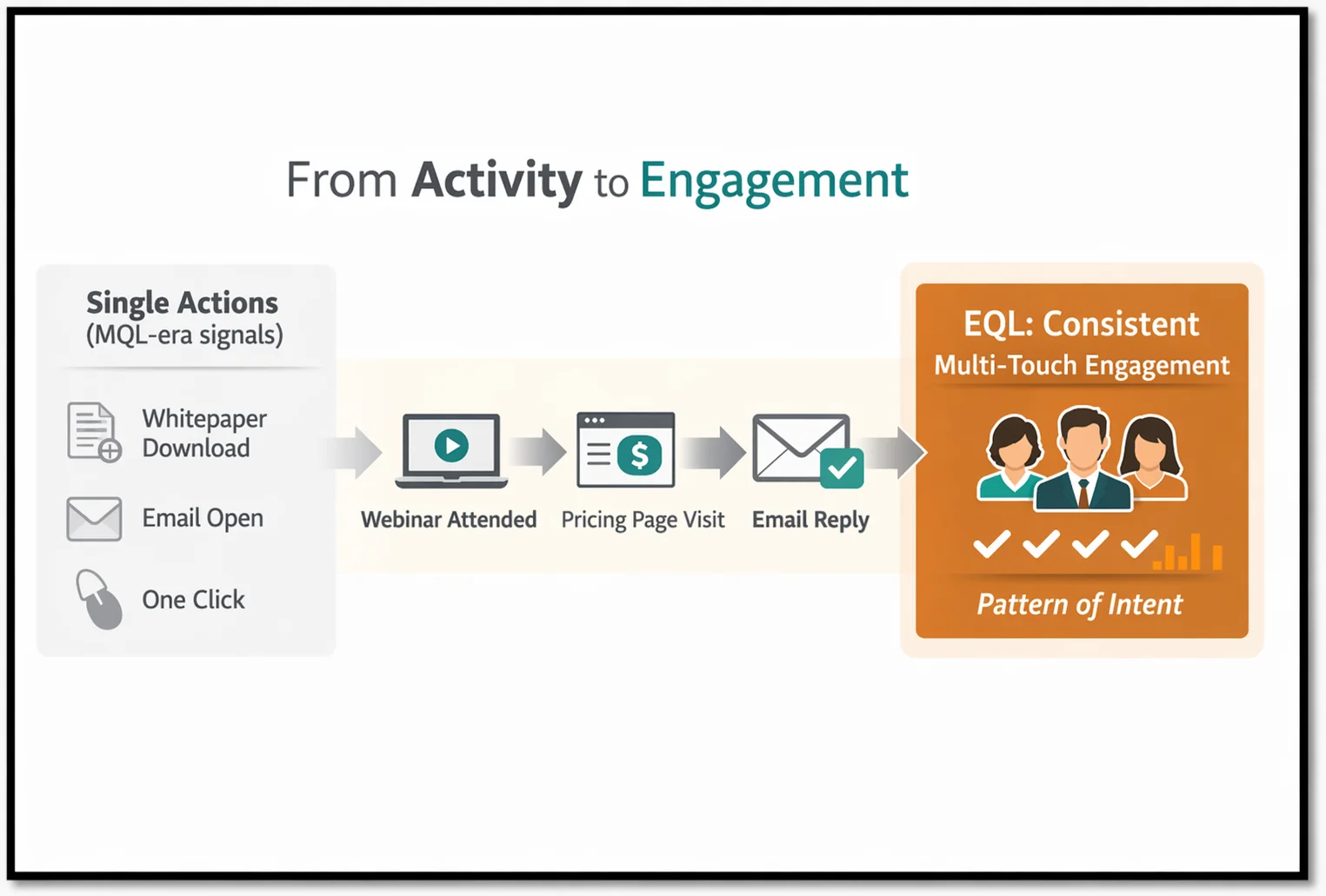
Engagement qualified leads (EQL) mark sustained and meaningful interactions across multiple touchpoints. It demonstrates a pattern of buyer interaction across touchpoints.
For instance, a buyer attending a webinar, followed by a pricing page visit, and a reply to a nurture email is a warm lead. Extending MQLs further, EQLs need behavioral consistency.
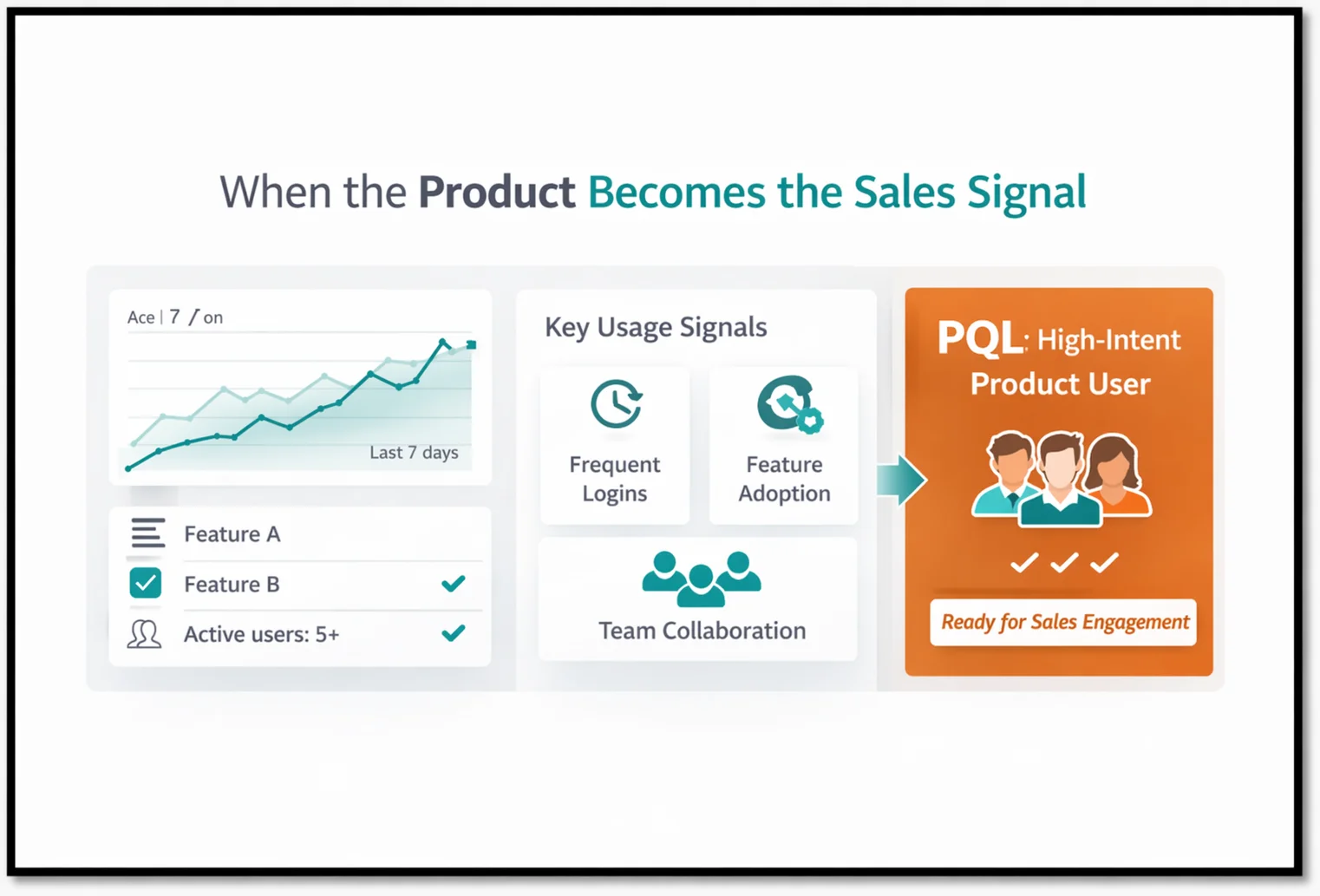
Product qualified leads (PQL) originate from data on product usage. The product itself directs the sales motion. Revenue qualified leads (RQL), on the other hand, demonstrate strategic fit and potential contract value of accounts.
To qualify a lead, MQAs prioritize the account over the individual. They need multi-stakeholder engagement, which is a key trend in modern B2B sales cycles, before handoffs.
MQL-based revenue attribution is slowly phased out to be replaced by pipeline contribution tracking. As a result, the process of qualifying a pipeline has become more about buying readiness. This is where intent data becomes crucial.
How Does Intent Data for Lead Qualification Contribute?
Buyers leave a trail even before they make the first move. The main challenge is signal visibility across systems. B2B teams fail to act on behavioral signals, including competitors’ content consumption, webinar attendance, pricing page visits, email replies, keyword research, and hiring trends.
The sales team can act proactively by reaching out to accounts that are actively researching the solution. This is the fix for poor MQL quality. Predictive lead scoring assigns a probability score to each account by integrating intent data with historical conversion data.
The AI lead qualification engine consists of three layers, including ICP fit, intent signals, and engagement depth. From cross-referencing technographic and firmographic data to filter out stale accounts, to tracking real-time account behavior, to prioritizing high-probability prospects, the engine makes a pivot from batch scoring.
This shift becomes frictionless when data pipelines assist real-time signal processing.
What Are the Best Lead Qualification Frameworks for B2B?
Make unified data the non-negotiable aspect of modern lead qualification frameworks. Without a single accessible view for CRM records, intent signals, product usage logs, and marketing scores, the downstream qualification decision, including routing, scoring, and prioritization, will remain incomplete.
Integrate dimensions like fit, intent, and timing into lead scoring criteria. Standing alone, fit aligns the account with your ICP. Intent provides insights related to buyers’ genuine interest in the solution. Timing checks for the presence of triggered events. Their intersection will help you build the pipeline.
Prepare a lead qualification checklist. This will include the ICP match, multi-stakeholder engagement, intent signal assessment, and buying stage clarity. At this stage, your sales and marketing teams must align on the definition of qualification.
Build speed-to-lead into the system. Delays in lead routing will hamper the conversion probability. However, the absence of accuracy will accelerate incorrect decisions.
Develop qualification workflows with consent frameworks and data privacy. Compliance as a growth lever is highly ignored in this context. Frameworks built with CCPA, GDPR, and sector-specific regulations offer a sustainable advantage to B2B teams.
Prioritize the evolution of your attribution model. Decisions related to budget allocation become smoother when teams can track campaigns, channels, and qualification signals that translate into closed-won revenue.
What is the Future of Lead Qualification in B2B?
Modern lead qualification is an infrastructural decision. Capturing data, how it is connected, and its activation are the factors that govern this decision. B2B teams that continuously target and route the correct accounts and time engagement with them have a decisive competitive edge through 2026.
B2B lead qualification trends 2026 will be about three core themes, including signal-based qualification, account-level engagement, and revenue attribution. They will replace form-fill-based qualification, individual lead tracking, and MQL-centric reporting, respectively.
The future will revolve around questioning the qualification infrastructure to ensure a predictable revenue flow. Modern qualifications will move beyond measuring a metric, changing the way how marketing will operate. The shift will be toward pipeline engineering from campaign execution.
Final Thoughts: Redefine Lead Qualification for Pipeline Impact
MQL was always a useful approximation for thinner data and a simpler buyer journey. However, moving beyond MQLs has become necessary due to complex buyer journeys, elongated sales cycles, and increasing buying committee sizes.
Winning B2B teams have already moved past the debate on MQL thresholds. Their qualification systems have embraced unified account views, intent data, revenue attribution, and predictive scoring. They are measuring qualified pipelines instead of qualified leads to generate revenue.
When connected data systems, unified account views, and real-time pipelines align, signal-based qualification becomes effective. Thus, rather than being a marketing issue, lead qualification is a system design-related problem.
Want to know where your qualification model is falling short? Book a 30-minute free demand strategy audit with Marketboats and check what is limiting your pipeline growth.
FAQs
1. Is MQL dead in B2B marketing?
Definitely not, although it is insufficient. Modern B2B marketers integrate MQLs with account-level qualification models and intent signals to reflect on pipeline growth.
2. What are the biggest challenges with marketing qualified leads?
As marketing-qualified leads emphasize engagement, they often ignore intent. They sideline the account context, produce a low conversion rate, and disrupt the sales and marketing alignment.
3. How to move beyond MQLs in B2B marketing?
Implement account-level qualification first. Then, employ intent data, followed by aligning sales and marketing teams. Lastly, deploy predictive models to focus on revenue impact.
4. Predictive lead scoring vs traditional scoring: what’s the difference?
While predictive scoring prioritizes AI for behavioral pattern analysis, traditional scoring emphasizes fixed rules. As a result, predictive scoring gives a more accurate qualification.
5. How AI improves lead qualification?
Artificial intelligence identifies intent signals, analyzes behavioral patterns, prioritizes high-value accounts in real-time, and predicts buying stages. As a result, it sends high-intent leads to the sales team, reducing the rejection rate.