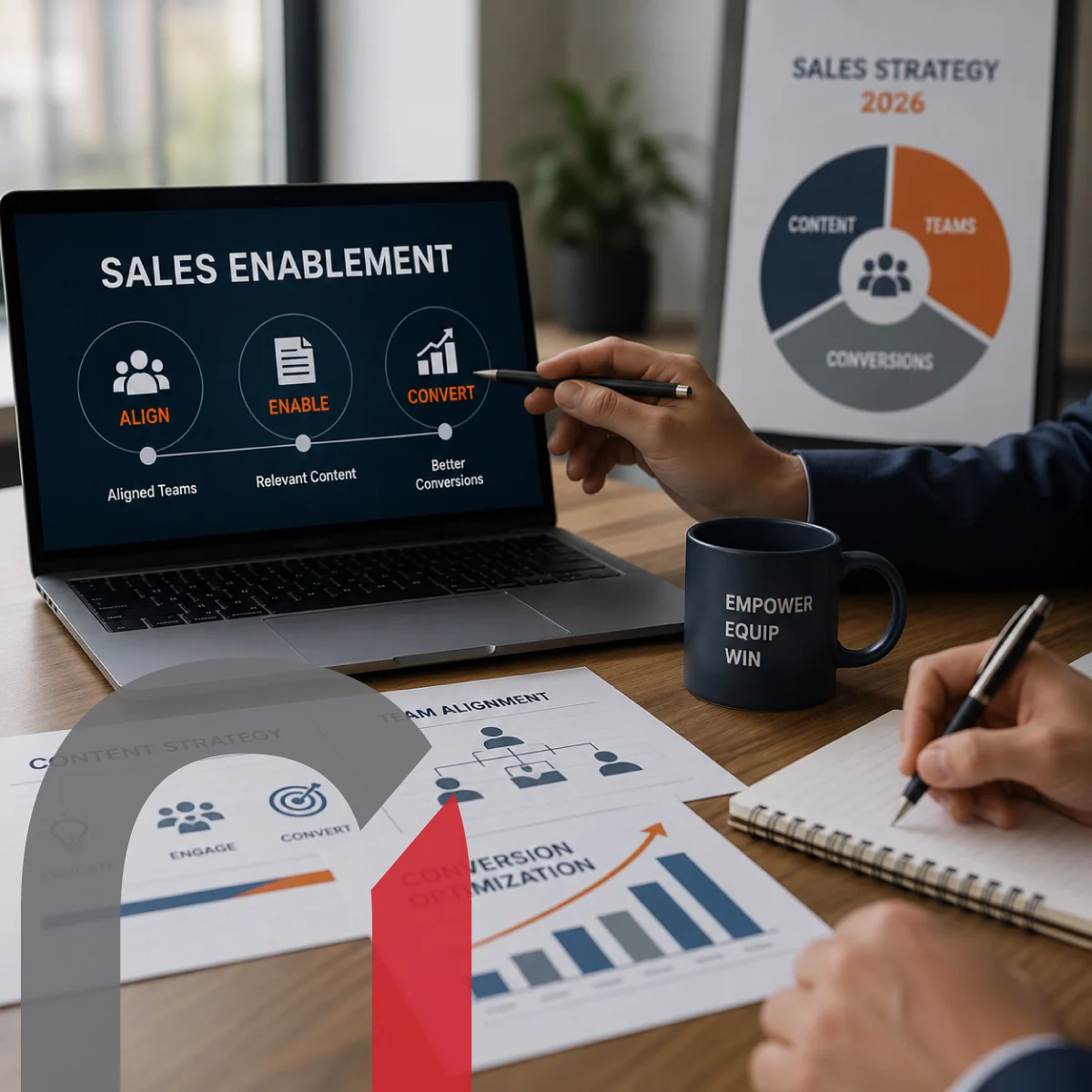
Sales reps using a B2B sales enablement strategy can enter every conversation with the right content at each buyer stage and real-time competitive intelligence, giving them a competitive edge in consistently closing deals.
Most B2B teams treat sales enablement content strategy as a content library project. Few teams actually use it, but the sales team keeps improvising in the field. Generating more content volume yields less sales enablement impact on revenue growth than the right content, delivered at the right time and mapped to the correct buyer stage.
When enablement programs solve the volume problem rather than addressing the mapping issue often fail. Substack’s 2026 research cites Forrester and SiriusDecisions’ findings stating that sales never use about 65 to 70% of B2B marketing content.
Instead of devising the sales enablement framework around more collateral, it should be designed around conversion friction across the buyer journey. A framework answering questions that B2B buyers have already researched, pushing opportunities forward, and challenging weak assumptions is commercially more valuable.
What Is a Modern Sales Enablement Strategy, and How It Differs from Traditional Methods
Modern enablement frameworks begin with customer journey alignment, mapping back to content and measuring forward to pipeline. However, integrating CRM and AI into a program that lacks stage-level content mapping causes enablement program failure.
Though AI in sales enablement is supposed to reduce reps’ research time, it should not automate the strategic judgement involved in a complex B2B deal.
Modern sales enablement best practices align the correct content with the right skill development and the correct technology to map a buyer’s position in their journey. While conventional enablement is optimized for more training, tools, and collateral, modern methods are optimized for relevance.
What Is the Difference Between Traditional and Modern Sales Enablement Strategy for Mid-market B2B Companies
The feedback loop is a key structural distinction between traditional and modern enablement models.
| Parameter | Traditional Enablement | Modern Enablement |
|---|---|---|
| Emphasis | Content volume, including training and collateral. |
Content relevance, such as deploying the correct asset at the appropriate stage. |
| Measurement | Production volume and content views. |
Sales cycle length, win rate by stage, and competitive win rate. |
| Content Approach | Marketing produces the content and distributes it across sales. |
Marketing and sales teams together create the content from a shared brief. |
| Marketing Involvement | Based on internal assumptions, the marketing team produces the content. |
The marketing team is a co-author alongside the sales department, and it reviews the performance monthly. |
| Role of Technology | Technology acts as a repository where it stores and delivers the content. |
Technology brings in intelligence, closing feedback loops, recommendations, and scores deals. |
Modern programs continuously enhance content creation and its deployment using information on deal outcomes and rep performance data.
How to Create Sales Enablement Content That Converts at Every Stage of the Buyer Journey
Distributing the correct asset to the appropriate conversation is the core objective of content mapping for sales enablement. As enablement content is easier to produce and measure at the awareness stage, most B2B content is produced at that stage.
Enablement content becomes commercially more valuable at evaluation and decision stages, yet many companies underinvest in both these stages. HubSpot’s research found that 76% of B2B teams observed increased sales by 6 to 20% due to sales enablement.
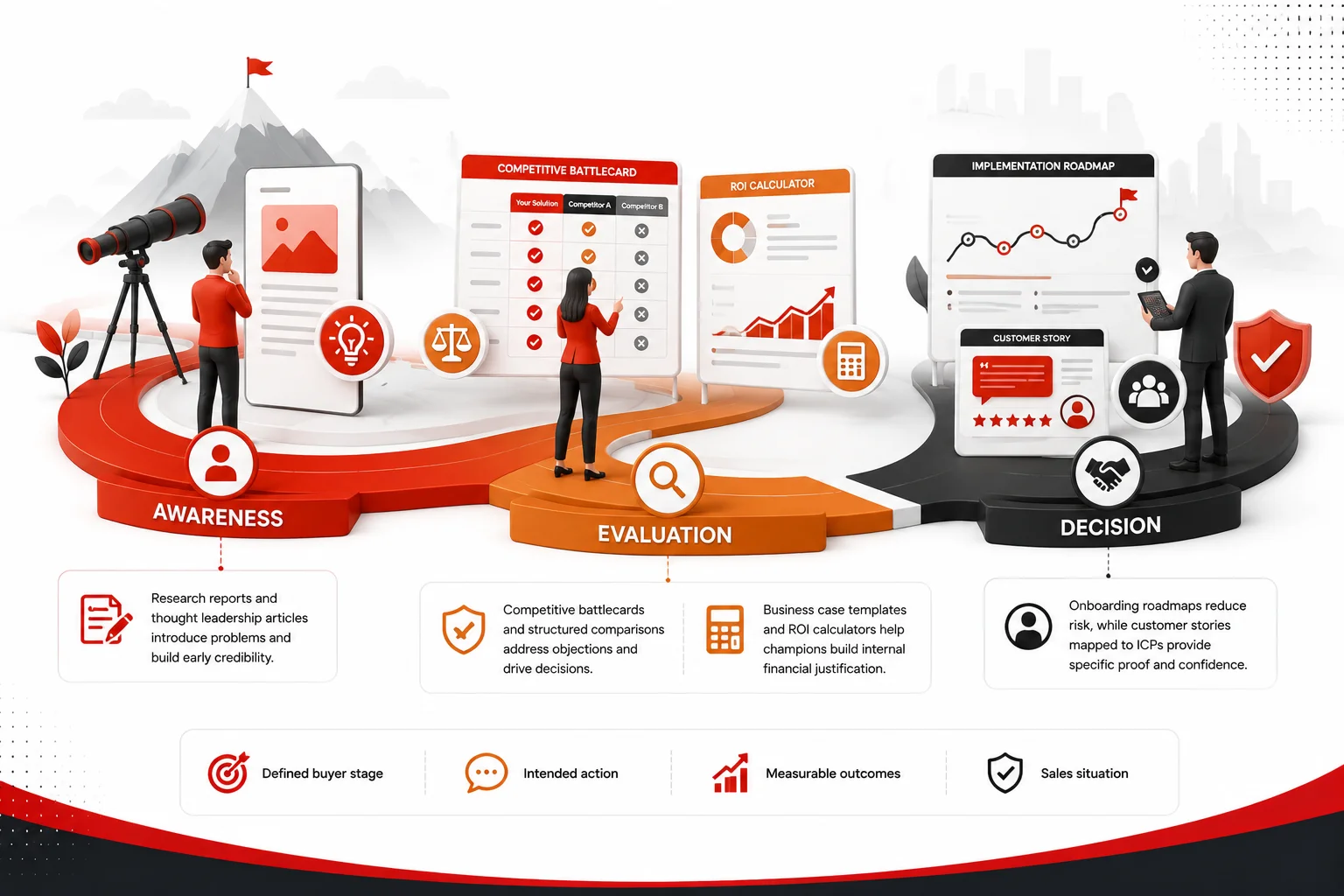
Here are different sales enablement content examples for B2B teams across three stages of the buyer journey:
1. Awareness Stage
- Research reports and thought leadership articles build credibility by introducing category problems before the conversation starts.
2. Evaluation Stage
- Competitive battlecards or structured comparisons using tools like Salesforce and Highspot help buyers analyze differences. As they address competitor objections in real time, they become valuable assets that can support the highest-ROI-generating sales enablement metrics.
- Business case templates and ROI calculators allow the champion to develop internal financial justification without sales’ validation.
3. Decision Stage
- Onboarding roadmaps and implementation guides reduce perceived risk.
- Customer stories mapped against ICP segments offer specific proofs rather than generic evidence.
A defined buyer stage, intended action, measurable outcomes, and sales situation are important prerequisites for every enablement asset.
How to Align Sales and Marketing Teams in B2B to Execute Enablement Consistently
Aligning sales and marketing teams is often a structural reform, which is why relying only on culture and communication will increase the probability of failure of these programs. While marketing demands better content, sales seek better leads, yet neither of them owns the entire buyer journey profile.
The following three structural decisions align marketing with sales:
- Shared Content Brief: Sales enablement planning begins at an enablement content brief co-authored by sales and marketing teams, and a lack of a shared brief produces inconsistent outcomes. It can transform sales-marketing collaboration from good intention into an operational standard, yet many B2B enterprises have not formalized the content brief alignment mechanism.
- Shared Feedback Cadence: Sales reps feed a monthly review report to the following month’s content brief about the content that moved deals forward and the content that did not.
- Shared Pipeline Definitions: For reducing handoff friction and improving pipeline conversion with sales enablement, marketing and sales functions must share common definitions of MQL, HQL, and SQLs.
Sharing the same conversion signals and buyer-stage definitions makes sales and marketing alignment commercially more valuable.
How AI Is Transforming Sales Enablement, and What Automation Delivers in 2026
AI-driven sales enablement strategy widens the gap between enterprises that have clean CRM data and stage-mapped content and B2B teams that don’t. AI enhances the content architecture and data quality it operates on, implying that B2B teams with a weak data foundation will produce less commercially valuable ROI on AI investment.
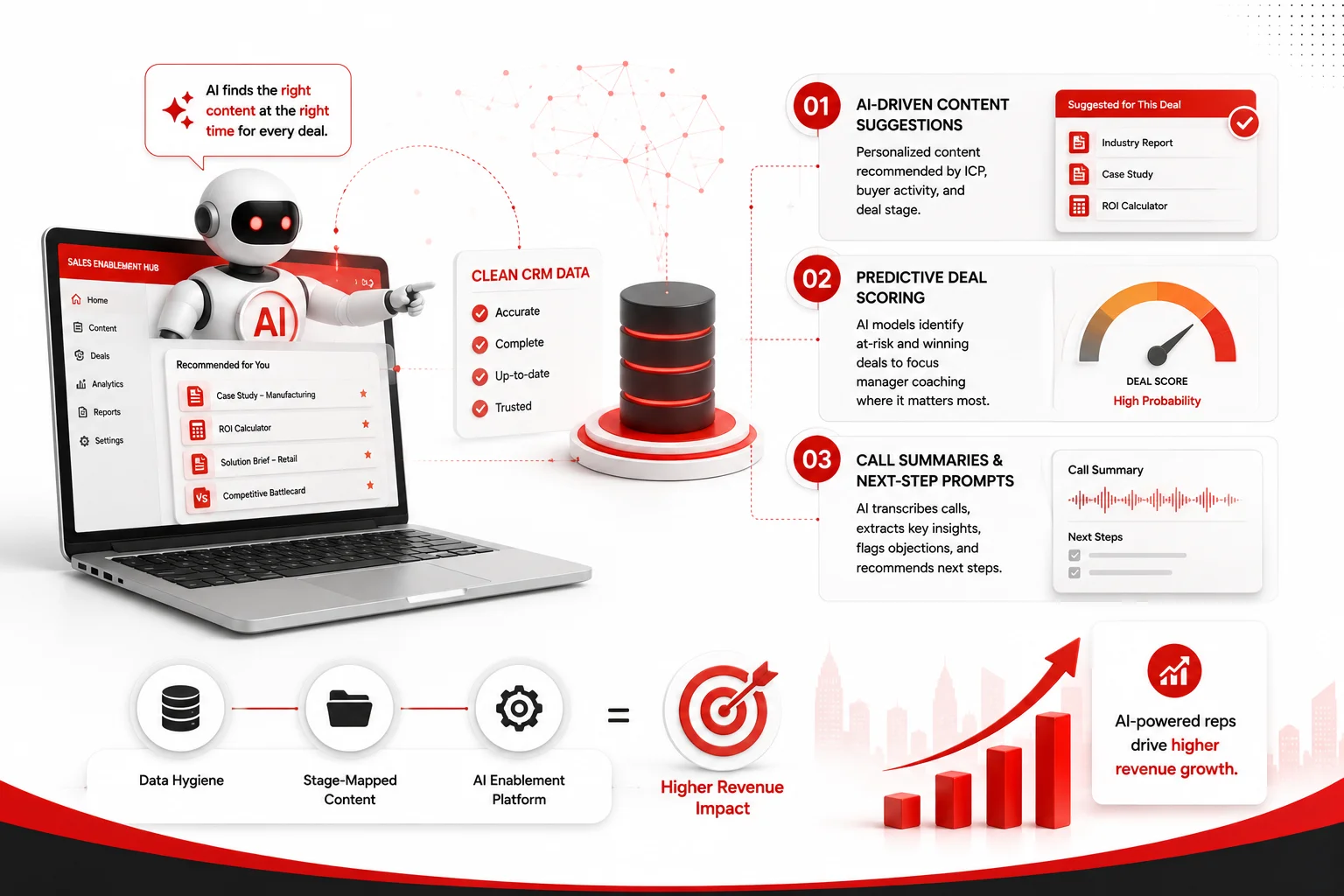
Beyond a recommendation engine, the revenue enablement strategy should make AI investment in CRM data hygiene. Here are three specific AI applications in sales enablement:
- AI-driven Content Suggestions: Sales enablement platforms, including Seismic and Highspot, surface relevant content tailored to ICP segment, recent buyer interaction, and the deal stage to eliminate manual search through libraries.
- Predictive Deal Scoring: Based on the historical CRM data, AI models can identify deals at risk and progressing deals. Predictive analytics in B2B sales enablement provides better commercial value because it emphasizes manager coaching time instead of uniform distribution across the pipeline.
- Call Summaries and Next-step Prompts: CRM and sales enablement integration using tools like Chorus and Gong helps reps transcribe and analyze sales calls to identify objections and suggest solutions.
According to IBM’s 2025 research, reps using AI-driven demand generation and enablement forecast 25% higher revenue growth. Investing in AI technology with no proper prior stage-mapping will only accelerate access to the wrong content.
How Sales Enablement Improves Conversion Rates and Pipeline
Many B2B enterprises report content views and production volume, but they measure activity instead of commercial value. However, measuring sales enablement ROI with metrics that connect enablement to revenue helps leadership evaluate investment decisions.
The following metrics analyze the effectiveness of the sales enablement process:
- Win Rate by Stage: It identifies where the pipeline leaks and which content is missing at that stage.
- Content Engagement Rate by Stage: It monitors B2B content for sales enablement that reps use, and based on the gap between the used and ignored content, a directional signal is produced for the subsequent content brief.
- Sales Cycle Length: Effective enablement reduces stage friction to curtail cycle length.
- Competitive Win Rate: It measures the commercial value that positioning content and competitive battlecards have produced.
- Ramp Time for New Reps: It directly tracks sales training and onboarding
To gain executive credibility, the measurement model should progressively traverse from usage to behavior to commercial outcome instead of jumping from content activity to revenue attribution.
Summary: What Is the Future of Sales Enablement in 2026 and Beyond
B2B enterprises treating sales enablement as a commercial framework rather than only a content function will govern its future. Every iteration improves when stage-mapped content, structured sales-marketing alignment, AI-powered delivery, and metric-connected measurement work together.
However, programs that emphasize measuring ROI of sales enablement programs based on content volume production will fall behind. The gap between B2B enterprises using stage-mapped content and clean CRM data and those ignoring them will continue to widen as predictive analytics and AI-powered recommendations mature.
Marketboats can help you find answers to how to build a B2B sales enablement strategy in 2026 and develop a sales enablement system that connects alignment, conversion measurement, and content into a single commercial engine.
FAQs
1. How to build a sales enablement strategy?
The first step in building a sales enablement strategy is identifying revenue bottlenecks and buyer journeys. Connecting the content is the next step, while training, workflows, technology, and gap measurement follow.
2. Why is sales enablement important in 2026?
Consistent seller execution has become immensely important in 2026. Productivity pressure, AI adoption, self-directed research, and complex buying groups further increase its complexity, which can be addressed using effective sales enablement.
3. How do you measure sales enablement success?
Sales-cycle length, win rate, conversion, opportunity progression, ramp time, and quota attainment are key outcomes that measure the success of sales enablement.
4. What tools are used for sales enablement?
AI applications, enablement platforms, coaching tools, content management systems, conversation intelligence, and CRMs are some tools that support and monitor sales enablement.
5. How to align sales and marketing teams effectively?
Creating a shared definition of buyer stage is the fundamental step in this alignment. Establishing content ownership is the next step, followed by defining feedback loops and pipeline goals.