
Beyond focusing only on sales enablement content volume, B2B teams that efficiently create pipeline impact in 2026 map the correct content to the right buying stage at the right time. Many B2B teams overproduce awareness content while underinvesting in the evaluation and decision stages, where buyers need evidence to move forward.
A large content library can still create friction when assets are not mapped to specific sales situations or buying stages. Reps may struggle to identify the right asset when they need it. According to TeamSlide’s 2026 research, as reps spend more time finding the right asset, sales teams never use 65% of the sales content.
Enablement content mapped to a specific sales situation, desired outcome, or buyer stage is far more valuable than content shared in a folder. The best content for B2B sales conversions answers buyers’ questions at the stage where the deal currently sits.
What Are the Sales Enablement Content Types That Map to Each Buyer Stage
Buyers at the awareness stage rarely make vendor decisions, yet B2B teams often produce more ToFu content than content designed for evaluation and decision-making. More commercially valuable content closes deals at the evaluation and decision-making stages, yet many B2B teams underinvest in them.
The following three-stage map offers a roadmap to build the B2B sales enablement content strategy:
| Buyer Stage | Sales Enablement Content Types |
Commercial Purpose |
|---|---|---|
| Awareness | Explainer videos, research reports, educational blog posts, and thought leadership articles. |
The customer education content reaches buyers before they evaluate vendors, establishing credibility. |
| Evaluation | ICP-mapped case studies, ROI calculators, and competitive battlecards. |
The lead nurturing content addresses buyers’ comparison queries and objections while they actively build a shortlist. |
| Decision | Onboarding roadmaps, compliance documentation, and implementation guides. |
The onboarding content for sales reduces perceived risks that can block the final sign-off. |
When marketing builds content libraries without sales inputs, they often overlook security and compliance documentation, which often becomes critical at the decision stage of the buyer journey. Instead of building content mapping for sales enablement around content categories, build it around deal stages and buyer questions.
What Are the Best Examples of Sales Enablement Content for B2B Teams That Convert Deals
Generic case studies rarely give buyers enough evidence to judge whether the outcome applies to their situation. That limits their ability to influence conversion. Stronger case studies for sales enablement directly answer buyers’ questions about the problem, context, and expected outcome.
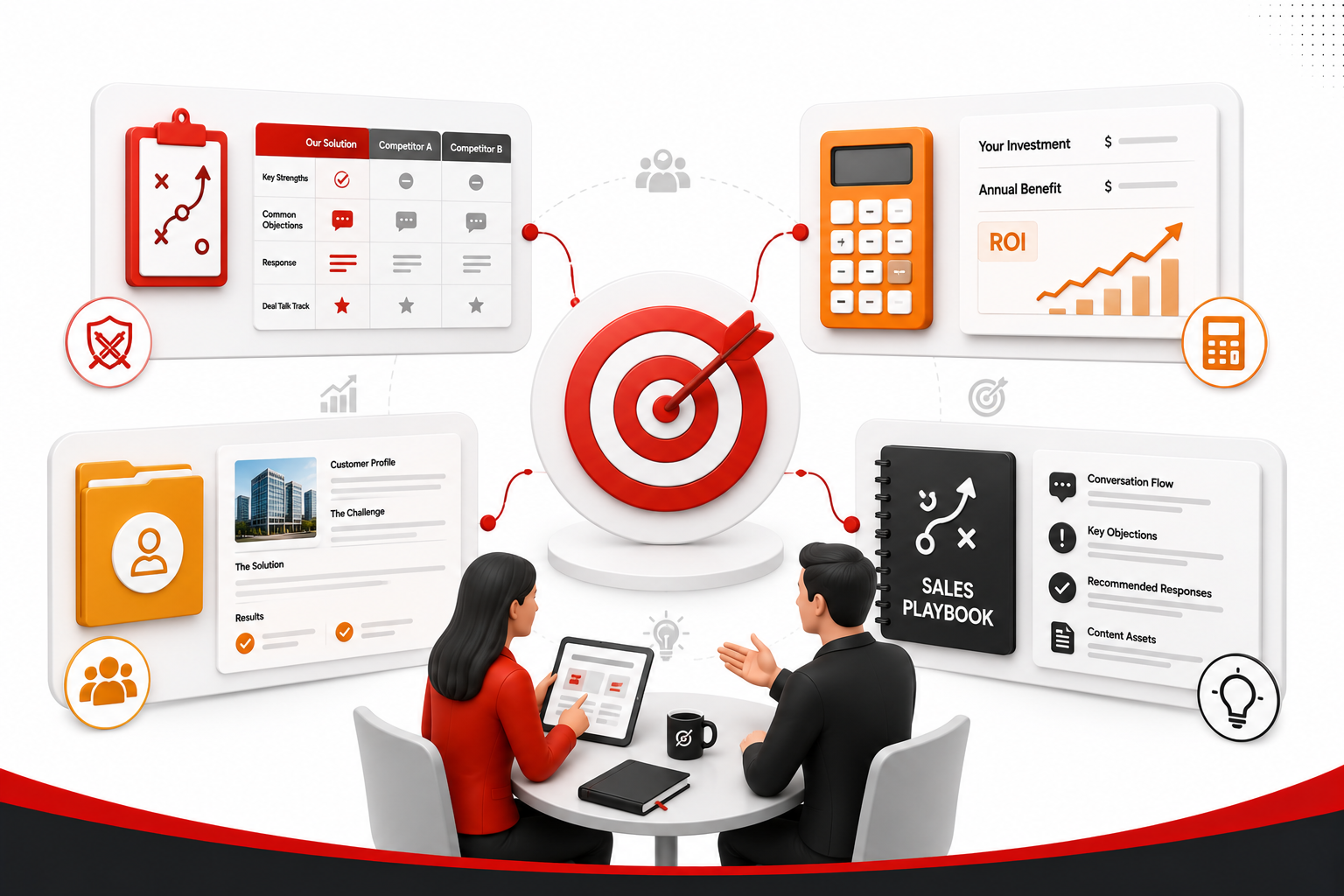
The following sales enablement content types can have the highest conversion impact:
1. Competitive Battlecards
Competitive battlecards give reps a concise comparison of competitor positioning, differentiation, and common objections. Building the battlecard around competitor objections that appear in the majority of stalled or lost deals is the first step.
Rework’s 2026 analysis cites Gartner’s research stating that reps using updated battlecards win 23% more competitive deals than those who don’t.
2. ROI Calculators and Business Case Templates
These interactive tools allow the champion to quantify the financial case without the rep’s intervention, and the deal can move faster. This is because less effort is needed to build internal consensus.
3. Customer Case Studies
Strong case studies or whitepapers for B2B sales give buyers enough context to recognize their own problem, constraints, and potential outcome without having to make the connection themselves.
4. Sales Playbooks Content
Sales playbooks transform institutional sales knowledge into a repeatable execution framework rather than depending on individual judgments, and reduce ramp time.
How to Build a Sales Enablement Content Strategy
Most content audits focus on whether teams have enough assets. The bigger commercial gaps are often stage-specific. The following structural decisions transform the B2B sales content strategy from a content library to a stage-mapped enablement system:
- Content Audit Against the Stage Map: Identify gaps in the sales enablement content framework by checking whether the required asset exists, is relevant to the ICP, is useful to the buyer, and is being used by reps.
- Rep Feedback Loop: Run a monthly review where reps identify which content helped move deals forward, creating a field-evidence-based content strategy for B2B sales teams.
- Content Distribution by Deal Stage: Make stage-relevant assets easy for reps to find within the tools and workflows they already use, such as Salesforce or HubSpot. Content for sales enablement that reps cannot find at the moment of need will underperform, regardless of how strong the asset is.
Key Takeaway: How to Create Sales Enablement Content That Drives Measurable Pipeline Impact
The best sales enablement content for B2B companies creates pipeline impact when it is rep-tested, distributed at the moment of use, and mapped to the right stage. Most enterprises already have more sales content than their reps can realistically use. The bigger opportunity is improving how that content is mapped, surfaced, and validated.
The practical starting point for building the best content for closing B2B deals is a buyer-stage content audit. Marketboats can help you perform this audit and identify existing gaps in buyer journey mapping.
FAQs
1. What are the types of sales enablement content?
Sales playbooks, case studies, ROI tools, competitive battlecards, implementation guides, comparison guides, and thought leadership are some important types of sales enablement content.
2. Why is sales enablement content important?
Sales enablement content offers sales representatives relevant evidence for buyer-specific situations, supports internal champions, pushes deals forward, and helps reps handle objections.
3. How to create sales enablement content?
Start by mapping content to buyer stages and recurring deal objections. Then build assets around those situations and validate them with sales before scaling production.