
B2B buying groups rely on peer communities, colleague networks, or AI search to build their vendor shortlist before contacting reps. Forrester B2B Forum EMEA 2026 highlights how buyer-controlled journeys, AI-driven search, and digital discovery are creating visibility gaps for traditional GTM teams.
Single-contact lead generation can misinterpret a single stakeholder’s engagement as an account’s buying intent. Forrester’s 2026 research finds that B2B buying committees involve 13 internal and 9 external decision influencers.
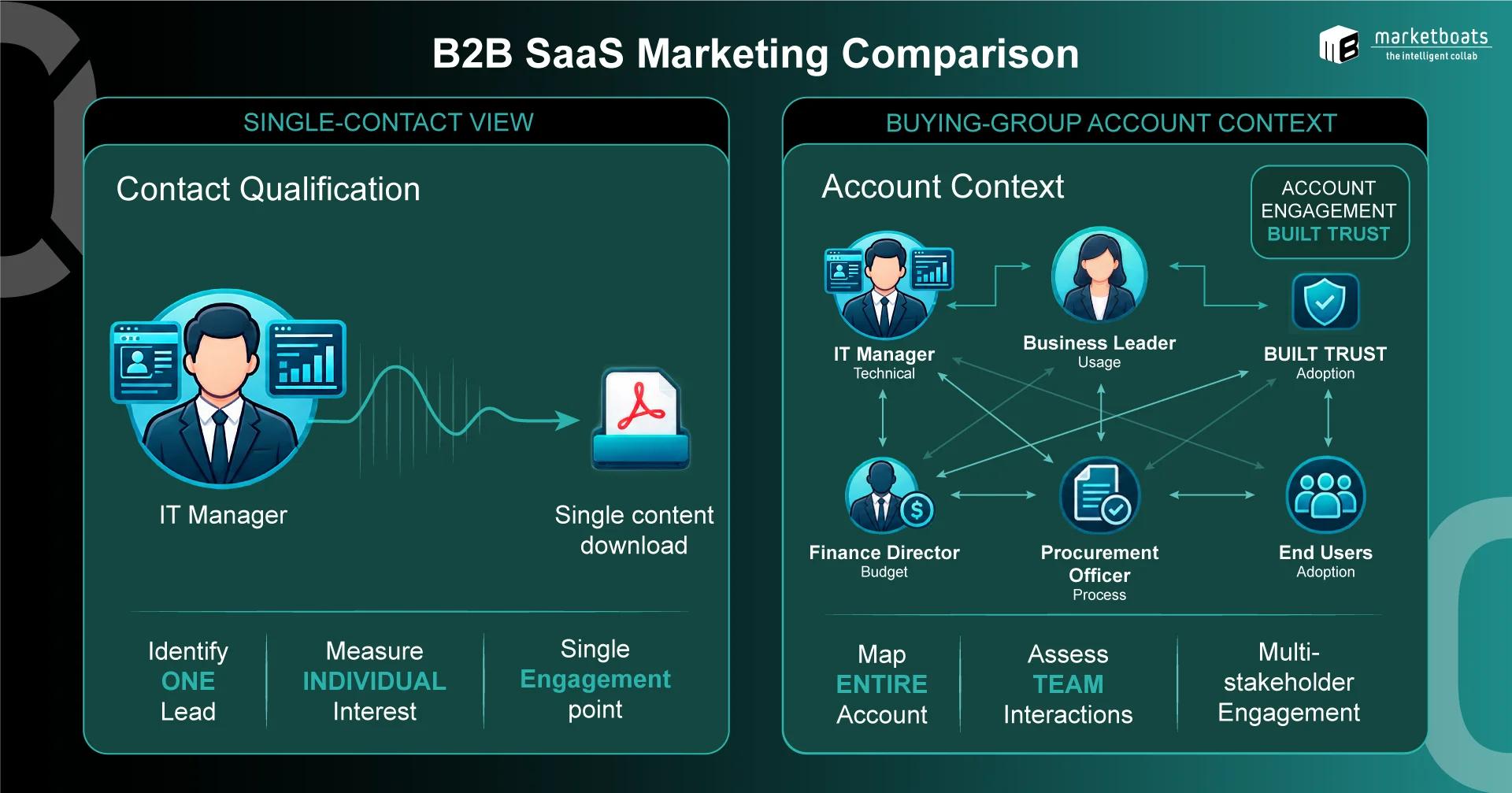
A single qualified contact can be a data point, but multiple relevant stakeholders suggest stronger evidence of account-level buying activity. While many B2B teams count MQLs, modern buyers build their shortlists, and enterprises that show up where buyers are actively researching often make the shortlist.
How Do B2B Buyers Build a Vendor Shortlist?
B2B buyer shortlists form through four channels, including peer communities, industry networks, internal colleague recommendations, and AI search tools. These shortlists can begin forming before buyers click on the website, but many demand-gen measurement frameworks monitor clicks.
The following aspects have changed the buying journey:
- Visibility Becoming a GTM Challenge: The vendor selection process happens via review platforms, AI search, or analyst content, and your website is only one part. Buyers can form opinions before visiting. Demand gen that ignores these channels often competes for accounts that have already chosen.
- Converging Brand and Demand: Brands influence shortlists when buyers form opinions before contacting a rep. As a result, treating demand and brand as separate entities may create a measurement gap.
- Authority Supersedes the Brand Page: Marketing cannot build that authority through brand pages alone, but it needs to bring voices of subject-matter experts, executives, or practitioners who shape the brand’s perception in the market to build a consistent POV across multiple research touchpoints.
- AI-powered B2B Buying: While buyers use ChatGPT or Gemini for vendor evaluation, marketers need to know how brands are positioned across AI-driven research journeys.
How Do B2B Buying Groups Make Purchasing Decisions?
B2B buying decisions often happen through parallel evaluation, where each function evaluates the same solution against different criteria, and no single stakeholder represents the entire committee’s buying readiness.
A contact meeting all ICP thresholds might not generate pipeline when the account context does not reflect broader evaluation activity. B2B lead qualification can never rely on a single contact’s activity. According to Gartner’s 2025 research, buying groups reaching consensus are 2.5x more likely to experience a high-quality deal.
How B2B Buying Committees Create Vendor Shortlists
| Buying Committee Role | Primary Concern | Typical Research Inputs |
|---|---|---|
| Business Leader | ROI and commercial impact. | Executive briefings and outcome-driven case studies. |
| Technical Evaluator | Ease of integration, capabilities, and security. | Security whitepapers, integration documentation, and technical architecture guides. |
| Finance | ROI justification and TCO. | Pricing comparisons and ROI calculators. |
| End User | Adoption curve, workflow fit, and usability. | Product walkthroughs and peer reviews. |
| Procurement | Vendor requirements, risks, commercial terms, and pricing. | Pricing frameworks and vendor compliance documentation. |
Every function’s activity demonstrates a different signal footprint, and combining them around an account can show B2B buying group intent more accurately. B2B teams should therefore check whether they are reaching contacts within an account who can influence the buying decision.
How to Measure B2B Buying Group Engagement
Account-level signals, including cross-functional engagement, consumption of role-specific content, engagement velocity, and handoff context quality, can measure B2B buying group engagement.
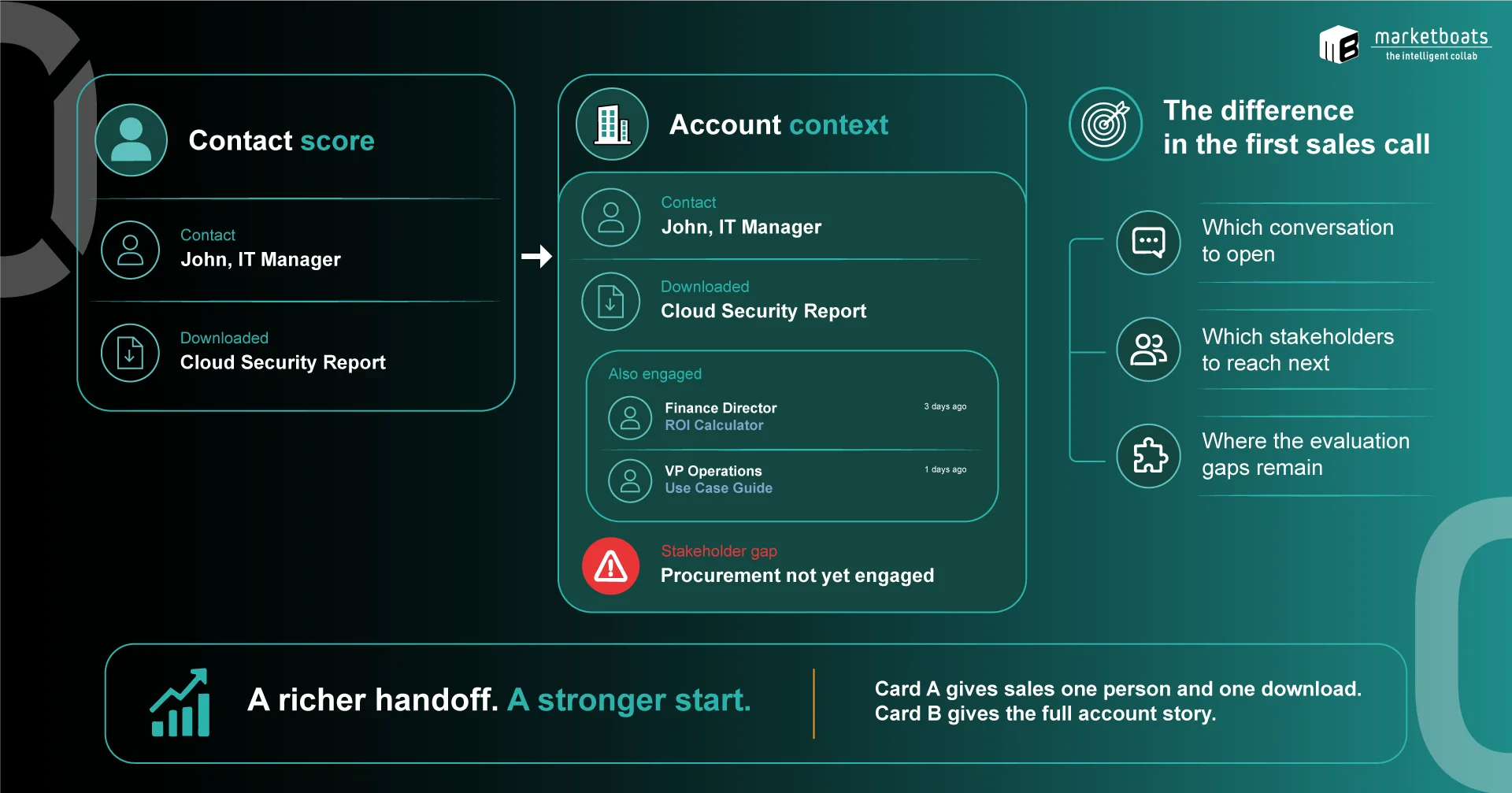
Account-level integration of MAP and CRM can make these signals observable, but many marketing automation programs are rarely configured this way, creating a measurement gap.
| Account-level Signal | What It Reflects | Commercial Outcome |
|---|---|---|
| Cross-functional Engagement |
Multiple functions from the same account engage with relevant content. | Buying signal |
| Role-specific Content Consumption |
While the CFO reviews the ROI calculator, the technical evaluator checks security documents. | In-progress parallel evaluation. |
| Engagement Velocity | The speed at which new stakeholders from the same account engage. | High velocity can signal active evaluation. |
| Handoff Context Quality | The proof of multi-function engagement. | Produces better context before the first sales conversation. |
A high-scoring MQL with no broader engagement may provide less evidence of buying-group activity than a low-scoring contact whose account’s functions engage at multiple stages. B2B teams should feed this context into their lead-scoring models to support better pipeline decisions, and this is how to improve B2B lead qualification.
Final Thoughts: What Are B2B Buying Groups for Lead Quality and GTM Strategy in 2026
Rather than reflecting only individual contact engagement, a qualification model that shows account-level buying activity improves B2B lead quality.
A handoff that provides account context, rather than a contact score, can give sales stronger context for the initial conversation, and B2B enterprises that adapt their GTM visibility, measurement, and content strategy to these realities can gain a pipeline advantage.
Contact Marketboats to learn how buying groups improve B2B lead quality and build a B2B buying group marketing strategy to generate account-level qualification signals.
FAQs
1. How can marketers measure buying group engagement?
B2B enterprises can measure buying group engagement by tracking cross-functional engagement, account context at handoff, engagement velocity, and role-specific content.
2. How does AI influence B2B buyer shortlists?
AI can research, compare, and evaluate vendors for B2B buyers before they contact sales directly. Buyers often use tools like Perplexity, Gemini, or ChatGPT to generate evaluation criteria and vendor comparison frameworks before engaging any vendor.
3. How can B2B marketers improve lead quality using buying-group signals?
Integrate individual contact engagement with account-level signals from different relevant stakeholders to improve lead quality. Sales routing should consider individual engagement alongside relevant multi-function engagement within the account. The multi-function engagement evidence should surface at sales handoff.