
Modern B2B purchase decisions involve consensus among multiple stakeholders, so evaluating only one siloed contact can produce an incomplete picture of the buyer journey.
The traditional single-contact lead generation model focused on one lead and assumed it owned the problem, evaluated the solution, and influenced the buying decision, but B2B buying behavior has become self-directed and collaborative. As a result, that assumption no longer holds in 2026.
Forrester’s 2026 research finds that B2B buying committees often involve 13 internal and 9 external decision influencers. Single-contact optimization can accurately signal individual engagement but may not reliably indicate account-level buying intent.
More than a simple shift from leads to accounts, the B2B demand generation strategy needs to shift from contact-level data to account-level context. While a qualified contact is a data point, multiple stakeholders engaging with different content types can signal buying intent.
Why Single-contact Lead Generation Fails in B2B, and What a Qualified Account Needs
B2B buying groups require cross-functional consensus, so a contact that meets all qualification criteria can still fail to generate pipeline if the surrounding account is not engaged.
Account-based demand generation is not new, but the signal data quality available about active committee members, their engagement patterns, and their activity in 2026 has changed.
ABM shifted account targeting from a collection of individual leads to a focus on intent, fit, and engagement. However, the challenge that persists is whether buying committee members actually engage and form consensus.
Here is what a typical B2B buying committee can look like:
| Buying Committee Role | What Is the Stakeholder’s Primary Concern |
Which Content Type Moves Them |
|---|---|---|
| Business Leader | ROI and commercial impact. | Executive briefings, revenue impact models, and outcome-driven case studies. |
| Technical Evaluator | Ease of integration, capabilities, and security. |
Security whitepapers, integration documentation, and technical architecture guides. |
| Finance | ROI justification and total cost of ownership. | Business case templates, pricing comparisons, and ROI calculators. |
| End User | Adoption curve, workflow fit, and usability. | Use case demos, product walkthroughs, and peer reviews. |
| Procurement | Vendor requirements, risks, commercial terms, and pricing. | Reference contacts, pricing frameworks, and vendor compliance documentation. |
Instead of treating buying committees as operational inputs, many B2B campaigns treat them as a theoretical term. B2B enterprises continue to build campaign architectures around individual contacts rather than multiple buying committee members.
While the IT manager’s activity is a data point, the IT manager and the Finance Director from the same account can, together, represent buying signals. The difference in the account context is how to identify buying group members in enterprise accounts.
What Is Buying Group Marketing in B2B, and How to Move from Lead Generation to Buying Group Engagement
Buying group marketing treats decision-making stakeholders in a specific purchase as a single engagement unit. Instead of treating a single lead as the complete opportunity, it connects content, qualification logic, measurement, and targeting to a wider group.
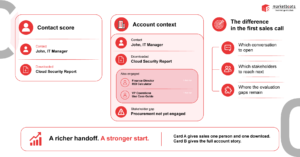
Rather than eliminating contact-level targeting, it changes how you interpret contact engagement, and it emphasizes account-level context instead of a standalone qualification event. The following decisions explain the shift:
- Map the Buying Group Before Producing Content: Identify functions that influence purchase. For B2B SaaS, the functions can include technical evaluators, security, finance, procurement, users, and business owners.
- Build Role-specific Content: Every function will need different content types to make a decision, and the content brief must explicitly clarify which asset should serve which role.
- Employ Account-level Qualification: Along with individual account score, the qualification criteria should emphasize account-level engagement.
Demandbase’s 2026 research finds that B2B teams targeting three buying groups achieved a 28.92% revenue win rate. Role-relevant content adds commercial value by ensuring every function interacts with content designed to answer its questions.
A content brief that compiles the buying committee role, the query the role raises, and the content format that produces commercially meaningful responses can drive better buying group engagement.
How to Measure Buying Group Engagement in B2B
Instead of tracking siloed lead scores, measuring three signals, including the number of engaged buying functions, the variety of content consumed, and the rate of increasing account engagement, in parallel can monitor buying committee engagement.
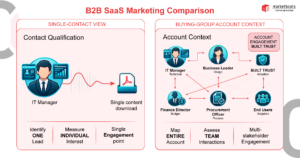
The following account engagement signals can measure buying readiness:
- Role-specific Content Consumption: Multiple stakeholders consuming domain-specific content indicates parallel evaluation.
- Number of Distinctly Engaged Functions: Multifunction engagement within the same account can offer wider evidence of buying readiness than a siloed function.
- Engagement Velocity: New stakeholders from the same account joining over time can indicate expanding evaluation, and increasing velocity signals the beginning of an active evaluation cycle.
- Content Breadth: The combination of content consumption at the awareness stage of one function with that of the evaluation stage of the other can unveil B2B buying process
- Handoff Context Quality: The sales team should receive an input of consumed content, involved functions, pattern of engagement, and relevant questions rather than only the lead score.
Configuring CRM and MAP at the account level to track engagement can make these buying group signals observable. Most B2B enterprises monitor contact engagement and aggregate it upwards.
According to Gartner’s 2026 findings, 45% of surveyed B2B buyers use Gen AI, while 70% prefer a completely digital buying experience. B2B buyers are more inclined toward digital research and GenAI, so enterprises have less visibility into the individual buyer journey.
Thus, account-level context becomes more important while interpreting engagement signals. The handoff context signal can shift the sales conversation’s starting point and add commercial value to pipeline quality signals. A sales team with better pre-call context can influence enterprise purchase decisions.
A high individual lead score may not indicate whether multiple functions are engaging with role-specific content. An individual score-centric measurement model may miss commercially advanced buying groups.
Bottom Line: How Account-level Signals Improve B2B Pipeline Quality
The B2B lead generation strategy shifts the commercial measurement unit from a single contact to the account to improve pipeline quality. B2B enterprises should check which accounts to engage before moving the contact forward.
A B2B campaign strategy that produces account-level qualification signals, role-specific content, and handoffs that provide account context often generates higher-quality pipeline.
As intent data tools, including Bombora and 6sense, and ABM platforms mature, B2B teams can execute buying-group marketing at scale and operational precision, and their execution capacity improves with every cycle. B2B enterprises that emphasize capability building can build a stronger structural pipeline-quality advantage.
Marketboats can help you understand how B2B buying committees make purchase decisions and build an engagement strategy framework that generates account-level qualification signals.
FAQs
1. How do B2B buying committees make decisions?
Buying committees evaluate decisions based on functional priorities such as technical fit, implementation, procurement requirements, cost, security, and business value.
2. Why does single-contact targeting fail in enterprise B2B?
Single-contact targeting can miss multiple stakeholders who influence implementation, budget, adoption, security, and approval. As a result, it can misinterpret activity as buying motion.
3. What is buying group marketing?
Buying group marketing is the process of coordinating content, targeting, stakeholder-centric measurement, and qualification involved in a specific purchase.
4. How do you measure buying group engagement?
First, track the number of engaged functions. Then monitor role-specific content consumption, content breadth, the quality of account context available to sales, and engagement velocity, which together provide a broader view of buying committee engagement.
5. How does buying group strategy improve pipeline quality?
Buying group strategy can add account-level context to individual lead data. It lets B2B enterprises distinguish siloed engagement from broader buying activity and consensus.