
Evaluating registrants against ICP criteria before an event is called pre-webinar lead qualification, which lets the engagement scoring model start with a commercially relevant, clean input set.
Many B2B webinar programs assume each registrant is a potential lead, but the post-event scoring model often says otherwise, which can waste SDR capacity on less commercially viable attendees. This can also introduce noise from ICP-misfit registrants into the scoring model.
Treating each registrant as an MQL is a structural flaw that increases volume, reducing quality. GetContrast’s 2026 analysis finds that 39% of B2B enterprises track leads as a key webinar metric.
The commercially high-value qualification decision is often made while filling webinar registration forms. As these forms produce useful buyer data, the qualification should begin before attendance.
What Questions Should You Ask on a Webinar Registration Form to Identify Qualified Leads
Webinar registration questions should ask about company name, company size, job role/seniority, key business challenges, and current solution/tool in use, and free-text intent fields should be placed last to reduce drop-off.
Though shorter registration forms improve registration rates, they might reduce the quality of the registration pool. A form long enough to surface qualification signals can be a better commercial trade-off than optimizing only for shorter form length.
B2B webinar lead qualification often becomes difficult because, according to ActualTech Media’s 2026 research, 27% of registrants enter inaccurate or incomplete information while filling the form. The following table is a suggestive guideline for designing forms to reduce this inaccuracy:
| Field | What It Captures | Why It Matters |
|---|---|---|
| Company Name | Identity of an account. | It enables ICP-fit assessment without adding multiple qualification fields. |
| Company Size | Employee range. | Depending on the number of employees, qualification thresholds can differ, and this field filters ICP-misfit registrants. |
| Job Role/Seniority | Role and authority. | It helps distinguish researchers, decision-makers, and influencers. |
| Key Business Challenges | Problem with buying and intent language. | It signals the sales team for relevance and outreach. |
| Current Solution/Tool In Use | Technology or process in use. | It can surface competitive displacement opportunities and help sales teams prioritize contacts based on their current solution. |
While picklists simplify responses for segmentation and scoring, free-text fields can surface richer intent signals. The right combination depends on whether data supports downstream nurturing, sales qualification, segmentation, or scoring.
How to Build a Webinar Lead Scoring Model to Prioritize Registrants Before the Event
Based on the ICP-fit criteria, the webinar lead scoring framework can assign point values to registration forms to produce a fit score for each registrant, determining routing before the event starts. This is how to qualify webinar leads before the event.
Pre-event outreach to high-scoring registrants prior to the webinar can be a high ROI-generating SDR activity, yet many B2B teams rarely initiate it, as they wait until post-event before making the first move.
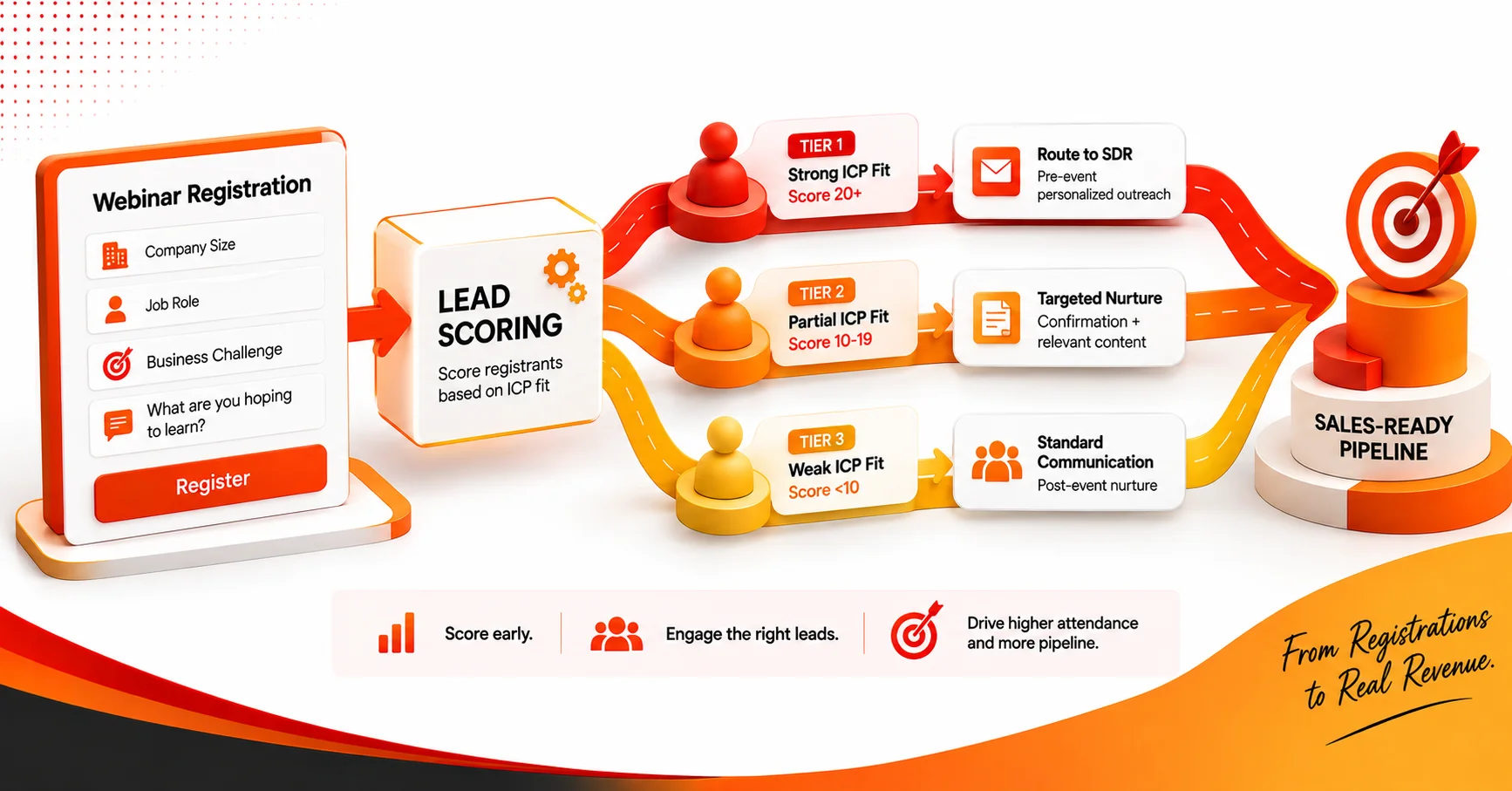
A practical B2B webinar lead scoring framework can use the following three tiers:
- Tier 1- Strong ICP Fit (Score 20+): The webinar qualification strategy should route these registrants to the SDR CRM queue for pre-event personalized outreach.
- Tier 2- Partial ICP Fit (Score 10-19): Send such registrants a sequence containing a standard confirmation, followed by targeted content that aligns with their business challenge.
- Tier 3- Weak ICP Fit (Score <10): Registrants falling under such webinar qualification criteria should be kept in a standard event communication, routing them to post-event nurture.
High-intent webinar leads receiving personalized pre-event emails may be more likely to attend than those receiving only automated confirmations.
The pre-event scoring framework helps distinguish registrants with stronger commercial potential from those better suited to post-event nurture, while routing sales-ready webinar leads to SDRs before capturing engagement signals.
Final Thoughts: How to Qualify Leads Using Webinar Registration Questions
The answer to how to qualify webinar registrants lies in using a five-field registration form, a point-based ICP qualification scoring model, and a three-tier routing system to direct high-intent registrants to SDR outreach before the actual webinar.
The post-event pipeline quality often depends on pre-event qualification work. The pre-event qualification system that improves engagement data quality is built collectively by form design, the B2B lead scoring framework, and pre-event webinar lead routing.
AI can extend this process by analyzing larger volumes of registration and behavioral data, identifying patterns, and supporting automated lead qualification. Marketboats can help you find an answer to how to identify high-intent webinar registrants and build a framework that connects engagement, registration, qualification, and pipeline.
FAQs
1. What makes a webinar registrant a qualified lead?
When available data shows strong ICP fit, a relevant business need, and sufficient commercial potential, a registrant can qualify for further sales evaluation. However, this alone might not establish complete qualification.
2. How do you score webinar registrants?
Target-account fit, company size, role/seniority, business challenges, and current solutions can determine how webinar registrants are scored. Based on these parameters, assign scores to each factor, segment contacts into priority tiers, and link every tier to a defined routing sequence.
3. What information should you collect from webinar registrants?
Current solution or tool, primary business challenge, job title or seniority, company size, and company name are some important responses that can provide firmographic, intent, and role-based signals without requiring a lengthy registration form.