
When the framework, including registration, engagement, and follow-up stages, is built by prioritizing buying intent signals over attendance volume, the B2B webinar lead generation strategy produces a qualified pipeline.
Enterprises often measure registration count and attendance rate to define webinar programs’ success, but webinar-based lead generation performance goes beyond registration volume.
Pipeline-qualified attendees per event can provide a more accurate pipeline picture, and optimizing for this metric produces a larger and stronger pipeline. Digital Applied’s 2026 research finds that attended-to-MQL converts at 38%, while MQL-to-pipeline is 11%.
Designing webinar programs backward from pipeline outcomes can help teams answer how to turn webinars into sales pipeline. Rather than promoting broadly, precise targeting can boost webinar conversions, where registration forms surface qualification signals before the event starts.
How to Convert Webinar Registrations into Pipeline
The first step in webinar pipeline generation is setting up a qualification model that begins at the registration stage and continues through the event to conclude with a structured post-event routing process. It is aimed at connecting intent-driven attendees to sales within the first few hours.
Enterprises often commit a follow-up mistake by setting up an automated post-webinar nurture sequence. A registrant who never attended a webinar and a high-intent attendee receive the same nurture sequence, which is only list management.
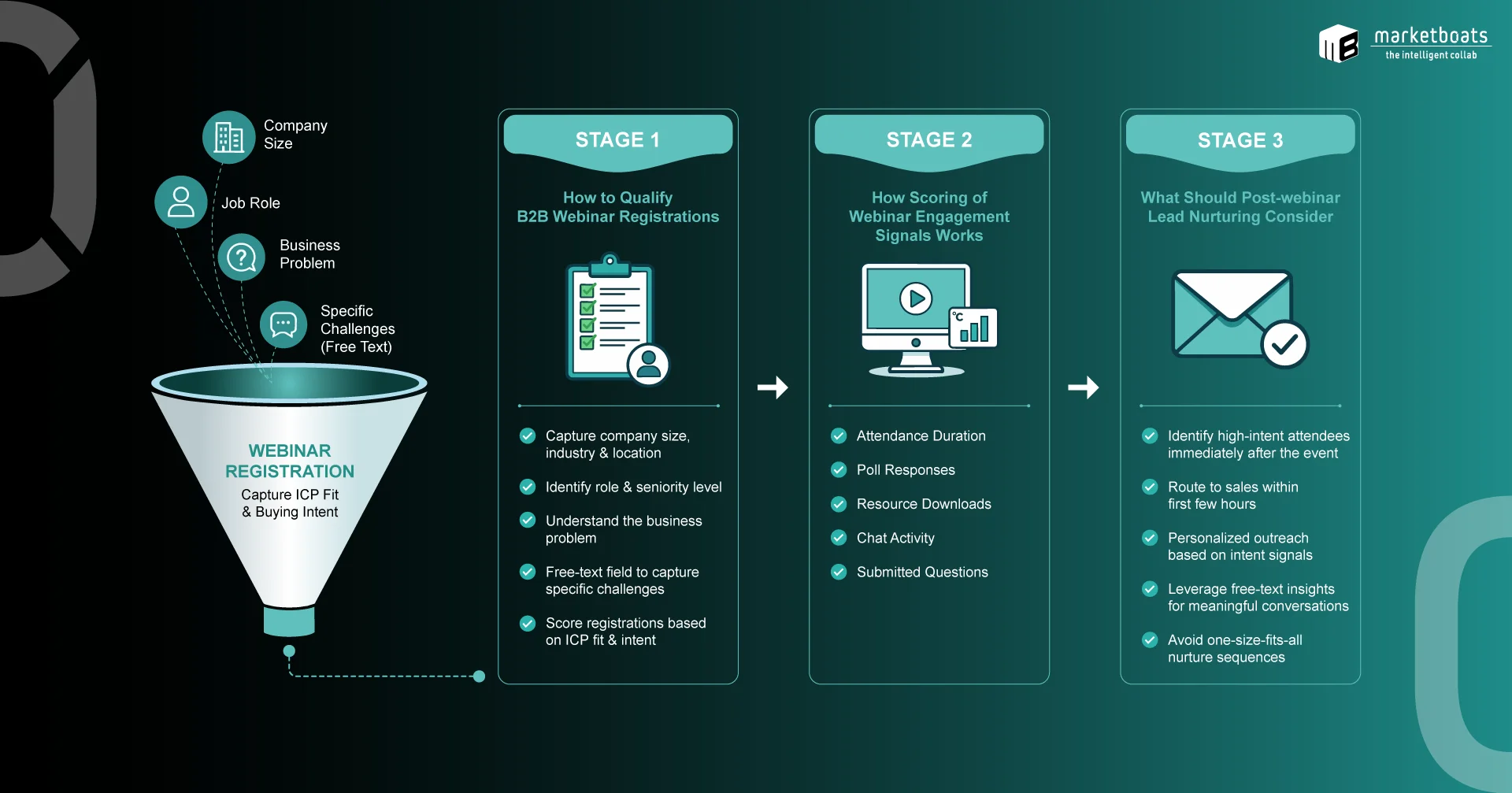
Asking the following questions at three stages can produce a webinar lead qualification framework for you:
Stage 1: How to Qualify B2B Webinar Registrations
The registration form should capture ICP fit details like company size, their organizational role, and the business problem they face. A free-text field that seeks specific challenges attendees hope to get addressed can capture buying intent more accurately.
Stage 2: How Scoring of Webinar Engagement Signals Works
Poll responses, attendance duration, resource downloads, chat activity, and submitted questions are some scorable engagement signals that a live webinar can produce.
An attendee attending the entire event, asking product-specific questions, and downloading use case guides has generated three different intent signals.
Stage 3: What Should Post-webinar Lead Nurturing Consider
Rather than relying on an automated nurture sequence, attendees with high buying intent should receive personalized sales outreach soon after the webinar ends. Easywebinar’s 2026 analysis finds that B2B teams that integrate high-intent activity into behavioral follow-up report a 25-35% lift in sales-accepted leads.
Registration forms and post-event routing rules can be implemented without changing webinar content, and they can result in better webinar lead generation. Sales teams can use free-text fields during outreach. It can make the post-event interaction more meaningful than a cold call.
What Webinar Engagement Signals Indicate Buying Intent, and How to Score Them
Resource clicks, chat activity, post-event content consumption, Q&A activities, watch time, and repeat attendance are some signals that indicate buying intent. The practical B2B webinar marketing strategy can look like this:
| Engagement Signals of Attendees Who |
Aggregate Points |
Why It Matters |
|---|---|---|
| Attended more than 75% of the session. |
10 | While casual attendees drop off earlier, sustained attention hints at genuine interest. |
| Submitted a poll response | 12 | Self-declared buying stage can provide a stronger intent signal than passive engagement alone. |
| Requested post-event replay |
5 | It reflects attendees’ genuine interest in retaining the information |
| Asked a product-specific question |
15 | A question related to integration, implementation, or pricing indicates an evaluation mindset. |
| Downloaded a use-case- specific resource |
8 | It reflects that the attendee maps solutions for their own context. |
Attendees scoring more than 25 points reflect high intent and require an immediate SDR follow-up, while those scoring below 15 need standard follow-up. Attendees scoring between 15 and 24 points show medium intent and need targeted nurture.
Product-specific queries produce more commercial value than other signals, but many follow-up processes rarely reference them and send generic emails to B2B webinar leads who told sales what they want.
AI-powered webinar lead scoring such as ON24 and Goldcast can integrate with Salesforce-connected workflows to automate scoring against defined thresholds and route high-intent attendees into the CRM for sales follow-up or further qualification.
How to Generate Pipeline from B2B Webinars
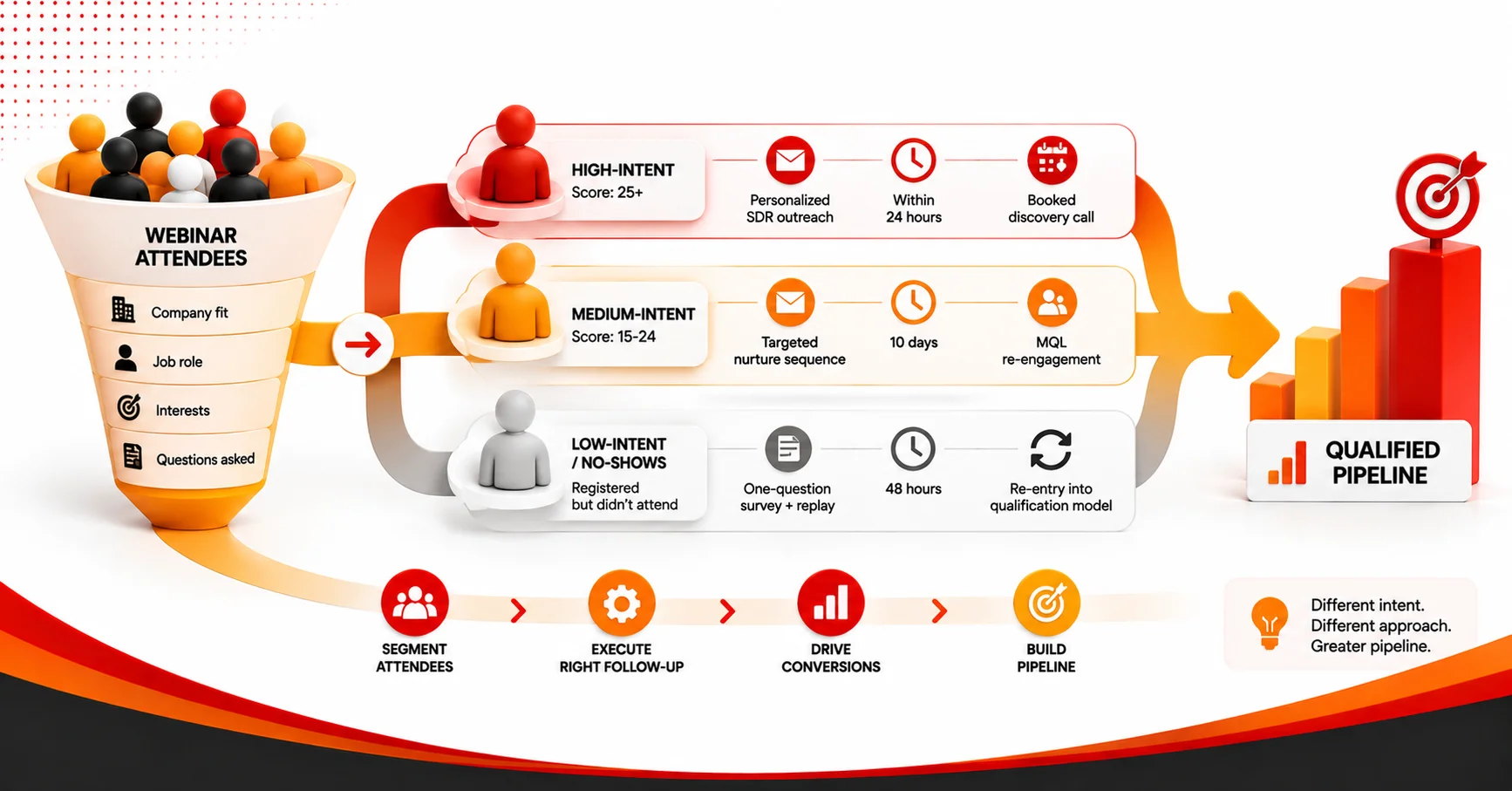
For B2B webinar pipeline generation, post-event follow-up should be segmented into three parallel layers, including SDR outreach for high-intent attendees, targeted nurture for medium-intent attendees, and reactivation for low-intent leads.
Personalized SDR outreach referencing the product-specific question often carries more commercial value, as it implies that enterprises read and retained the question instead of treating attendees as ordinary entries in a nurture sequence.
Whistle’s 2026 research finds that personalized SDR outreach achieves an 18% response rate compared to 3.43% for generic outreach.
Many webinar lead generation tactics often consider no-shows as cold calls, but it might not always be true because a well-qualified VP of Operations who did not attend events can be a warmer lead than an unqualified attendee who attended all sessions. The following is a suggested action plan for each layer:
| Layer | Audience Score |
Content/Action | Timeline | Expected Outcome |
|---|---|---|---|---|
| High intent | 25+ | Personalized SDR outreach |
Within 24 hours |
Booked discovery call |
| Medium-intent | 15-24 | An email nurture sequence |
10 days | MQL re- engagement |
| Low intent/No- shows |
No-show | Replay access | 48 hours | Re-entry into a qualification model |
How to Identify High-intent Webinar Attendees Before the Follow-Up Process Begins
The composite intent score, a combination of live engagement signals and registration qualification data, answers how to identify buying intent from webinar attendees. The following four-layer webinar qualification strategy can produce commercially precise identification:
- Fit: The company, organizational role, and segment of attendees should match the ICP at the registration level.
- Engagement: To qualify webinar attendees, their chat activity, attendance, poll responses, and watch time should be recorded during the event and synced to the MAP.
- Intent: Signals differentiating evaluation intent from research curiosity, including solution comparisons, implementation concerns, or product-specific questions, should be monitored using AI.
- Action: Post-event actions, including pricing-page visits, demo requests, and follow-up content interaction, can be monitored, where routing decisions need a defined threshold in the MAP.
Instead of replacing qualification logic and independently declaring leads sales-ready, AI-driven B2B webinar lead scoring supports prioritization. Instead of relying on only one signal, the registration-plus-engagement scoring framework integrates registration data and engagement behavior to score B2B webinar leads.
How to Measure Webinar Attendee Engagement as a Revenue Metric
When engagement scores are connected to revenue outcomes and pipeline-level movement, webinar attendee engagement becomes a revenue metric. As a result, webinar lead conversion reports can track attendance behaviors that predict revenue outcomes.
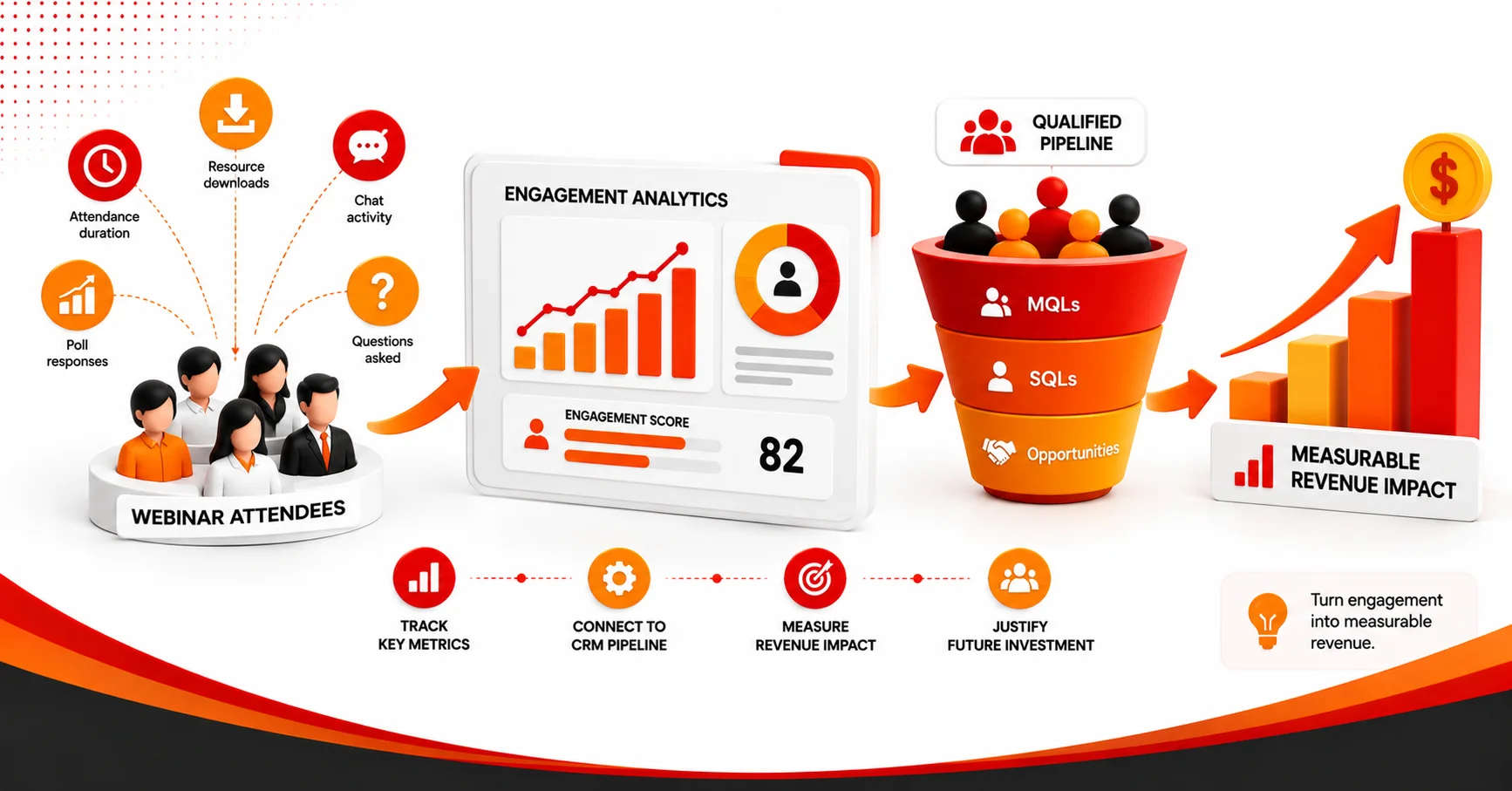
Revenue per webinar attendee can be a metric alongside other revenue-generating investments. Many B2B teams rarely prioritize connecting revenue data, CRM, and MAP, which is why they neglect employing a revenue-per-webinar-attendee measurement framework.
The following table describes metrics tracking the webinar acquisition strategy ROI:
| Metric | What It Measures | Commercial Value |
|---|---|---|
| Webinar-to-MQL conversion |
Attendees meeting engagement thresholds and ICP fit |
Pipeline generation |
| MQL-to-SQL conversion |
Sales-accepted MQLs | Scoring accuracy |
| Average deal size | Average value of webinar-sourced closed-won deals |
Buyer and opportunity quality |
| Pipeline Influence Rate |
Pipeline influenced by webinar touchpoints |
Pipeline reach |
| Revenue per attendee |
Closed-won revenue per qualified attendee |
Budget justification |
Webinar measurement at the revenue level becomes possible due to the technical mechanism that connects webinar engagement data to CRM deal records through MAP integration. Webinar performance measurement can remain event-centric, and teams without this mechanism can make revenue connections only directionally.
Key Takeaway: How to Turn Webinar Leads into Opportunities and Build a Scalable Pipeline
Using a system that can qualify at the registration stage, score engagement during the live event, route based on intent tier, and monitor success at the revenue stage can answer how to turn webinar registrations into qualified leads.
Rather than maximizing attendance, teams can generate stronger webinar leads by combining precise registration targeting, structured engagement scoring, and commercially aligned routing.
Maturing AI-driven webinar platforms can widen the gap between structured intent-scoring webinars and attendance metric-oriented events, as AI can improve the quality on which the scoring model operates.
Marketboats can help you answer how to qualify webinar attendees and build a webinar demand generation strategy that can convert registrations into pipeline.
FAQs
1. How do B2B webinars generate pipeline?
Webinars can attract relevant buyers, capture qualification information, measure their engagement, score intent, and route high-intent leads to sales to generate a pipeline.
2. How do you score webinar attendees?
The combination of attendance behavior, resource engagement, ICP-fit, post-event actions, polls, and questions can be used to score webinar attendees.
3. What are the best webinar engagement signals?
Meaningful poll responses, product-specific questions, resource downloads, post-event actions, and sustained attendance are some strong signals that indicate engagement.
4. What webinar activities indicate buying intent?
Product-specific queries, product implementation and integration concerns, and pricing-related questions often indicate buying intent.
5. How do you measure webinar ROI?
Track the entire funnel from registrations to qualified attendees through opportunities, MQLs, pipeline, SQLs, and closed-won revenue.