
Leaving competitor responses to rep improvisation is one of the easiest ways for B2B teams to lose competitive deals. Competitive battlecards offer reps structured, tested answers when objections arise. B2B sales battlecards are buried in PDFs and shared folders that are often inaccessible, so reps cannot use them under pressure.
SEMRush’s research found that 57% of deals are competitive, yet 32% of them are lost to competitors. The finding reinforces why competitive intelligence must reach reps when they need to respond to a competitor in an active deal.
An ideal competitive battlecard framework should be built around real-life competitive situations and objections affecting the deal, and it should act as a decision-support tool within a broader B2B sales enablement strategy.
What Are the Key Elements of an Effective Battlecard for B2B Sales Teams
Battlecards for sales teams should allow reps to match the deal conversation with buyer priorities, understand the competitive situation, and respond confidently. The following six elements answer what to include in a battlecard and how it fits into the broader sales enablement content types used by B2B teams:
| Element | What It Contains | What Is Its Significance |
|---|---|---|
| Competitor Overview | It summarizes the competitor’s positioning, target buyers, core strengths, and common deal presence. |
This competitor analysis for sales teams establishes the context of competitors’ presence in the deal. |
| Landmines | They are claims, questions, or objections that can push your reps on the back foot during a sales conversation. |
It prevents reps from getting caught off-guard during a live conversation. |
| Differentiated Responses |
Reps can prepare a tested response against every probable landmine. |
Instead of defending against the claim, reps can redirect the conversation toward their strongest differentiator. |
| Proof Points | It highlights use-case- specific buyer outcomes in deals where the competitor commonly appears. |
It gives reps specific evidence, customer outcomes, and quantified results to support the response. |
| Head-to-head Comparison |
It compares three to five buyer-relevant capabilities where the vendor has a meaningful advantage. |
Three specific differentiators outperform a long list. |
| Qualification Signals | It identifies deal behaviors that reflect competitors’ entry in the opportunity. |
Reps can deploy battlecards before buyers name vendors. |
The landmine section helps reps to prepare for competitors’ offensive moves, producing high commercial value in sales enablement battlecards. Qualification signals make battlecards a proactive tool, and reps identifying these signals early can deploy them before buyers form their opinions.
How to Structure a Competitive Battlecard That Performs Well in Live Sales Conversations
Marketing teams often understand buyer requirements differently from the objections and competitive conversations reps encounter in live deals. A battlecard creation process around product documentation rather than call recordings and win/loss data might correctly describe the product, but prepare reps for the wrong conversation.
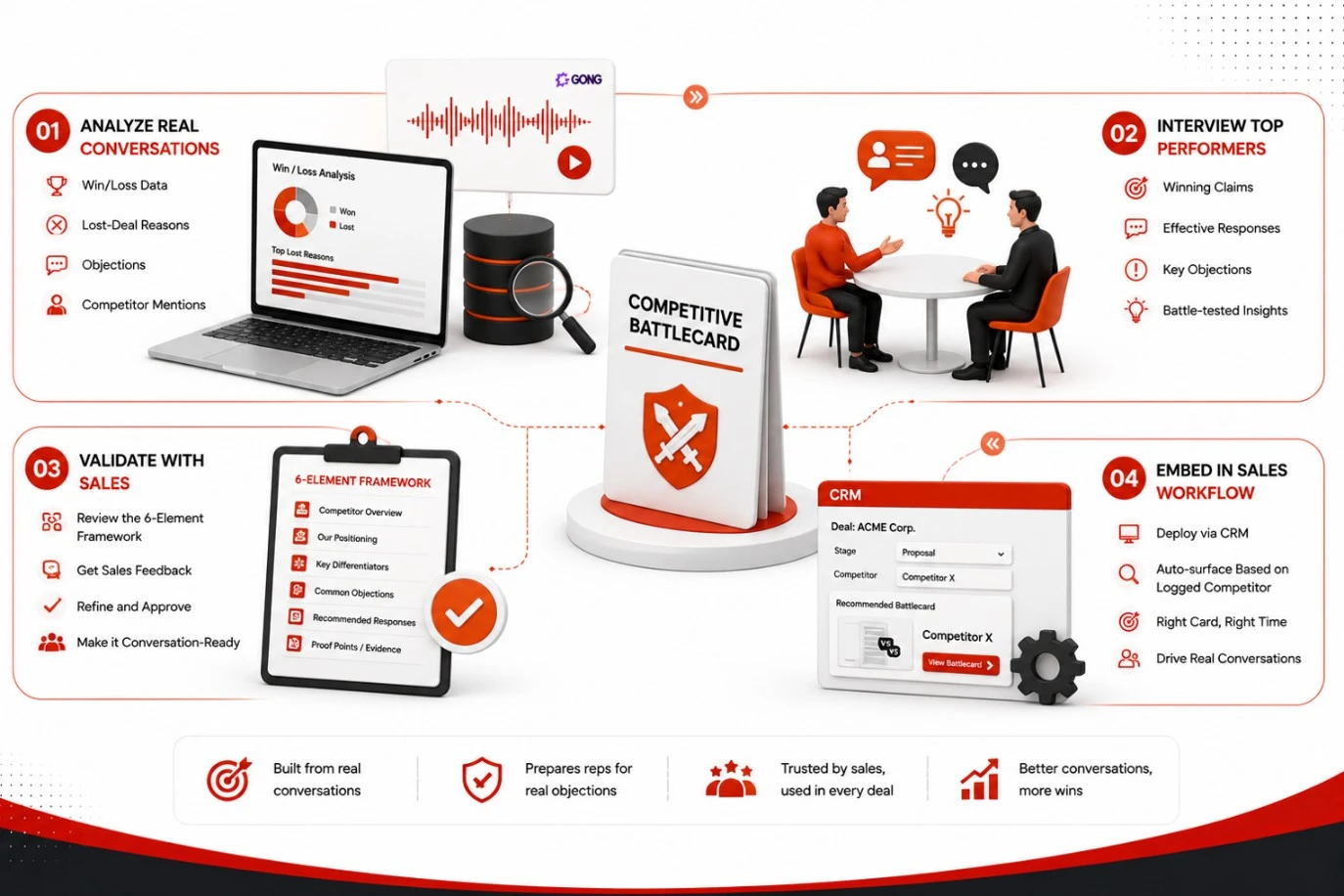
Here is the step-by-step guide to creating sales battlecards:
Step 1: Win/Loss Data and Recorded Call Analysis
Reviewing lost-deal reasons, comparison points, objections, and competitor mentions is the first step. CRM win/loss fields reveal deal-level patterns, while conversation intelligence platforms such as Gong and Chorus can surface recurring objections and competitor mentions from call recordings.
Step 2: Interview High-performing Reps
Reps who consistently win competitive deals often know which competitor claims appear repeatedly, which responses work, and which objections matter most.
Step 3: Validate the Sales Enablement Content Draft
After drafting the six-element framework, validate it with sales before publishing. Without validation from sales, the battlecard acts only as a hypothesis. Many teams skip this step, and as a result, battlecards don’t reflect actual conversations, which is why sales teams often distrust them.
Step 4: Embed the Competitive Battlecard Template in the Sales Workflow
Embed the battlecard into the sales workflow so reps can access competitive guidance without leaving the systems they already use. When a competitor enters an opportunity, sales-enablement platforms, guided workflows, or CRM deal fields surface the relevant battlecard.
How to Use Battlecards in Sales Conversations to Improve Competitive Deal Execution
A rep’s credibility might decrease if they sound rehearsed due to the competitor battlecards that appear scripted. Reps conversing based on questions, evidence, and flexible talk tracks is how sales teams use battlecards. Gong’s research finds that early discussions in sales cycles can have a 49% higher chance of closing the deal.
Many of the best competitive battlecard examples for B2B teams support the following three moments:
- Pre-call Preparation: Reps analyze probable objections, relevant proof points, and competitor positioning.
- Live Buyer Objection Handling: Reps can employ value-based selling, as their response links the vendor’s differentiator with buyers’ stated outcome by raising verified claims, tested answers, and handling objections.
- Post-call Follow-up: Recording buyer objections and new competitor claims can feed the creation of the next value proposition battlecards. Each conversation should make the next battlecard version smarter.
Final Thoughts: How Battlecards Improve Sales Win Rates
Competitive intelligence battlecards might become obsolete if they are not updated periodically, as a battlecard built on outdated intelligence rarely reflects current market conditions. Periodic updates, competitor signal monitoring, and quarterly win/loss review are three structural maintenance decisions that help reps handle buyer objections.
The effectiveness of battlecards should be monitored based on rep usage rates, deal progression, and competitive win rates. Offering the right competitive intelligence to reps at the correct time is how to build competitive battlecards for B2B sales teams.
Marketboats can help you build data-backed competitive battlecards designed for real sales conversations.
FAQs
1. How do you create a competitive battlecard?
Start with win/loss data, call recordings, and rep interviews to identify recurring competitors, objections, and deal patterns. Then build, validate, and deploy the battlecard with sales.
2. What should be included in a battlecard?
Qualification signals, proof points, head-to-head comparisons, landmines, competitor positioning, and differentiated responses are some important ingredients of a battlecard that performs well.
3. What tools are used to create battlecards?
CRM systems, sales-enablement platforms, and competitive-intelligence platforms are used to build, update, distribute, and monitor usage of battlecards.