
Appearing in Perplexity and ChatGPT responses is the result of sound AI search optimization for B2B, where each section answers a specific question in its first sentence.
AI search ranking factors depend on verifiable claims. Still, most content is written only to impress human readers, and this unextractable content remains uncited despite high competitiveness or authoritativeness in the underlying thinking process.
Onely’s 2026 analysis highlights that over 73% of enterprises have zero mentions in AI-generated responses despite their higher Google Page One ranking. High content volume with very low extractability hardly translates into any AI citation.
Rather than content volume, content architecture generates earned citations and hence should be the foundation of B2B content strategy for AI search visibility.
How to Structure Blog Content for ChatGPT Citations
B2B enterprises often underinvest in the heading structure while devising their AI answer engine optimization strategy, ignoring question-to-heading alignment, and overinvest in keyword research.
Each section containing an independently extractable standalone answer acts as the foundation for answer engine optimization (AEO) and generative engine optimization (GEO).
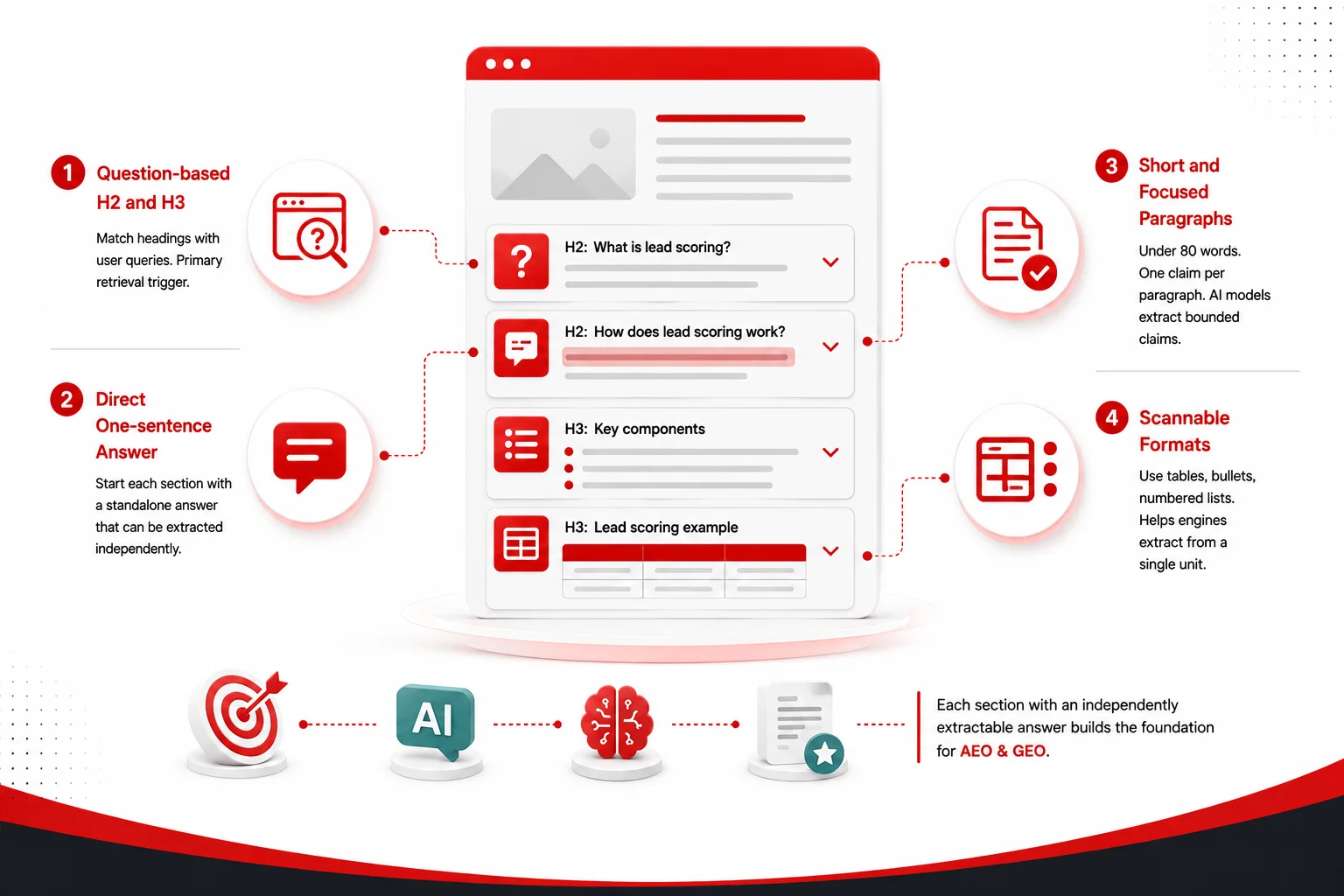
Here are the four structural decisions of AI citation optimization that can improve citation potential:
- Question-based H2 and H3: Matching headings as closely as possible with user queries reinforces question-based content structure. It strengthens query-to-content alignment, while the rest of the section provides the evidence and context needed for retrieval and citation; this is how LLMs extract answers.
- Direct One-sentence Answer: Each section must start with a standalone answer that can be independently extracted.
- Short and Focused Paragraphs: Each paragraph must be short, precise, and contain one claim. AI systems can more easily retrieve self-contained, bounded claims.
- Scannable Formats: Structured content for AI, including comparison tables, bullets, and numbered lists, helps engines extract information from a single unit.
How to Write Content That AI Search Engines Trust
Here are the three credibility signals that can help B2B enterprises optimize content for generative AI by shifting it from extractable to citable form:
- Attributed Statistics: A verifiable, specific, and attributable stat with report name, publisher, and year can increase citation probability. It offers practical credibility improvement and often needs little additional research.
- Named Authors with Domain Expertise: Although discussed in Google ranking’s context more often, E-E-A-T for AI search can strengthen source reliability and help AI systems assess whether a claim is worth retrieving.
- External Citations: Citing sources like Forrester or Gartner implies higher trust signals in B2B content, improving content’s retrievability.
A piece of content with structured sections and complete attribution often outperforms a well-argued article with none of these elements, and this is how to make content AI-readable and scannable.
How to Get Your Website Cited in AI Answers Using Schema and Technical Signals
An answer’s quality and specificity help AI engines determine whether to cite the answer, and this is the answer to how to get cited by ChatGPT. Rather than replacing them, technical signals often amplify credibility and structural signals.
By marking question-answer pairs, FAQ schema for AI search can help machines interpret question-answer relationships as structured content, although structured data alone does not guarantee AI citation or search visibility. Amicited’s 2026 research finds that FAQ schema improves structured content’s citation probability by 28-40%.
Maintaining product categories, company names, and key descriptions consistent across trusted third-party sources, structured data, and the website builds a solid entity consistency profile.
Final Thoughts: How to Rank in AI-generated Answers
Fundamentally, AI citation is an architecture-related issue. AI content optimization for search works best when every section offers a direct answer with a defined information unit and credible evidence.
B2B teams succeeding with content optimization for LLMs often follow this workflow:
Question → Direct answer → Evidence → Structure → Technical signals → Citation monitoring
AI-powered search visibility must become a measurable layer of the content strategy. To identify content gaps, check whether each page matches what users are searching for and provides a direct answer in the opening section.
Marketboats can help you perform a content audit so that the question of how to format articles for LLM extraction is answered through your content strategy.
FAQs
1. How to optimize B2B content for Perplexity AI?
Along with starting the paragraph with an answer, using strong source attribution, clear headings, consistent entities, current statistics, and structured content can help you optimize B2B content for Perplexity AI. Perplexity places strong emphasis on web-grounded answers and visible source attribution.
2. How SaaS companies can rank in ChatGPT answers?
Integrating original research with third-party mentions and product expertise, along with technical documentation, consistent brand information, and clear comparisons, helps B2B SaaS companies rank in ChatGPT answers.
3. How to build topical authority for AI search?
To build a strong topical authority, the content must be covered comprehensively through connected pages that include clear definitions, use cases, risks, comparisons, buyer decisions, and implementation questions. Internal linking and reinforcing with verifiable external references further bolster the topical authority.