
Moving beyond engagement spikes, thought leadership ROI is reflected through authority accumulation and pipeline influence. B2B teams that measure this ROI have successfully shifted their measurement model from attribution to influence.
Edelman’s 2025 report finds that 73% of B2B decision-makers believe that an organization’s thought leadership content is more trustworthy and influences vendor evaluation.
Most B2B teams cannot connect these assets to pipeline creation, and they use surface-level metrics to measure thought leadership’s impact, which is disconnected from revenue, and this is the core problem.
Thought leadership is operational across wider funnel activities, where direct attribution becomes structurally difficult. Applying campaign ROI logic to thought leadership undervalues it.
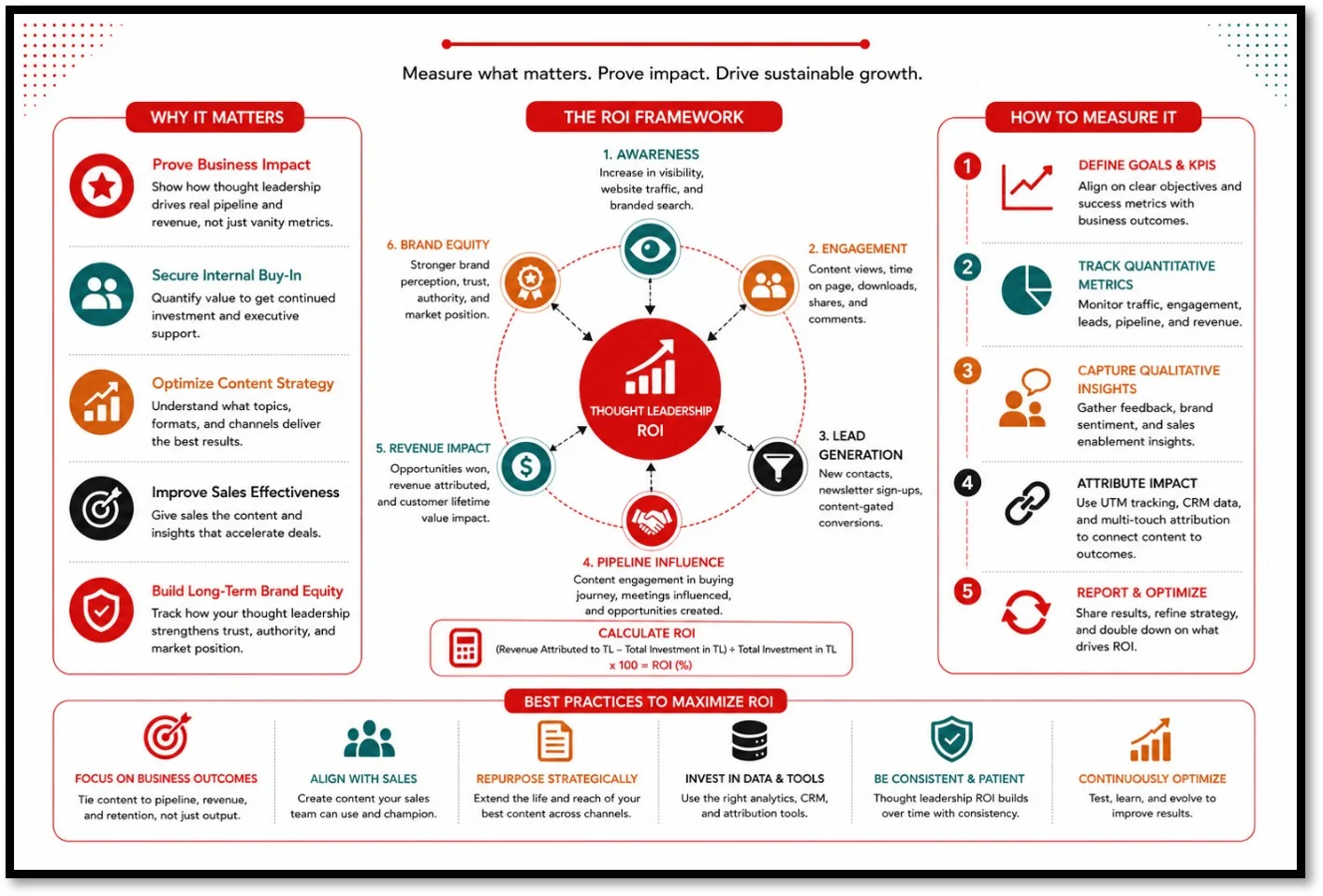
Why Measuring Thought Leadership ROI Is Difficult
The failure of the content attribution strategy is structural because standard frameworks, including first and last-touch, and multi-touch models, are built to capture interactions triggering conversions.
Thought leadership, on the other hand, doesn’t trigger any conversion event, but creates conditions that improve future conversion probability. A buyer does not enter the funnel purely based on any content piece they read.
Thought leadership develops preferences before any measurable intent surfaces, increasing the conversion possibility, while attribution models measure only conversion moments. These fundamentally different commercial functions create the measurement gap that forces one framework onto another, misleading budget decisions.
What Metrics Measure Content Marketing ROI in B2B
Based on tracking frequency, ROI measurement metrics are classified into two tiers. The first tier includes dwell time on page, newsletter open rates, and page views, which analyze the engagement and reach.
The higher-signal metrics from tier two measure content impact on sales pipeline via pipeline influence rate, sales cycle compression, brand mention frequency, and share of voice in category-relevant conversations.
While the first-tier metrics check if people have read the content, the second-tier metrics ask if the buyers’ perception changed after content consumption. Pipeline acceleration is more important than content virality, and influence metrics outperform engagement metrics.
Accounts engaging with thought leadership content before evaluating deals often move through conversion faster, reduce education, and create stronger commercial alignment.
How to Build a Content ROI Measurement Framework
The fundamental component of the B2B content performance measurement strategy is establishing a pre-engagement baseline before launching any program. Measure average sales cycle length, CAC, and baseline pipeline conversion rates for accounts that have no content touchpoints.
Instead of mapping content interactions to isolated conversion events, they must be mapped to the account’s pre-engagement history.
Reviewing this after deal closure reveals the role of thought leadership in shaping conditions for conversion. As per Monetizely’s 2025 report, effective thought leadership programs yield 1.8x higher pipeline conversion rates.
Tracking CLV and retention by content engagement cohort is another component of the framework. Thought leadership’s ROI extends to customer quality, beyond pipeline generation, when engaged accounts reflect higher CLV.
More than being transactional, content ROI is cumulative, and that is why thought leadership must be measured as a trust infrastructure. The measurement framework that makes thought leadership defensible is the one proving that the pipeline it touches performs differently.
How to Track ROI of B2B Thought Leadership Campaigns
The primary step to track B2B content ROI measurement is to add pre-engagement content interaction fields to the CRM opportunity record. When a deal enters the pipeline, track the thought leadership content the buying group viewed before becoming a prospect.
Creating a thought leadership influence cohort in the current reporting is the next stage. Classify closed-won deals based on whether accounts interacted with the thought leadership content before converting.
Upon comparing deal size, close rate, and pipeline velocity across two cohorts, the difference measures and defends the ROI of B2B content strategy successfully. The content that decreases sales friction possesses measurable economic value.
Connecting MQL-to-SQL conversion rates to historical content engagement patterns is the last step. MQLs engaging via thought leadership before being contacted reflect higher engagement rates than leads with no prior content engagement.
The entire influence might not be attributable, but it is commercially important, and successful B2B teams track the right moments of the pre-engagement period before the pipeline record exists.
Final Thoughts: How to Calculate ROI of Content Marketing When the Value Is Influence
B2B content performance measurement is a model-mismatch issue. Thought leadership shapes buyer perception even before any measurable intent surfaces.
B2B teams that measure pipeline influence, cohort performance, and pre-engagement history accurately defend thought leadership budgets successfully. Companies that only rely on measuring clicks undervalue authority-building assets.
Longer buying cycles and anonymous pre-evaluation research will make the pre-engagement period even more commercially important.
Want to develop a concrete content marketing ROI B2B framework? Contact Marketboats and book a 30-minute free audit to identify where and how your content influences the pipeline without being measured accurately.
FAQs
1. How B2B companies track content performance beyond traffic metrics?
Successful B2B teams monitor account engagement history, revenue contribution, pipeline influence, and conversion acceleration rather than tracking only traffic and impressions.
2. Which are the useful tools to measure content marketing ROI in B2B?
Revenue intelligence systems, attribution platforms, account-level reporting tools, and CRM analytics are some tools that offer better ROI visibility over standalone analytics dashboards.
3. Why content marketing ROI is hard to measure?
Thought leadership governs how B2B buyers perceive the brand, even before conversion events activate. As a result, its commercial outcomes cannot be captured via traditional attribution models.