
Structured data for B2B websites translates a comprehensive content piece into AI model-friendly claims, which can make well-structured content easier for search and AI systems to interpret.
Most B2B technical SEO best practices end at schema integration for rich snippets, but for AI retrieval, schema needs a different selection type and implementation priority. The addition of schema types hardly creates more citations. Clear, authoritative, and accurate content is the prerequisite for content to become visible.
AEOGrader.org’s 2026 research finds that pages having structured data for answer engine optimization are cited 2.4 times more than those with no structured content. Correct schema markup and a direct answer to the user query often help a B2B page be retrieved faster.
What Schema Types Improve AI Citations, and Which Are the Best Schema Types for B2B Websites in 2026
Here are the six types of schema markup for generative AI that can help structure important B2B content and entity signals:
- FAQPage: FAQ schema markup for SEO marks question-answer pairs as structured and retrievable units, helping machines interpret the relationship between questions and answers. This is how schema markup helps ChatGPT understand content.
- HowTo: It can structure process-oriented content into defined steps, making the information easier for machines to interpret.
- Author and Article Schema Markup: Inclusions like publish date, organization affiliation, and author name can signal E-E-A-T and structured data
- Organization: It strengthens entity-based schema markup by establishing core business data and prioritizing accurate entity relationships, consistent business information, and visible answers.
- Breadcrumb Schema Markup: It helps AI models identify topical structure and content hierarchy.
- SpeakableSpecification: It identifies sections suitable for text-to-speech. The feature remains in beta and is primarily designed for voice-based distribution rather than AI citation optimization.
FAQPage and Organization schema are particularly useful when a B2B page needs to clarify question-answer relationships and core entity information.
How to Create JSON-LD Schema for B2B Websites That AI Models Can Retrieve
Technically, JSON-LD schema for SEO is preferred due to its easier implementation and scalability. However, structural correctness matters more than format preference.
Instead of assisting AI models, schema markup for AI search with incorrectly mentioned entity relationships misleads them. JSON-LD is the preferred format for Bing, Google, and AI retrieval systems because it can be updated, validated, or added without touching the content layer.
JSON-LD differentiates the human-readable content layer from the machine-readable content for AI, allowing structured information to be maintained without embedding markup directly into the content layer.
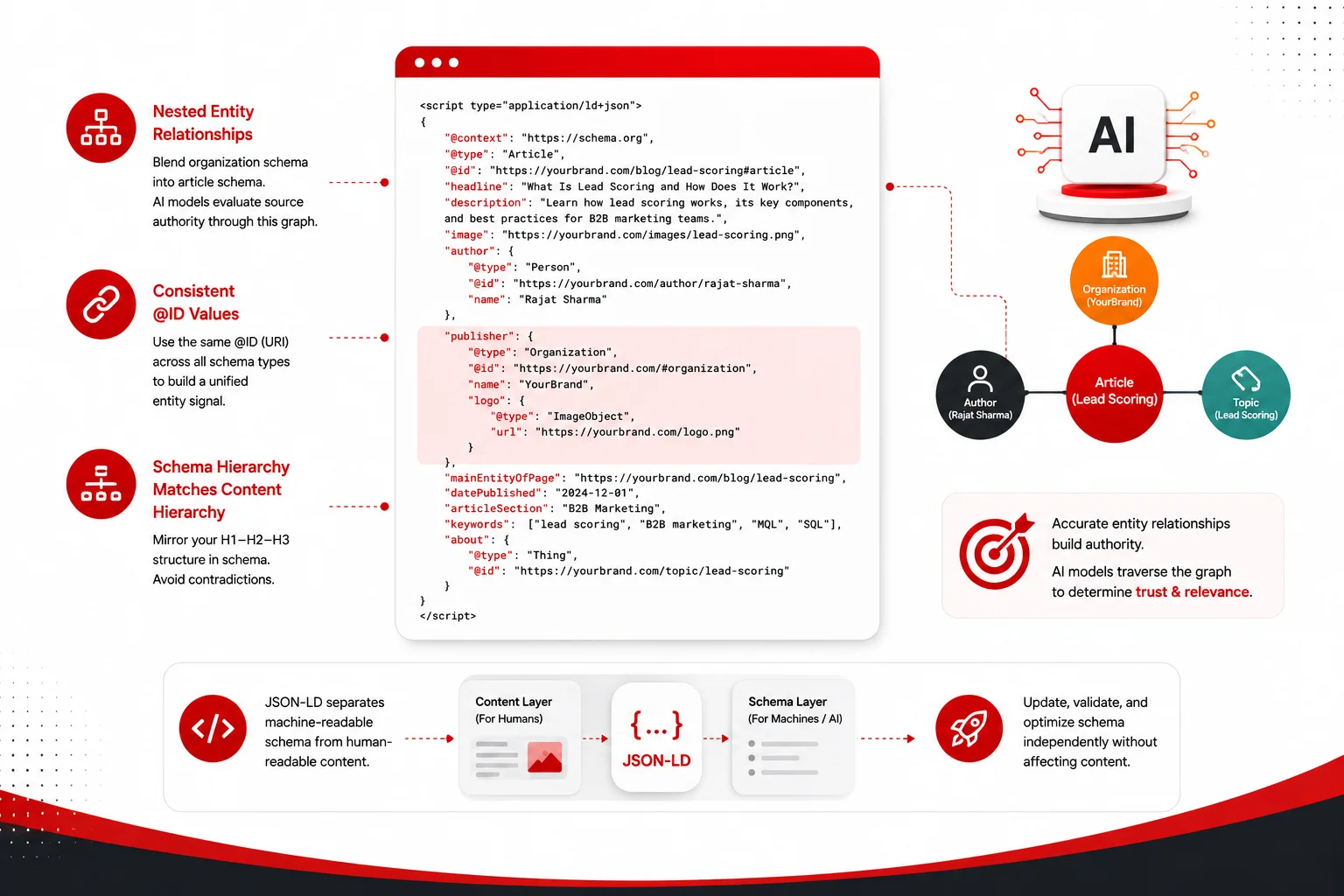
Here are the implementation decisions that enhance AI retrieval:
1. Nested Entity Relationships
The publisher property should blend the organization schema markup into the article schema, resulting in a connected graph that offers clearer relationships between the publishing organization and the article. An accurate entity relationship often outperforms the number of irrelevant markup types.
2. Consistent @ID Values
Consistent @ID values help maintain a unified entity signal across schema types.
3. Schema Hierarchy Matching Content Hierarchy
Instead of contradicting the H1-H2-H3 content structure, the schema markup for SaaS websites should mirror it.
How to Validate Schema Markup Step by Step Before and After Deployment
B2B enterprises often ignore maintenance practices to treat schema validation as merely a launch task. AI search optimization with schema consistently breaks due to content migrations, CMS updates, and page redesigns, which is often visible after the AI citation frequency drops sharply.
According to WPRider’s 2025 analysis, the correct implementation of schema markup for LLM optimization can improve AI retrievals by over 36%. Here is the AEO checklist for structured data and validation that can avoid this breakage:
- Google’s Rich Results Test Before Deploying: It helps B2B enterprises identify structural errors in JSON-LD before they erode live pages.
- Entity Relationship Validation: Use Schema.org’s validator to check structured data syntax and inspect whether integrated entities and @ID values are consistently defined.
- Submit the Sitemap: Updating sitemaps in Google Search Console after deployment might accelerate re-indexing and recognition of structured data for LLMs.
- Monitor Errors: Review Google Search Console consistently to surface warnings and errors.
- Retest After Each CMS Update: As CMS platforms repetitively update JSON-LD on page updates, perform another check after template and plugin changes using tools like SEMrush and Screaming Frog.
Beyond initial implementation, a monthly audit of schema for autonomous search agents generates more commercial value.
Key Takeaways: How Structured Data Improves AI Discoverability and AI Search Visibility
AI-first structured data strategy helps B2B enterprises translate content authority into AI model-readable signal using structured data, which must replace last-minute technical tasks with content architecture by becoming part of it.
B2B enterprises that implement the schema markup checklist for SEO correctly, from maintaining the implementation to periodic validation, often have a compounding edge over competitors with silently degrading schema.
Marketboats can help you audit your current technical SEO schema markup and identify which data gaps reduce AI search visibility.
FAQs
1. How to implement structured data for B2B websites?
Begin with the content types that are significant for the page. Further, embed relevant JSON-LD, Product, Article, Organization, Person, or other applicable entities. Lastly, validate the implementation with Schema.org and Google’s testing tools.
2. How to optimize schema markup for AEO?
Keep schema accurate, use stable identifiers, and connect related entities to optimize schema markup for AEO. Ensure every marked-up claim appears visibly on the page. The last step of optimization is the integration of schema with authoritative sources, clear content structure, and direct answers.
3. How to add FAQ schema for better search visibility?
Develop question-and-answer content appearing visibly on the page. Marking up the content accurately and validating the implementation are the following steps to add FAQ schema. However, FAQ schema does not guarantee AI citations or rich results.