
Most B2B teams can generate leads. The real challenge starts when the operational system between targeting, validation, outreach, and handoff begins to break down.
According to Martal Group’s recent research, 68% of B2B marketers report increasing their lead volume year-over-year, while only 32% say their lead quality has improved proportionally. The bottleneck sits in the operational infrastructure connecting targeting to delivery.
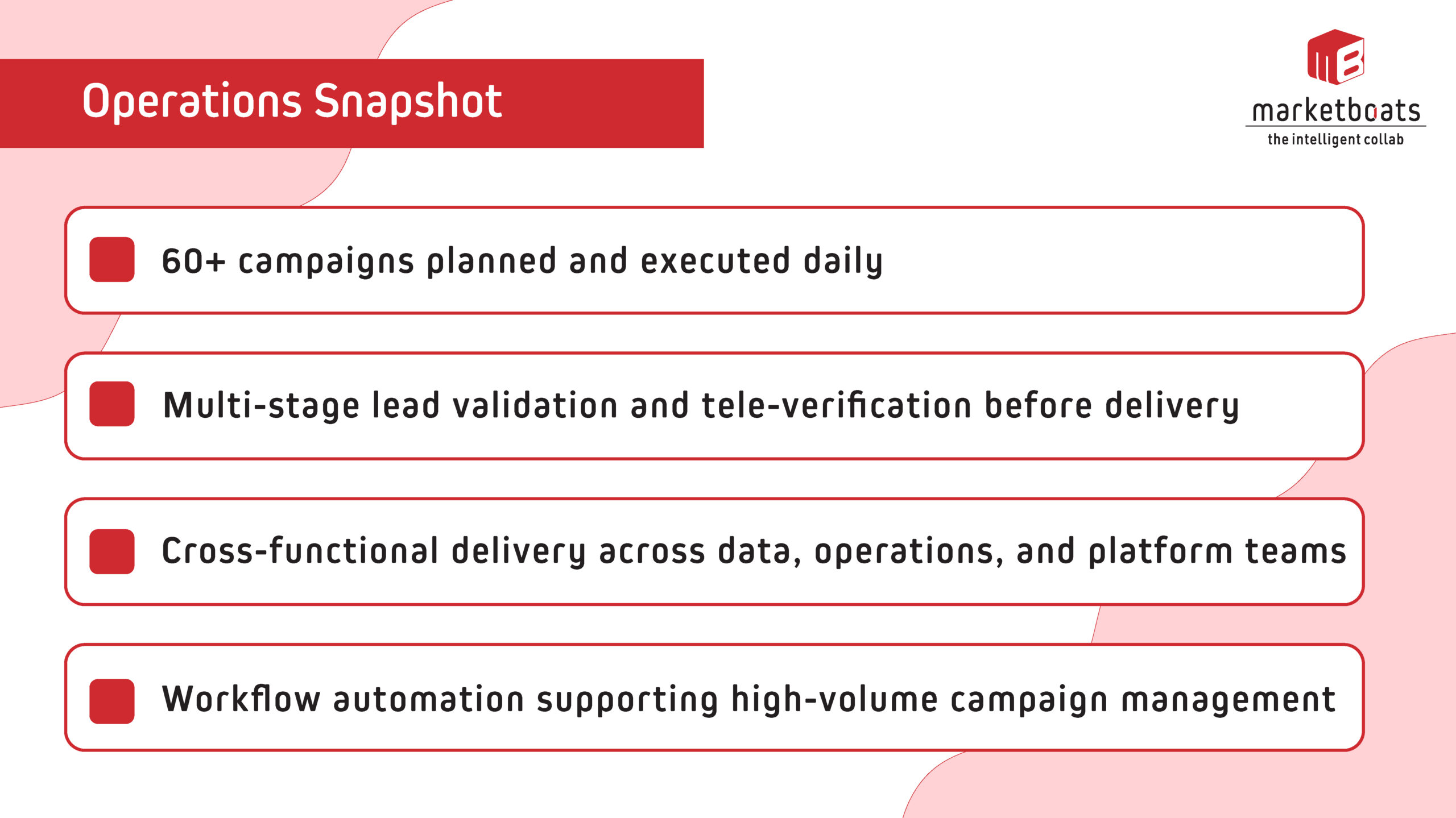
At Marketboats, we run B2B lead generation operations across outbound and demand generation programs. On an average day, we plan and execute more than 160 campaigns and deliver thousands of validated leads to clients across technology, healthcare and enterprise software sectors.
Tools and dashboards help. But the real work happens in the operating system that keeps lead quality improvement, delivery speed, and campaign governance connected at scale.
The Reality of B2B Lead Operations at Scale
Most B2B organizations hit the same pattern as they scale:
- Campaign volume increases while operational complexity grows exponentially
- More stakeholders enter the process creating coordination debt that slows everything down
- Quality control becomes reactive rather than built into the workflow
- SLA breaches become normalized eroding trust between marketing and sales
- Tool sprawl creates blind spots where no single team has complete visibility into the delivery chain
When you see a lead quality problem, look deeper. More often than not, you’ll find an operations architecture problem underneath.
My role sits right in the middle of that system.
What B2B Lead Operations Means in Practice
I manage campaign planning at Marketboats. That means I sit between a client’s requirements and the teams that make B2B lead generation work every day: email operations, email design, data, lead validation, MIS, tech, and data engineering.
My job is easy to explain and hard to pull off with discipline: Decide what we will run today and make sure it actually gets delivered.
Most days start with the same set of checks:
- Which demand generation campaigns are live
- What is due today
- What has tight ICP targeting that needs special attention
- What looks simple on a tracker but will get stuck because contact data is thin or validation is backed up
- What engagement trends are telling us before we press send again
When open rates or replies start dipping, we slow down and fix something upstream in the lead delivery system. We treat it as a signal, not just a number on a report.
Key Insight: Most B2B teams run campaigns in parallel but optimize them in isolation. Our daily stand-up creates a shared forcing function where cross-functional dependencies become visible before they break delivery.
The 90-Minute Stand-Up That Runs Our Revenue Operations
We’ve been running this daily stand-up for four years. This is where the day gets decided.
Dashboards handle reporting. This call locks the plan.
Who’s in the Room
The same teams, every morning. The people who can unblock delivery:
- Marketing and email design – creative execution and campaign messaging
- Data – contact discovery, list pulls, and enrichment
- Lead validation and tele-verification – quality assurance before delivery
- MIS – pacing, throughput, SLA tracking, and performance analytics
- Tech and data engineering – workflow automation in marketing and platform reliability
Everyone stares at the same campaign queue. Each team brings a constraint. Surface those constraints here, or spend the rest of the day finding them one by one, usually right when pipeline quality starts to slip.
How We Prioritize Campaigns Without Breaking Quality
Volume creates obvious pressure. When you’re running 160+ campaigns simultaneously across different industries, ICPs, and engagement stages, the wrong prioritization decision costs you immediately.
We prioritize based on three factors:
- Delivery cadence – SLA commitments and contractual obligations come first
- Complexity of targeting and ICP – campaigns requiring specialized data enrichment or multi-touch validation get scheduled when those resources are available
- Client deadlines – pipeline acceleration campaigns tied to sales cycles or product launches get priority weighting
Then we decide the daily mix:
- How many email campaigns we run
- Which clients go first
- Which channels are realistic to ship without hurting lead quality downstream
- Where we need to throttle volume to maintain engagement metrics
What We Talk About When Things Aren’t Working:
Daily synchronization shows its value here:
- Engagement trending down in a segment – Are we hitting saturation? Is the messaging stale? Do we need to rotate creatives or adjust send times?
- Lead validation not clean enough – What’s causing the quality drop? Is it data source degradation or validation criteria drift?
- Contact coverage not strong in our internal subscription databases – Do we need to activate third-party data partners or adjust ICP parameters?
- Last-minute client changes in campaign specifications – What’s the impact on delivery timeline? What needs to be re-validated?
- Moments where the ICP needs flexibility – Can we deliver against the original spec without forcing leads into the wrong bucket?
By the end of the call, decisions are done. That’s the real output.
Lead Validation and the MQL-to-SQL Handoff Architecture
The validation layer is where most organizations lose control in B2B lead operations. According Leadboxer’s research, 44% of marketing-qualified leads have real conversion potential, and 67% of lost sales are due to poor qualification because of unclear handoff criteria or quality concerns flagged too late.
Our validation architecture prevents that:
Data Team Allocation
- What accounts to pull from which data sources
- What enrichment is required (technographic, firmographic, intent signals)
- What needs deeper manual research before outreach
Lead Validation Team Allocation
- Which accounts get verified first (based on campaign priority)
- What proof is expected before a lead is marked ready for MQL-to-SQL handoff
- Which validation criteria apply (job title verification, company size confirmation, technology stack validation)
Tele-Verification Allocation
For high-value accounts or campaigns with strict quality gates:
- Which leads need a qualification call before delivery
- What talking points verify buying intent vs. general interest
- Which accounts require executive-level confirmation before progressing to SQL
Email Operations, MIS, and Platform Teams
Email Operations:
- What mailers are going out today
- What’s still pending from design
- Which campaigns need A/B testing before full deployment
MIS tracks:
- What to track hour-by-hour to catch pacing issues early
- What to flag if delivery velocity slips against SLAs
Tech and data engineering address:
- What needs fixing in the workflow or automation platform
- Which integrations are creating bottlenecks
- What data pipeline issues could slow down delivery
- Where manual processes can be automated to improve throughput
On good days, half the work gets done inside the call because the handoffs inside the delivery chain stay clean.
Why System Transparency Matters More Than Individual Dashboards
Most B2B organizations have abundant data and weak shared context.
We run everything on one shared view:
- Same tracker across all teams
- Same definitions for campaign stages and lead states
- Same visibility into blocks and dependencies
- Same understanding of what “next step” means
This creates natural accountability:
- If lead validation slows down, email operations feel it immediately
- If data is thin, outreach cadence breaks and everyone sees the gap
- If the platform has an issue, everyone waits – and everyone is invested in the fix
- If a client changes requirements, the ripple effects are visible across the entire chain
Because everyone can see the chain, solutions become cross-functional. High-volume B2B campaign management stays stable at scale when you have this level of visibility.
How Our Operations System Evolved
Most of our improvements came from the same problems showing up repeatedly in this call.
Here’s what that looked like in practice:
Problem 1: Research Slowed Lead Validation
Symptom: Validation team spending excess time switching between LinkedIn, company websites, tech stack databases, and news sources
Solution: We improved our internal workflow automation to reduce research friction and make validation more efficient.
Problem 2: Campaign Volume Outgrew Ad Hoc Prioritization
Symptom: Conflicting priorities between clients, missed SLAs, and team confusion about what to work on first
Solution: Codified our prioritization framework into the platform process with weighted scoring for delivery cadence, complexity, and client tier
Problem 3: Contact Enrichment Quality Hurt Engagement
Symptom: Engagement rates declining despite clean contact data
Solution: Implemented AI-powered enrichment for intent signals and built a knowledge repository that captures institutional learning about accounts over time
Scaling B2B Lead Generation Without Scaling Chaos
When we started, we planned around 15 campaigns a day.
Today, we plan and execute around 160 campaigns daily and deliver thousands of validated leads.
The stand-up stayed consistent. The tooling and automation around it evolved.
The structure holds because the system depends on clear handoffs, shared visibility, and governed workflows – not on one person.
What This Means for Revenue and Operations Leaders
For VPs of Marketing, Heads of B2B Revenue Operations, and Directors of Demand Generation managing high-volume lead generation programs:
- Volume without operations infrastructure creates quality debt – You can scale leads, but without scaling your validation, handoff, and SLA governance, you’re building fragility into your pipeline.
- Asynchronous coordination breaks down at scale – Slack threads and email escalations create invisible coordination overhead. Structured daily synchronization converts chaos into predictable throughput.
- Transparency beats dashboards – Teams with shared visibility self-correct faster than teams that rely on reporting layers and retrospective analysis.
- The best automation eliminates coordination, not just tasks – Workflow automation that removes decision-making ambiguity matters more than automation that just speeds up manual work.
- Your operating system is your competitive advantage – Competitors can copy your messaging and your ICP targeting. They can’t easily replicate an operations architecture that delivers quality at speed.
Why This Meeting Actually Works
Operations circles love to say “meetings are waste” and “async is always better.”
That works for information distribution. It falls apart for decision synchronization.
This daily stand-up is where campaign planning meets execution. We think about lead delivery as an operating system.
Without it, the same decisions still happen – scattered across pings, escalations, and late surprises.
With it, every morning ends the same way: A plan clear enough to run, and honest enough to survive the day.
For teams scaling volume without losing control of quality, this operating model underpins every engagement we run.
About the Author
Santosh Redekar, Manager – Email Marketing, Marketboats
With experience of over 10+ years, Santosh manages campaign planning and operations for B2B lead generation campaigns across technology, healthcare, and enterprise software sectors. He specializes in building scalable operations infrastructure that connects targeting, validation, and delivery without compromising quality.