
AI in demand generation uses generative AI and machine learning to find, prioritize, and engage the B2B buying groups most likely to purchase, while humans retain judgment. You can adopt AI marketing automation to accelerate lead production, but engaging multiple decision-makers within the same account can produce better commercial yield.
Zipdo’s 2026 research finds that AI automation can reduce support staff costs by 30%. However, automation built on weak systems can create more problems. More leads and campaigns may not guarantee you better productivity.
Connect AI-powered lead generation models with strong processes, systems, and human intelligence. When AI compresses the path to the correct conversation, demand generation can improve. AI needs an operational foundation to produce commercially meaningful outcomes.
Marketboats often examines why B2B enterprises struggle to consolidate data across different systems and spreadsheets. Sameer Gujral, Marketboats’ founder and CEO, has discussed the emergence of AI in demand generation; you can watch it here.
How AI Is Transforming B2B Demand Generation
AI-enabled demand generation has shifted from activity-led campaign execution to understanding buyer interest and selecting the correct next action for every account, across demand capture and demand creation.
The following table can help you better understand demand generation vs. lead generation, and where AI can add value:
| Evaluation Area | Demand Generation | Lead Generation | Where Can AI Add Value |
|---|---|---|---|
| Objective | It should build and capture demand. | It should capture contact details. | AI can prioritize accounts and perform intent analysis. |
| Core Metric | Track qualified opportunities and pipeline contribution. | Cost per lead and lead volume help measure lead generation performance. | AI can help with attribution and qualification. |
| Potential Risks | Weak attribution can result in poor demand generation. | Focusing only on volume can generate misfit leads. | AI can make decisions based on incomplete or stale data. |
Poorly implemented AI-powered demand generation can lower the sales acceptance rate while increasing volume. If you measure only lead volume, you might misread it as success. Do not automate an inefficient workflow just because it increases activity; it may not improve productivity.
To improve lead quality and campaign execution, your people, technology, and data should work together. Marketboats strongly believes weak foundational systems often lead to more activity, and that should be a warning sign.
Beyond automation volume, evaluate AI based on qualified outcomes and operational efficiency. Instead of asking how many leads a campaign generated, ask how many qualified conversations it started. This is how businesses can implement AI in demand generation.
How AI Helps Identify B2B Buying Groups
AI can connect activity across multiple contacts within the same account, map likely roles, and flag signs of purchase readiness to identify B2B buying groups. A contact-level lead score may not produce such buying group intelligence on its own.
The following practical checklist can help you understand how to engage multiple stakeholders in B2B buying groups:
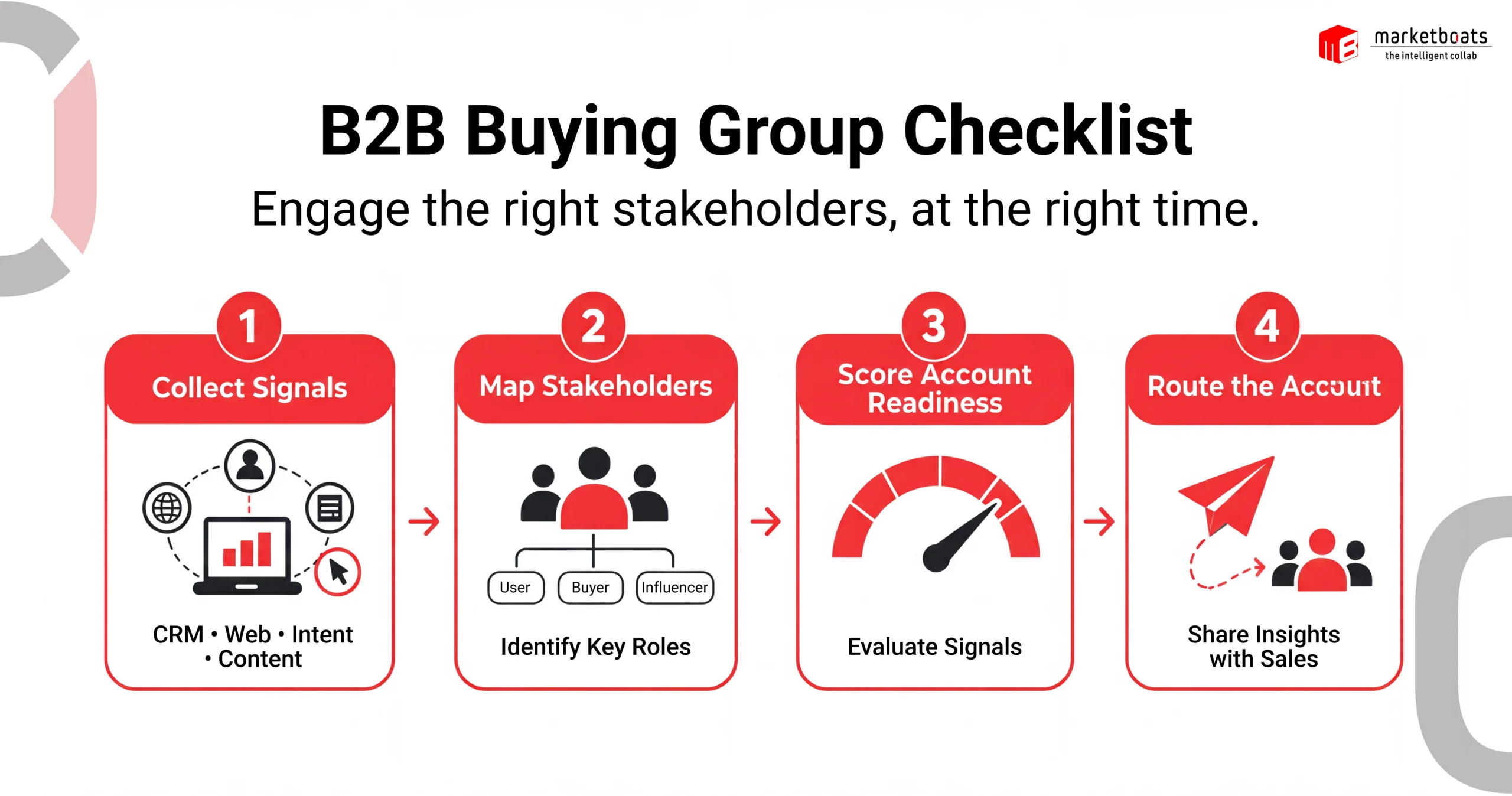
- Collect Signals: Combine CRM activity, website engagement, intent data, and content interactions to develop a shared view.
- Map Stakeholders: Differentiate contacts by their roles, and treat them as hypotheses until your sales team validates them.
- Score Account Readiness: Weigh signal breadth, recency, and engagement across multiple stakeholders within the same account.
- Route the Account: Hand over the engaged stakeholder roles, missing coverage, and account-level view to your sales team so that reps can determine the next action.
Analyzing a single lead score may describe one person’s interest, but engagement across multiple stakeholders within an account over time may reflect buying-group movement. GoConsensus’s 2026 report finds that multi-stakeholder demoboards are twice as likely to be tied to opportunities.
After adding organization-chart targeting, Marketboats averaged 1.36 leads reached per account in Q3 of 2026. This indicates the average number of contacts reached within each target account. Stakeholder mapping can be easy, but your sales team must decide which decision-makers matter most for each deal type.
How to Combine AI and Human Intelligence in Demand Generation
While AI can identify patterns at scale, human oversight can devise strategies, qualify opportunities, and handle conversations where trust and context determine the outcome. This is how human-AI collaboration in marketing can work.
You can use the following practical table to understand better how human expertise improves AI-driven marketing decisions:
| Tasks | What Role Does AI Play | What Role Do Humans Play |
|---|---|---|
| Lead Qualification | AI applies predictive lead scoring. | Humans must verify authority, readiness, and fit of those leads. |
| Buyer Conversation | AI prepares stakeholder and account context. | People nurture relationships and handle objections. |
| Signal Detection | AI can recognize engagement intent and patterns. | Humans should determine which signals matter the most. |
| Content and Outreach | AI can simplify drafting and personalize content variations. | People should judge tone, claims, and accuracy of the content. |
AI adoption can surface where deals have stalled, while people who know their buyers can explain why. Buyers may validate AI-generated information by checking it against other sources. People who can answer follow-up questions clearly can build credibility and trust early.
Marketboats encourages B2B teams to examine which systems, processes, or people contributed to a problem when results go wrong. Examining these factors in your AI-driven B2B marketing system helps you understand where human judgment is needed in AI-powered decision-making.
How to Use AI in B2B Demand Generation
First, set a north star metric and build the operational foundation around it. Then add predictive lead scoring, measurement tied to qualified opportunities, and buying-group engagement. This is how you can use AI in B2B demand generation.
Use the following five-step framework to embed AI in your B2B demand generation strategy:
| Sequential Steps | What Actions Should Be Taken | What Should You Check |
|---|---|---|
| Set Up a North Star | Determine one measurable outcome to achieve over the next 12 months. | One team should own the metric. |
| Build the Foundation | Improve data quality by connecting workflows. | The system should support growth without requiring proportional increases in cost. |
| Introduce AI | Include role-based engagement and predictive lead scoring. | Your sales team should accept prioritized leads. |
| Triage Performance | Evaluate people, processes, and systems when results deteriorate. | Every problem should have an accountable owner. |
| Monitor Outcomes | Measure pipeline contribution and qualified opportunities. | Compare outcomes against the defined baseline. |
According to Landbase’s 2026 findings, B2B contact data decays at 2.1% per month, and companies lose about 15% of their revenue due to inaccurate contact information. If you keep building your AI demand generation strategy on poor data, it can execute wrong decisions faster.
Generating lead volume and running more campaigns might not necessarily mean better demand generation. Connecting AI use cases to data validation, campaign execution, lead prioritization, audience segmentation, and account coverage can help address this problem.
AI in B2B marketing should help your organization reach its objective. Start with one B2B marketing automation workflow, then expand AI’s scope when its decisions prove reliable.
Summary: What Are the Best AI Strategies for B2B Demand Generation
Using AI to identify and prioritize buying groups and accounts, while relying on humans to qualify opportunities, manage engagement, and remain accountable for results, can create an AI-powered B2B marketing strategy that drives better commercial outcomes. Do not scale AI without fixing operational weaknesses, because it can scale complexity without producing optimal results.
Buying-group coverage and lead quality can indicate how effectively your AI system is functioning. Instead of measuring AI maturity by the number of activities performed, evaluate your system’s lead quality, business outcomes, and buying-group coverage.
Marketboats will advise you to answer the scalability question first and then move toward the growth question. We integrate scalable demand generation, human intelligence, and data-driven insights to help B2B enterprises connect with relevant buying opportunities.
Marketboats can help you understand why human intelligence still matters in AI-powered B2B marketing and build the operational foundation your AI initiatives need.
FAQs
1. How is AI changing B2B demand generation?
AI allows B2B enterprises to prioritize accounts, analyze intent signals, identify buying-group engagement patterns, and personalize campaigns. AI can shift the emphasis from lead volume and campaign activity toward pipeline contribution and qualified conversations.
2. What are the benefits of AI-powered demand generation?
Improved audience segmentation, account-level engagement, campaign efficiency, and lead prioritization are core benefits of AI-driven demand generation. However, its value can vary based on workflow integration and data quality.
3. Can AI replace human intelligence in B2B marketing?
No. Although AI outpaces humans in data processing, pattern recognition, and action recommendations, people still play an important role in assessing buying authority, making strategic decisions, and building relationships. As a result, human accountability remains vital throughout the buying journey.
4. How can AI improve B2B buyer engagement?
AI can combine intent and engagement signals across contacts within the same account, help B2B teams personalize communications by roles, and identify gaps in stakeholder coverage. Sales teams also need to validate these insights and decide how to engage each stakeholder.
5. What is the role of human intelligence in AI-powered marketing?
Human intelligence can provide contextual understanding, accountability, and strategic direction. It can also interpret buying behavior, ensure marketing decisions support actual business outcomes, validate AI recommendations, and handle complex conversations.