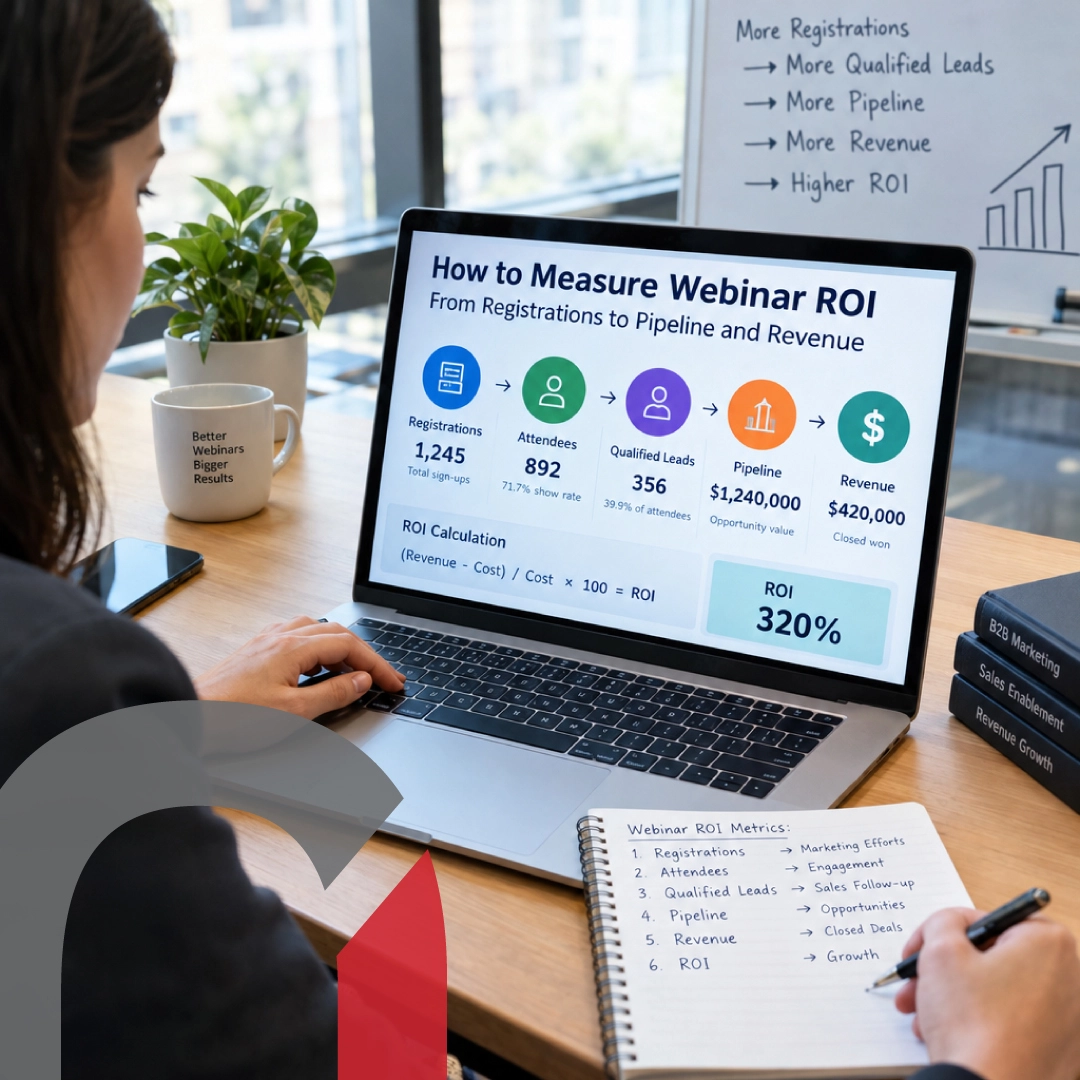
Instead of tying webinar cost to attendance rates, enterprises can measure B2B webinar ROI in 2026 by linking it to the pipeline and closed-won revenue it generated. Many teams measure ROI by webinar attendance rate or registrants, but these metrics rarely connect to revenue.
While KPIs many B2B teams currently monitor describe the event, webinar revenue attribution and webinar-generated pipeline show the commercial value of the investment. WaveCNCT’s 2026 research finds that webinar-generated leads move through the funnel 22% faster than prospects from other channels.
ROI should be reported alongside other revenue-generating investments using comparable commercial metrics. B2B teams connecting MAP and CRM before running their first webinar know how to prove webinar ROI to executives.
What Are the Most Important Webinar KPIs, and Why Aren’t Webinar Registrations Enough to Measure ROI
MQL-to-SQL conversion rate from webinar leads, average deal size, revenue per qualified attendee, webinar-to-MQL conversion rate, and pipeline generated per webinar are key webinar ROI metrics for commercial measurement.
Many B2B enterprises report webinar attendance, yet it is less commercially valuable, as registrants meeting the ICP qualification threshold and producing at least one intent signal matter more. A practical two-tier KPI framework can answer how to measure B2B webinar ROI:
| Tier | KPIs | What It Tracks | Why Registrations Alone Miss It |
| Tier 1: Activity | Attendance rate, webinar registration rate, registration-to-attendance rate, and average watch time. | Event quality and program reach. | These KPIs can describe the event, but might not provide enough commercial evidence for budget justification. |
| Tier 2: Revenue | MQL-to-SQL rate, average deal size, webinar-to-MQL rate, revenue per qualified attendee, and pipeline per event. | Commercial outcomes linked to webinar investment. | These metrics can be tracked when MAP and CRM are integrated at the opportunity and contact level. |
EPIC MARKETING EVENT’S 2026 research finds that the average MQL-to-SQL conversion rate and SQL-to-pipeline rates are 27% and 41%, respectively. Revenue per qualified attendee expresses webinar performance in monetary terms, making it easier to compare with other revenue-generating investments.”
The integration of MAP into CRM at the opportunity and contact level can make the tier-2 metrics measurable. Therefore, instead of reconstructing the webinar ROI measurement architecture from campaign data, it should be configured before running the first webinar.
How to Calculate Webinar ROI From Revenue
Webinar ROI can be calculated by subtracting total webinar program cost from webinar-attributed closed-won revenue, then dividing the result by total webinar program cost.
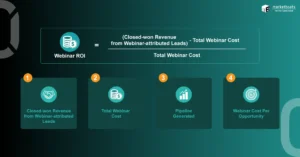
B2B enterprises should not treat their pipelines as realized revenue. A pipeline used for planning should be explicitly distinguished from webinar revenue-based ROI through labeling. The following can be a practical four-part webinar ROI calculation model:
- Closed-won Revenue from Webinar-attributed Leads: Begin with closed-won revenue from opportunities that meet the predefined attribution model and include webinar touchpoints within the attribution window. MAP needs to log attendance as a contact activity, while CRM should link this activity to the corresponding opportunity.
- Total Webinar Cost: Calculate costs like SDR time for webinar follow-up, content production, promotional spend, speaker fees, and platform licenses for platforms like Zoom Webinars, ON24, or Goldcast.
- Pipeline Generated: Report pipeline separately from closed-won revenue, which can allow leaders to see lagging and leading commercial outcomes.
- Webinar Cost Per Opportunity: Calculate the cost by dividing the program cost by the number of webinar-attributed opportunities. This metric allows B2B teams to compare webinar acquisition efficiency against other demand generation channels.
The inclusion of SDR time in webinar cost calculation can increase apparent cost, which is why many B2B teams avoid this webinar marketing ROI transparency decision.
It can also calculate accurate cost per opportunity, reflecting true investment needed to translate a webinar attendee into a pipeline. As a result, it ensures that budget decisions are more comparable to other demand generation investments.
Final Takeaway: How to Measure Webinar ROI and Connect It to CRM Revenue Data
MAP-to-CRM bidirectional sync, engagement activity tied to corresponding opportunity, webinar attendance logged as contact activity, and a predefined attribution window are four technical decisions that help B2B enterprises monitor webinar performance metrics and ROI.
Webinar ROI analysis becomes harder to scale reliably when MAP engagement data is not connected to CRM opportunity records. Connected data can make calculations much more straightforward. Rather than investing in the ROI formula, B2B enterprises should invest more in integration configuration.
When every component, from registration qualification and engagement scoring to post-event routing and pipeline attribution, is connected, the webinar-to-revenue engine can produce higher commercial value.
Marketboats can help you understand how to measure webinar-generated pipeline and build the webinar ROI measurement framework connecting registrations to closed-won revenue.