
AI qualification models integrate ICP-fit signals from registration data with behavioural engagement signals from live webinars to produce a compound intent score, routing the right accounts to sales more rapidly, which is how AI qualifies webinar leads.
Manual lead scoring can consume more time, delay intent-based action, and produce inconsistent scoring. Rather than replacing the qualification logic, AI-powered lead qualification employs the same logic faster and at scale.
As a result, MQLs can be approached within a few minutes after the webinar. Martal Group’s 2026 research finds that B2B teams approaching MQLs within the first hour achieve a 53% SQL conversion rate.
AI-powered prospect scoring can automate application criteria, which the sales team should define before configuring the AI system. AI’s real commercial value lies in turning scattered engagement data into an actionable prospect priority.
How AI Combines ICP Fit and Buyer Intent to Identify High-intent Webinar Leads
AI-powered lead scoring produces a composite score by combining ICP-fit and behavioral intent scores, then applying a defined threshold to route prospects to nurture, SDR, or disqualification, reducing manual intervention.
While fixed-point webinar lead scoring models treat all questions equally, AI-driven intent scoring evaluates the question’s content. For borderline-score registrants, this difference can produce different routing decisions. Brixon’s 2025 analysis finds that AI-powered scoring can produce 38% higher conversion rates from lead-to-opportunity.
| Layer | Data Source | What AI Does | Commercial Outcome |
| Layer 1- ICP Fit | Registration and account data enriched through platforms such as Clearbit or ZoomInfo. | AI evaluates industry, company size, and other firmographic signals against defined ICP benchmarks. | Routing priority and fit score. |
| Layer 2- Behavioral Intent | Polls, watch time, downloads, CTA activity, and questions. | AI analyzes engagement patterns against historical conversion parameters. | Routing action and intent score. |
AI-driven enrichment can reduce dependency on self-reported firmographic data. Because high- and low-scoring registrants route clearly under any framework, the AI intent layer can become more commercially valuable for mid-range scorers.
Humans inconsistently classify borderline cases, which is where AI webinar lead qualification can produce the most routing improvement. The mix of intent and fit avoids AI overemphasizing engagement without context.
How to Score Webinar Leads With AI, and How AI Can Qualify Webinar Leads
ICP criteria, engagement signal weights per behaviour type, a compound threshold for every layer, and CRM integration automatically executing the routing sequence upon meeting the threshold are the four input types that help AI score leads, and this is how AI identifies sales-ready webinar leads.
Routing tiers with a defined conversion target and a periodic review system can produce better commercial value through AI lead routing. However, the AI lead routing framework with no feedback loop might degrade in accuracy due to shifting market conditions and ICPs.
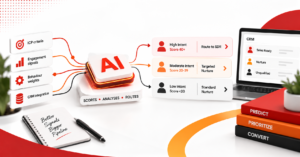
The following can be a practical automated lead qualification framework that B2B teams can use:
1. Tier 1- High ICP Fit and Strong Intent Signals (Score 40+): AI helps B2B teams automatically route high-intent prospects to the SDR queue with a pre-populated outreach brief. It summarizes business challenges and engagement behavior with the minimum manual intervention required.
2. Tier 2- Moderate Intent and Partial Fit (Score 20-39): Route such leads to a targeted nurture sequence and trigger SDR review to filter strong buyer intent signals.
3. Tier 3- Low Fit and Weak Intent (Score <20): Such leads are routed directly to standard post-event nurture with no SDR involvement.
Platforms such as ON24, Goldcast, and HubSpot with webinar integrations and predictive lead scoring capabilities can support automated scoring and intent-based routing workflows.
The quality of AI scoring depends on model design, validation, and input data. Although AI reduces the need for manual intervention, it rarely eliminates the importance of the defined qualification criteria.
Key Takeaways: How AI Identifies Buyer Intent, and How to Build an AI Lead Scoring Model
AI needs defined ICP criteria in the scoring framework, compound score thresholds for each routing tier, and CRM integration automatically executing routing actions to find the intent of webinar attendees; this is how AI identifies high-intent leads.
Rather than replacing the ICP definition, the B2B lead qualification framework using AI adds a rules-and-weights layer on top, and its real commercial value comes from speed and consistency at scale.
After qualifying webinar leads using AI, the next step is to convert these prospects into opportunities. Marketboats can help you understand how AI prioritizes high-intent prospects and connect AI qualification, pipeline execution, CRM routing, and webinar demand generation.
FAQs
1. How can AI identify high-intent webinar prospects?
AI analyzes webinar intent signals like ICP fit, registration data, watch time, CTA activity, polls, questions, and downloads, combining these inputs into a composite score. It then routes prospects based on predefined thresholds.
2. What are the best webinar intent signals?
Poll responses, relevant resource downloads, pricing or demo interactions, sustained viewing, and product-specific questions are some webinar intent signals that can indicate active buying interest.
3. What data does AI need to qualify leads?
Reliable registration and behavioral engagement data, predefined ICP criteria, CRM context, and historical conversion outcomes are the necessary inputs that AI needs to qualify leads. The qualification model also requires clear routing thresholds, which can drive its outcomes to a specific nurture or sales action.