
While ABM produces a pipeline, ABX develops relationships, and most B2B teams mistake the ABM to ABX transition as just a software upgrade rather than treating it as a strategic reorientation. B2B teams that ensured a successful transition from ABM to ABX are the ones who clearly understood where ABM fell short before they replaced it.
The transition failure in most cases happens in framing, not in execution. Most B2B teams retain ABM logic and run campaign delivery operations while adopting ABX language, and this is the core problem.
Salesforce’s research finds that 79% of B2B buyers expect consistent interactions across touchpoints and channels, but still, most ABX programs are disconnected. ABX becomes ineffective when it inherits the same isolated execution structure as ABM.
Why ABM Is Evolving Into ABX, and What This Shift Needs
The traditional ABM was designed for pipeline generation and was built around relatively linear buying journeys. However, the average buying committee size has grown to 6-10 stakeholders, and sales cycles have also lengthened. B2B buyers evaluate vendors even before their first sales interaction.
ABM limitations are structural, and its measurement model, campaign architecture, and account selection logic are not suitable for this environment. More than personalization sophistication, the transition from ABM to ABX is an operating logic shift.
ABM emphasizes account acquisition, whereas ABX extends ownership across retention, customer experience, and expansion. ABX implementation goes beyond changing marketing tactics to enhance organizational coordination.
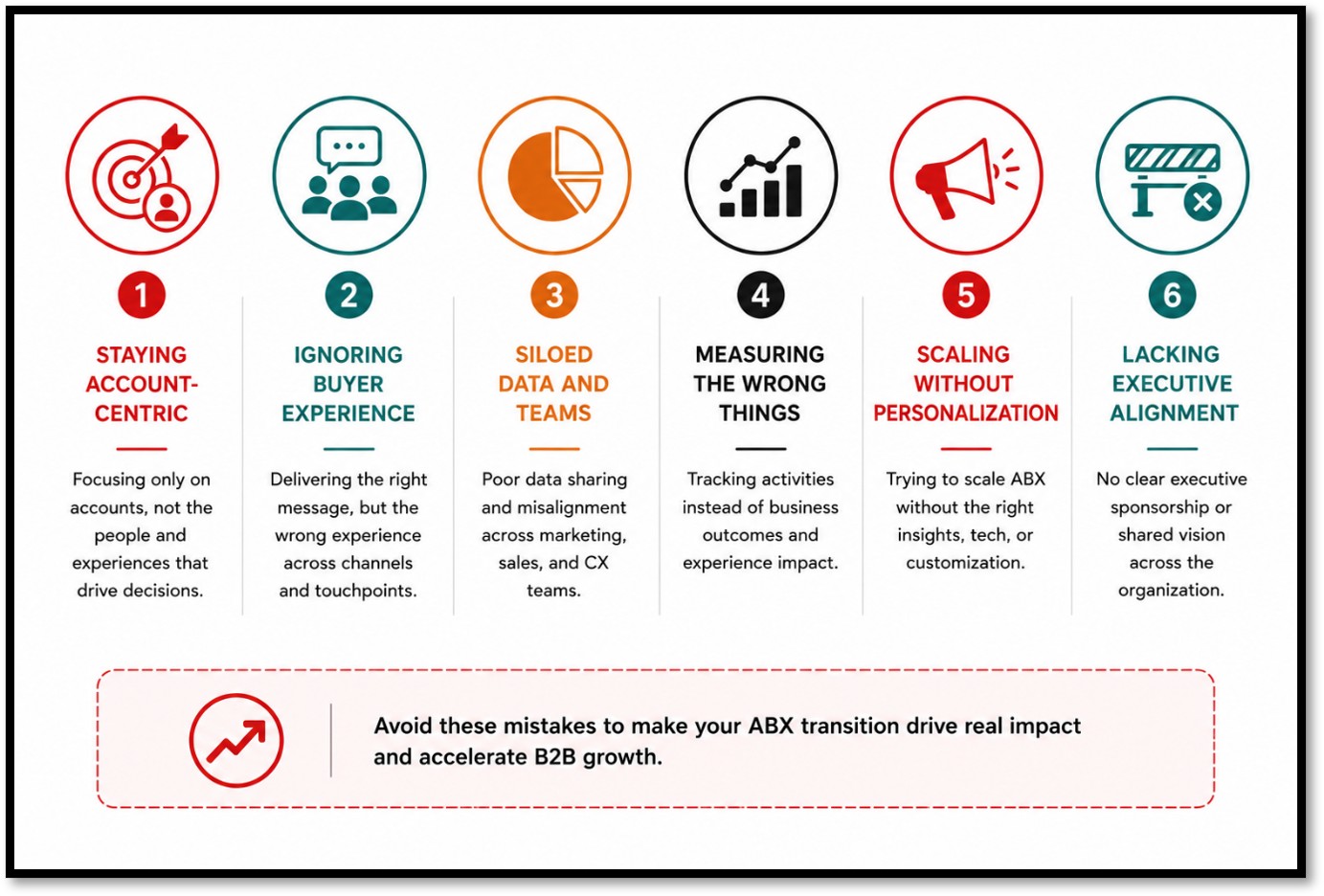
Common ABX Mistakes B2B Teams Make During Adoption
1. Using ABM Metrics to Measure ABX Success
Measuring MQL volumes and campaign response rates can never tell you how successful your ABX strategy is; instead, it will only reflect how efficiently the system tracks irrelevant activity. The success of ABX resides in metrics like expansion revenue, retention rates, and deal velocity, which reflect relationship quality.
2. Personalizing to Account Profile
Knowing that the account belongs to a particular sector helps you know what to talk about, while understanding how the buying group evaluates the implementation risks tells you when and how to initiate the engagement. The second information layer points toward ABX personalization, but most B2B teams only apply the first layer and misinterpret it as personalization.
3. Treating Post-sale Accounts as an Independent Program
ABX brings acquisition and retention closer, reducing the separation between them. The customer account reflecting expansion signals must receive the same experience quality as that of the target account in active evaluation, as they belong to the same buying group.
Most B2B teams transitioning from ABM to ABX expect a coordinated customer experience while preserving a siloed ownership structure. Fragmented handoffs break the account continuity.
What Makes ABX Different from ABM
Although ABM can tolerate marketing and sales misalignment, ABX mandates seamless coordination between sales, marketing, and customer success teams. Sales and marketing alignment is the structural requirement for ABX, where all teams must understand the account’s position during pre-sale, mid-sale, and post-sale.
ABX needs coordinated decision-making across the entire buyer lifecycle. HubSpot’s research unveils that closely aligned sales and marketing teams increase B2B companies’ profit growth by 27%, with 36% higher customer retention.
However, when these functions operate across different account data, success definitions, and engagement timelines, the account experiences three different vendor relationships, which creates a credibility problem. Personalization does not work when all teams optimize for different outcomes.
Unified pipeline accountability and GTM alignment become two structural requirements for ABX to become efficient, and this is the step most ABM-to-ABX transitions miss.
How Does ABX Improve B2B Growth, and How to Successfully Implement It
Step 1: Replace MQL Metrics with Relationship-stage Measurement
Define a healthy account relationship at every buying stage, including awareness, consideration, evaluation, adoption, and expansion, and track how effectively campaigns move accounts at every stage.
Step 2: Build Account Experience Around Buying Group Signals
ABX strategy for B2B growth rewards targeting a buying group instead of a single contact. The buying group’s behavior describes a commercial decision, and the experience needs to take this entire picture into account.
Step 3: Extend the Program Solely into the Post-sale Stage
Expansion signals must be defined explicitly as pre-intent signals and routed with the same urgency. The buying group involved in the purchase drives renewal and upselling, and that is why treating customer retention and expansion as the same program as acquisition gives the best ABX results to B2B teams.
Final Thoughts: Why Companies Are Moving from ABM to ABX
The ABM-to-ABX transition becomes successful when the architecture of measurement, alignment, and account experience is developed around relationship quality rather than the campaign outcomes. B2B teams that succeed at this alignment will have an edge.
ABX will become a baseline expectation instead of a differentiator due to ever-increasing buying committee sizes and post-sale revenue becoming a larger share of the total revenue. Companies that implement the B2B account-based marketing strategy efficiently will compound their advantage.
Marketboats can help you identify which structural changes you will need to produce a larger pipeline impact.
FAQs
1. How ABX improves customer experience in B2B?
ABX aligns sales, marketing, and customer success around coordinated account journeys to improve customer experience.
2. Why B2B companies are shifting from ABM to ABX?
Modern buying journeys need lifecycle-wide coordination across retention, expansion, acquisition, and customer experience, and that is why B2B teams shift to ABX.
3. What are the common mistakes when transitioning from ABM to ABX?
The biggest mistakes that B2B teams commit while transitioning are measuring campaign activity instead of relationship progression, separating post-sale experience from acquisition strategy, and retaining siloed ownership.