
Content marketing in AI era scales visibility, while thought leadership nurtures trust, and neither of them can work independently. Most B2B teams treat them interchangeably, and as a result, they produce volume with no authority.
AI has made it easier for B2B teams to produce content at near-zero cost and in no time. The scarcity that was once a competitive advantage for companies has shifted from content production and publishing capacity to the human perspective.
Demand Sage’s 2025 industry analysis finds that 89% of B2B teams include AI in their operations, but 80% of searches now end without a single click. Although content abundance is increasing, differentiation is shrinking.
Most B2B teams conflate the thought leadership vs content marketing discussion, which is the strategy misalignment that AI has made expensive.
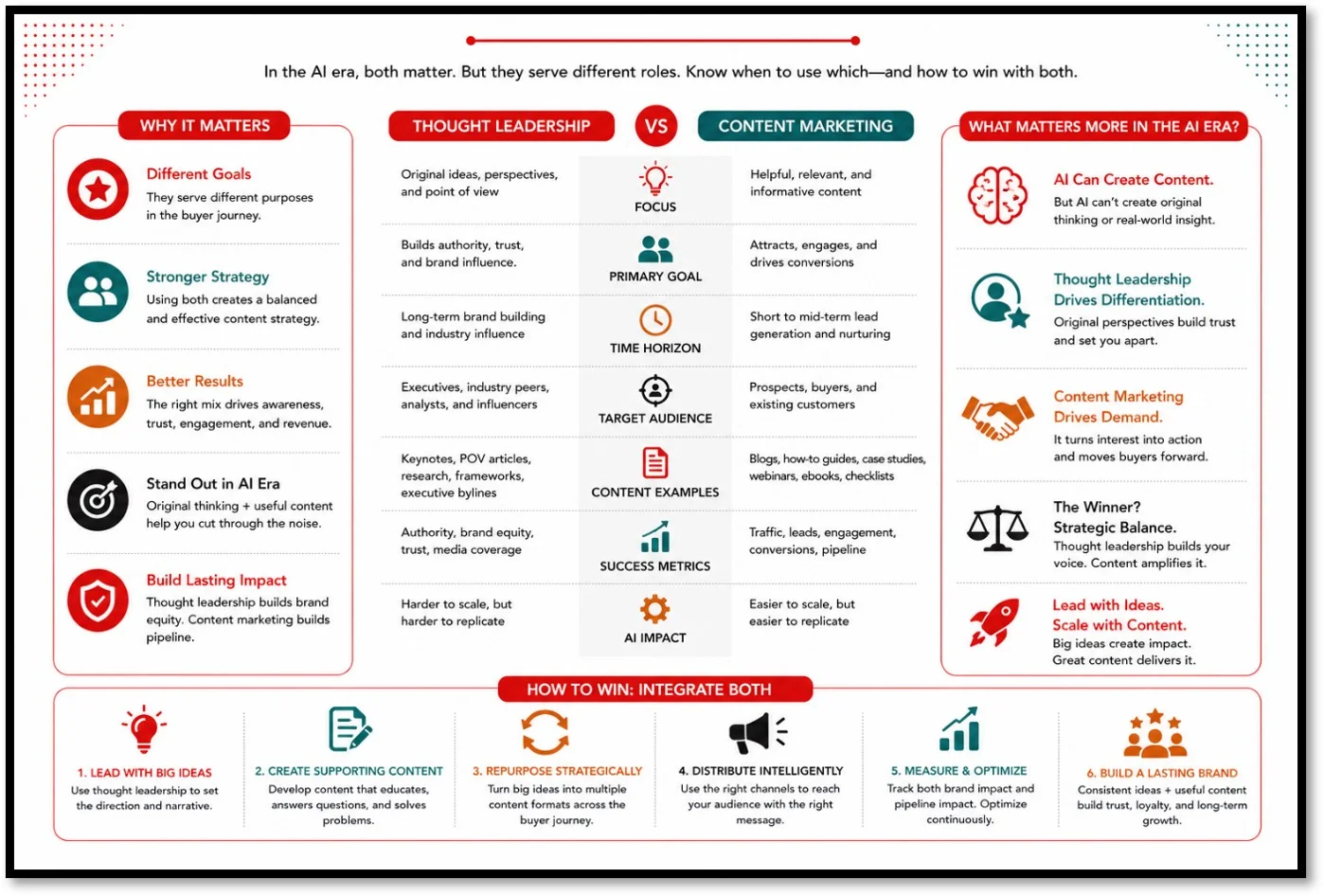
What Is the Difference Between Thought Leadership and Content Marketing, and Why It Matters
| Parameter of Comparison | Thought Leadership | Content Marketing |
|---|---|---|
| Objective | It shapes buyers’ thinking about the problem. | It attracts, informs, and nurtures prospects. |
| Primary Output | It produces arguments and POVs. | It optimizes and scales blogs, emails, and ads. |
| Who Produces | An industry practitioner with earned experience. | Any B2B company with a production system. |
| Is it AI replicable | Lived experience and accountability cannot be replicated. | Information and structure are scalable and can be replicated easily. |
| Operation | It is positioned before the funnel entry. | It operates throughout the funnel. |
| What Does It Build | Trust and authority. | Awareness and reach. |
While thought leadership in AI era builds a perspective, content marketing distributes information. B2B teams that treat thought leadership as just a content marketing format never understand its utility. Content marketing, in the absence of thought leadership, produces structurally identical assets for all competitors.
How AI Is Changing Content Marketing vs Thought Leadership
AI has structurally shifted content production and has raised the quality benchmark for B2B teams across different categories simultaneously. A well-researched, technically sound, and grammatically flawless content is no longer a differentiator, but the baseline.
The ceiling of differentiation has risen with the elevating floor of content volume for every competitor, and it demands a unique perspective that AI engines cannot replicate. This perspective comes from an argument in which the author’s reputation is included, a POV built over years of commercial judgment and lived experience.
The informational content has lost its scarcity value due to AI. AI publishes information faster than credibility can compound.
When to Use Thought Leadership vs Content Marketing, and How Each Earns Its Place
Thought leadership is mainly deployed at the top and the middle of the funnel, and it shapes buyers’ perspectives even before they evaluate vendors. Smart 360’s insights have found that 79% of B2B buyers are more likely to advocate for a vendor if they find the thought leadership content to be compelling.
Whereas content marketing operates throughout the funnel, from supporting discovery to nurturing and then enabling evaluation, it supports buyer progression once the buyer enters the funnel.
Thought leadership content prepares the background for content marketing by building pre-credibility. While thought leadership develops trust compression, content marketing amplifies the reach.
Thought leadership is the ambient authority that reinforces every funnel stage via credibility. As a result, content becomes replaceable in the absence of thought leadership.
How to Combine Thought Leadership and Content Marketing Into a B2B Authority Strategy
An ideal B2B thought leadership strategy integrates perspective with scalable distribution. The content program must have an identifiable perspective at the core that the company wishes to defend. Content marketing distributes this perspective to extend it further.
The human layer in this strategy is non-negotiable. While AI caters to structure, research, and drafting, the human perspective comes from a defensible claim that an industry practitioner with earned credibility makes. Scaling content without the human layer weakens differentiation.
Measuring authority signals beyond engagement is the last step to reinforce the strategy. Pre-engagement content that closed-won accounts consume, brand mentions, and share of voice in category consumption reveal whether the framework offers any differentiation.
AI must scale distribution rather than replacing perspective, and most B2B teams neglect this fact. Successful B2B companies never mix idea generation with content production.
Final Thoughts: How to Create a Content Marketing Strategy in the AI Era That Builds Authority
Siloed content marketing acts as the infrastructure without a concrete point of view. Though it is efficient at distribution, it does not add any value beyond what competitors are already claiming.
On the contrary, thought leadership with no involvement of content marketing offers no reach. B2B teams that have developed durable authority have balanced both, instead of debating on AI content marketing vs human thought leadership.
The compounding AI content volume will increase the scarcity premium on earned and defended human perspectives. Visibility in the AI era will favor trusted voices over content volume.
Want to develop a comprehensive thought leadership strategy? Book a 30-minute free strategic audit with Marketboats to identify how your volume-centric content pipeline can produce authority.
FAQs
1. How AI is changing content marketing vs thought leadership?
While AI is scaling the informational content seamlessly, thought leadership is still anchored to human perspective, its interpretation, and commercially earned expertise.
2. How to build thought leadership in AI era without sounding generic?
To build an ideal strategy, develop operator insights, defensible opinions, and firsthand commercial experience rather than summarizing already published information.
3. Is thought leadership better than content marketing?
Thought leadership can never replace content marketing. While thought leadership develops positioning and trust, content marketing distributes the authority across buyer touchpoints.