
B2B content syndication platforms reach buyers through third-party publisher networks by distributing gated content, including analyst reports, whitepapers, and eBooks, to ICP-matching accounts to generate leads.
Indeed, a larger publisher network looks promising in a content syndication proposal, but that does not necessarily mean that you will get ICP-fit leads and progress through the pipeline. Along with precise targeting, lead quality depends on transparent validation and well-defined qualification criteria.
More syndicated leads might not generate more pipeline, and inexpensive CPL can hide poor qualification. The Martal Group’s 2026 research finds that 61% of B2B enterprises say generating quality leads is the top challenge.
Rather than selecting content syndication tools based on publisher network size, choose platforms based on lead verification standards, buying group coverage, and ICP fit. B2B enterprises that prioritize intent targeting and lead verification can focus more of their acquisition spend on relevant, usable leads rather than reach alone.
What Is B2B Content Syndication, and How Does It Differ From Content Marketing?
Content syndication will allow you to reach potential buyers through third-party publisher networks. You can distribute whitepapers, eBooks, or reports to ICP-fit buyers, reaching prospects who otherwise might not discover that content on your website.
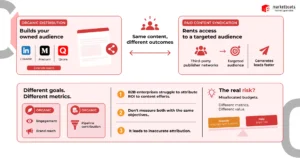
Paid content syndication and content marketing have different objectives. Paid syndication can ensure targeted audience reach and lead capture, while owned content can gradually build engagement and awareness.
The difference between the two becomes important when you measure ROI, and conflating them while reporting can make you either underestimate or overstate their values. Content Marketing Institute found that 56% of B2B enterprises struggle to attribute ROI to content efforts.
While you monitor organic reach and engagement for your owned channels, track acceptance rate and downstream pipeline contribution for paid content syndication. Engagement and brand reach track the former, while pipeline contribution tracks the latter.
What Are the Best B2B Content Syndication Vendors in 2026
The choice of content syndication vendor does not depend only on publisher reach comparison or CPL. Lead verification, buying-group coverage, intent data, and CRM integration matter just as much. The following table evaluates vendors on these parameters:
| Vendor | Model | Intent Data | Pricing Model | Best For |
| Marketboats | Managed syndication and intelligence | Intent-led targeting, qualification, and CALS reporting | CPL with an agreed lead-accuracy guarantee | B2B enterprises seeking verified leads and campaign visibility |
| NetLine | Content demand generation | Self-reported BANT at download | CPL | Gated-content campaigns |
| TechTarget | Enterprise intent and data | First-party | CPL/program-based | Enterprise technology companies |
| DemandScience | Data-led demand generation | Predictive intent modeling | CPL/program-based | Scaled B2B campaigns |
| INFUSE | Managed demand generation | Third- and first-party intent signals | CPL/managed program | Multi-touch programs |
| Integrate | Lead management and governance | Source-diagnostic | Platform subscription | Managing leads across multiple sources |
| Madison Logic | Account-based marketing | Account-level engagement and intent signals | Subscription/account-based | Enterprise ABM |
A low advertised CPL or a larger publisher network might not automatically generate better lead quality. Marketboats uses CALS campaign reporting, lead qualification, and intent-led targeting to offer managed content syndication services. It also supports programs built around MQL, SQL, and BANT qualification criteria.
Intent data can be a key differentiator when vendors use it to prioritize accounts showing relevant buying signals. Content syndication platforms that consistently use predictive or first-party intent data can generate better lead-to-opportunity conversion rates.
How to Verify Content Syndication Leads and Measure Lead Quality
Before accepting syndicated leads, check whether the contact details are accurate, the contacts match your ICP, the data was obtained and processed in line with applicable requirements, and there are relevant signals of business interest. These filters will allow you to evaluate whether leads are delivery- and follow-up-ready.
Auto-fill behavior, unverified contact data, and incentivized downloads drive low lead acceptance rates, while email or phone validation before delivery, BANT qualification at capture, and double opt-in improve verification.
Although lead acceptance rate can measure lead quality, it becomes more commercially meaningful when acceptance criteria are consistent, and B2B teams track downstream conversion. Content Syndication Org’s 2026 research finds that B2B teams using content syndication report 12x ROI compared to standard paid digital channels.
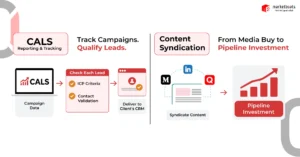
Marketboats employs CALS for reporting and campaign tracking, and its service data can describe campaign visibility and lead qualification. The company checks each lead against agreed ICP criteria and contact-validation requirements before delivering it to the client’s CRM.
Content syndication can shift from a media buy to a pipeline investment based on lead acceptance rate, and every vendor evaluation should include this before signing a contract.
How to Choose the Right B2B Content Syndication Vendor
B2B enterprises should evaluate a content syndication vendor on these criteria: lead verification methodology and acceptance-rate guarantees, GDPR/CCPA compliance documentation, ICP targeting depth, CRM and marketing automation integration, reporting transparency, and buying-group and multi-contact support.
The following framework can help assess potential pipeline contribution:
| Criteria | What to Ask the Vendor | Potential Red Flag |
| Lead Verification | How do you check contact details and lead criteria? | The vendor cannot provide a clear verification process or a defined lead-acceptance SLA. |
| Compliance | Can you explain your consent practices and data sourcing? | Leads cannot be legally used, or consent documentation is not available. |
| Reporting Transparency | Do you track downstream outcomes, acceptance, and sources? | The vendor focuses on volume-centric reporting, making post-delivery lead quality difficult to assess. |
| ICP Targeting Depth | Does targeting combine firmographic, technographic, and intent data? | The vendor relies only on demographic filtering and ignores intent or technographic layers. |
| Buying Group Support | Do campaigns reach multiple relevant contacts within an account? | Account-level targeting is not emphasized. |
| CRM Integration | Do leads move into Salesforce or HubSpot? | Unidirectional delivery can break attribution and prevent closed-loop reporting. |
Many B2B teams evaluate vendors by publisher reach and CPL, but these metrics alone cannot show whether syndicated leads will convert into qualified opportunities or customers.
You should run a pilot against your actual ICP criteria before finalizing a vendor. Monitor contact accuracy, downstream conversion, and lead acceptance to confirm the program delivers to your quality benchmark.
For Marketboats, transparent campaign reporting and agreed-upon contact-validation standards are key parts of services. Evidence must support every comparative claim on performance.
How Much B2B Content Syndication Costs, and What a Good CPL Indicates
The cost of B2B content syndication depends on geography, qualification depth, intent targeting depth, audience seniority, and industry. According to Sotros Infotech’s 2026 research, average content syndication costs for BANT-verified leads range from $150 to $400.
Although these figures are vendor-market predictions, they are not universal benchmarks. Managed programs can provide qualified leads that you can accept at a higher cost. Self-serve platforms may look lucrative because they are cheaper, but they may offer less-verified leads.
A low CPL does not necessarily mean a cost-effective campaign. Start by measuring cost-per-opportunity and cost-per-accepted-lead, then evaluate how much of the resulting pipeline converts into revenue.
This can provide a more commercially meaningful view than lead volume alone. To calculate ROI, compare the attributable return with the total program cost. When leads do not progress through the funnel or fail validation, even the lowest CPL can get expensive.
Rather than basing the CPL model on gross delivery volume, Marketboats structures it around verifiable, usable leads.
Bottom Line: Is B2B Content Syndication Still Effective in 2026?
When lead verification, qualification, and targeting work together, content syndication can support pipeline growth. Rather than evaluating leads that the vendor promised, evaluate what happens after lead delivery.
Analyze buying-group coverage, downstream conversion, ICP fit, and validation standards when you compare content syndication providers. This can help you decide whether the program is commercially valuable for you.
Start by comparing conversion and lead acceptance rates against mutually agreed acceptance criteria when you review your current program.
Marketboats delivers buying-group-targeted, verified, BANT-qualified leads using intelligence and content syndication systems, with CALS validating and maintaining transparent campaign reporting.
Start a conversation to compare HQL, BANT-qualified, and verified leads with your current program.
FAQs
1. What is a good lead acceptance rate?
There is no universal benchmark for every campaign. Set an acceptance threshold before launch, then monitor the percentage of leads accepted and how those leads convert downstream.
2. Does content syndication hurt SEO?
Content syndication does not automatically hurt SEO. For republished web content, use appropriate canonical signals and follow Google’s guidance on syndicated content, while recognizing that implementation can affect how search engines handle the different versions.
3. What is the difference between gated and ungated syndication?
Visitors must submit their data to access gated content, while ungated content does not require it. Ungated content assets can extend reach and reduce friction, whereas gated content can support lead capture.
4. Is content syndication GDPR compliant?
It can be, provided it follows applicable data protection rules. However, compliance depends on the lawful basis, data source, consent, follow-up activity, and purpose.
5. How long does content syndication take to show results?
Lead delivery time often depends on audience size, volume, targeting, and campaign setup. However, pipeline results may take longer because leads must be qualified, engaged, and moved through the sales process.