
AI adoption in business means using AI to solve defined problems within existing workflows and monitoring the results. Many teams treat AI as a strategy, but in reality, it is a capability that serves the business outcome that strategy delivers.
Your AI adoption strategy should not outpace your ability to design the processes around it. If you start with tool adoption, you may end up with pilot projects that have no clear outcomes. Simply adopting AI tools does not guarantee increased efficiency for your organization.
According to Ascend2’s The State of B2B Thought Leadership in 2026 report, 32% of B2B professionals use GenAI tools to discover thought leadership content. But enterprises need a clear strategy for incorporating GenAI platforms into their content discovery and distribution plans.
You should prioritize scalability before growth. AI implementation in business is more likely to succeed when your processes are stable and supported by clear business objectives.
How to Approach AI Adoption in Business
Start your AI implementation strategy with the business problem rather than starting it with a tool. The following six-stage framework can help you evaluate how to implement AI in business operations by asking six specific questions:
| Framework stage | What to explain |
|---|---|
| Business problem identification | What business problem needs to be solved? |
| Understanding the process | How does the existing workflow operate? |
| Data evaluation | Is the available data suitable and reliable? |
| Comparing solutions | Would rules, databases, automation, or AI work best? |
| Defining the outcomes | What measurable improvement is expected? |
| Thoughtful implementation | How will the business introduce, monitor, and improve the solution? |
Even if an AI pilot succeeds, it does not guarantee a successful AI readiness assessment. If you buy tools before defining the problem, you may end up with pilots that lack measurable business outcomes.
Examine which person, process, or system contributed to the wrong outcome. You may find that some organizational workflow problems do not need AI. Before you select an AI solution for your company, understand where your existing workflows are breaking down. Check how Samir Gujral explains this through his experience at Marketboats.
Then, when should businesses use AI instead of traditional automation? Choose AI when the problem involves variable inputs, pattern recognition, or decisions that predefined rules cannot handle effectively.
How to Assess Business Readiness for AI Adoption
Assess technology and data, processes, people, and governance to gauge business readiness for AI adoption. The following practical checklist can help you assess the readiness of your AI-powered business processes:
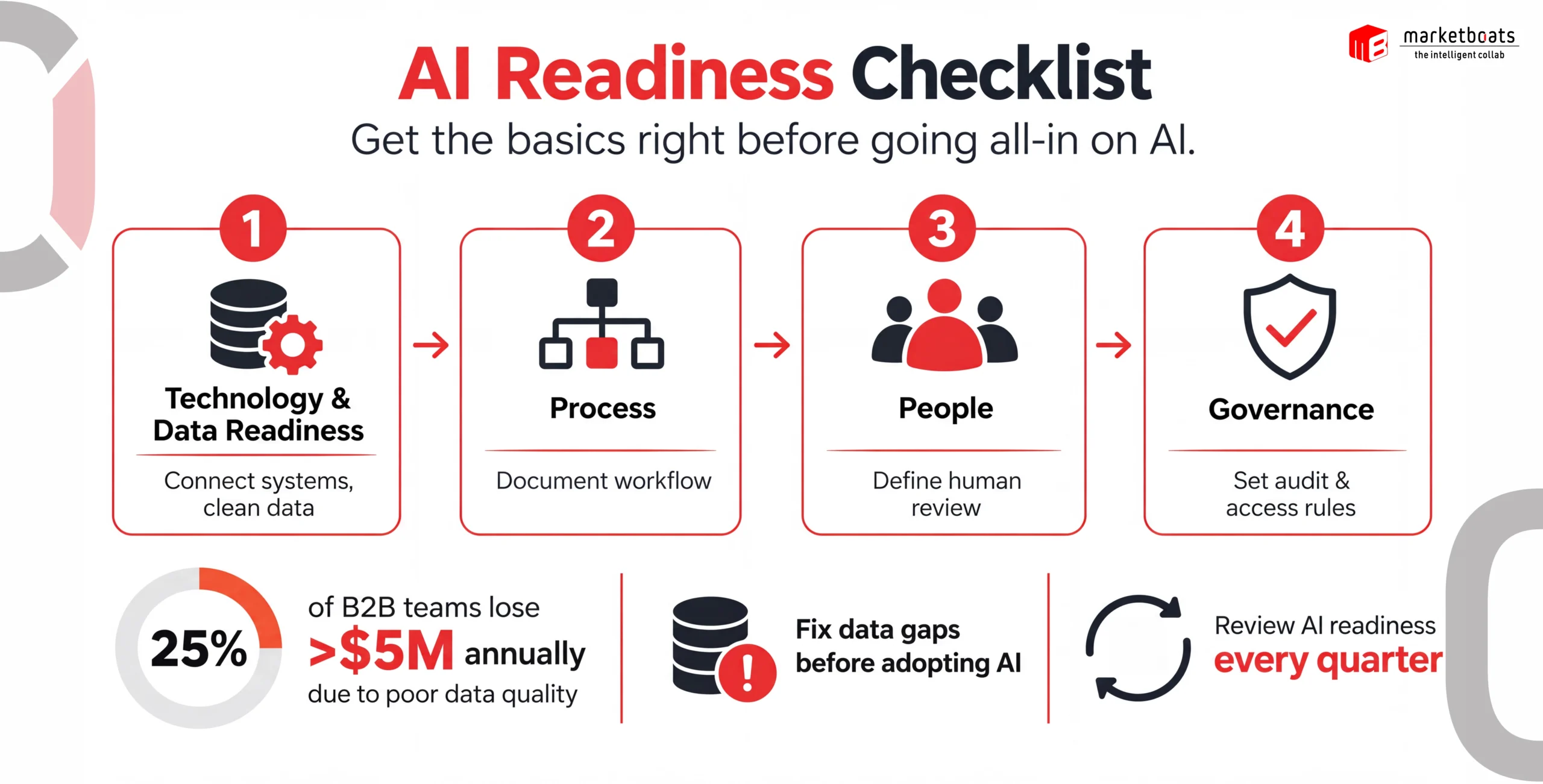
- Technology and Data Readiness: Check whether relevant systems are connected, data fields are standardized, and records are accurate.
- Process: Ensure that the workflow is documented and assign a clear owner.
- People: Define human-in-the-loop workflows and assign reviewers to validate AI-generated recommendations and decisions.
- Governance: Clearly document all audit, access, and consent rules.
IBM’s research found that 25% of B2B teams lose more than $5 million annually due to poor data quality. Before selecting any model, address data gaps, which are a common AI readiness challenge. You do not need AI for every process; sometimes a simpler automation solution is more cost-effective and reliable.
Instead of immediately using the AI implementation framework, address the readiness gap first. Adding technology without fixing the foundational system may increase organizational activity but may not produce the desired results.
Review AI readiness every quarter and select technology based on how effectively it solves the problem, rather than its popularity.
How to Identify the Right AI Use Cases for a Business
Score each candidate process based on data readiness, the cost of an incorrect decision, implementation feasibility, and business impact to identify the right AI use cases in business. Use the following decision table to understand how to evaluate AI opportunities in business processes based on different business situations:
| Business Situation | Best-fit Solution |
|---|---|
| Steps are identical and fixed every time | Business process automation |
| Stable calculation or lookup | Database or rules |
| High-impact decisions requiring human judgment | AI-assisted recommendations with human review and approval |
| Variable inputs that need pattern recognition | AI-assisted analysis and recommendations |
Start with automating routine tasks. AI can deliver more value when inputs vary, and the process requires pattern recognition or contextual analysis. Enterprise AI adoption should start with processes that create friction instead of identifying ways to employ AI tools.
Marketboats does not recommend relying on spreadsheets when they create unnecessary manual work and delays. Instead, analyze workflows before implementing AI.
Select AI projects whose outcomes you can measure within one quarter, and AI use-case prioritization should emphasize data readiness, implementation effort, business impact, and feasibility.
Bottom Line: How to Develop an AI Adoption Strategy for a Business
AI integration in business starts with defining the business objective and selecting the right technology to implement it responsibly. Your existing weaknesses may amplify if you scale AI across weak processes.
Adopting more AI tools should not be the core objective of your AI implementation roadmap because tool adoption alone does not guarantee business maturity. Measure success through business outcomes rather than the number of AI models used.
Before expanding AI adoption, build a strong business foundation that supports your AI implementation strategy. To support better execution, Marketboats combines human intelligence, connected processes, and scalable systems. To understand how to align AI implementation with business objectives, talk to our team.
FAQs
1. Why do businesses need an AI adoption strategy?
A proper AI adoption strategy can connect organizations’ AI investment to defined problems, accountable implementation, and measurable outcomes. It can justify AI investments and help B2B enterprises allocate resources toward use cases with measurable business value.
2. How should a business approach AI implementation?
The first step in AI implementation is to define a business problem. Then, assess data readiness and existing workflows, compare possible solutions, and monitor measurable outcomes.
3. How do you identify the right business processes for AI?
Identify the right business processes for AI by prioritizing those with variable inputs, suitable data, manageable decision risks, and measurable business impact.
4. When should a business use AI instead of traditional automation?
Businesses should consider AI when processes involve variable inputs, pattern recognition, or contextual decisions that predefined rules cannot handle effectively. Traditional automation remains suitable for stable, repetitive tasks.
5. What is the difference between AI and business process automation?
AI can analyze data, recognize patterns, and generate recommendations based on changing inputs. Traditional business process automation follows predefined rules to complete repetitive tasks.