
Operating inside B2B buying networks that have carried out market benchmarking, risk scoring, and supplier verification will transform procurement in 2026 and help B2B teams outperform their competitors, who rely on negotiating harder and running better RFPs.
Most procurement frameworks ignore sourcing architecture and aim to modernize with software upgrades. New tools embedded in the existing model amplify limitations instead of eliminating them, and this is the core problem.
Veridion’s 2024 research identifies that 17% of B2B teams struggle with procurement due to the complexity involved in the process. As a result, the evolution of procurement in the digital age must be architectural, more than technological.
Beyond finding suppliers, the biggest challenge for procurement teams is identifying the right supplier before competitors do.
What is the State of Procurement in 2026, and Why Software Is Not the Ultimate Solution
Shifting from being a purchasing function, procurement is becoming a growth lever. More supplier categories, increasing stakeholders in the decision committee, and accelerated time-to-need expectations are key concerns for modern procurement strategies because no software platform has been designed to address all three simultaneously.
A standard response to the query is to adopt software like e-sourcing tools, procurement management platforms, or contract repositories, but none of these software solutions resolves the primary constraint. Although many teams assume process speed is the primary constraint, supplier intelligence is where the real bottleneck is created.
B2B enterprises that have a faster workflow with a shallower supplier pool often produce suboptimal sourcing solutions efficiently. Efficient procurement built on limited supplier intelligence optimizes the wrong variable.
Why Traditional Procurement Models Are Changing the Architecture Problem
Conventional procurement frameworks catered to predictable supply chains, a few week-long buying cycles, and stable supplier relationships. Today, everything has changed.
Supply chains have become fragile, speed expectations have compressed, and buying committees have expanded. As a result, beyond model failure, the traditional procurement framework is no longer a fit for the new environment.
The core problem is that procurement teams operate on an architecture that cannot handle the data volume and stakeholder complexity that digital procurement ecosystems demand.
Which Are the Key Trends Driving Buying Network Adoption
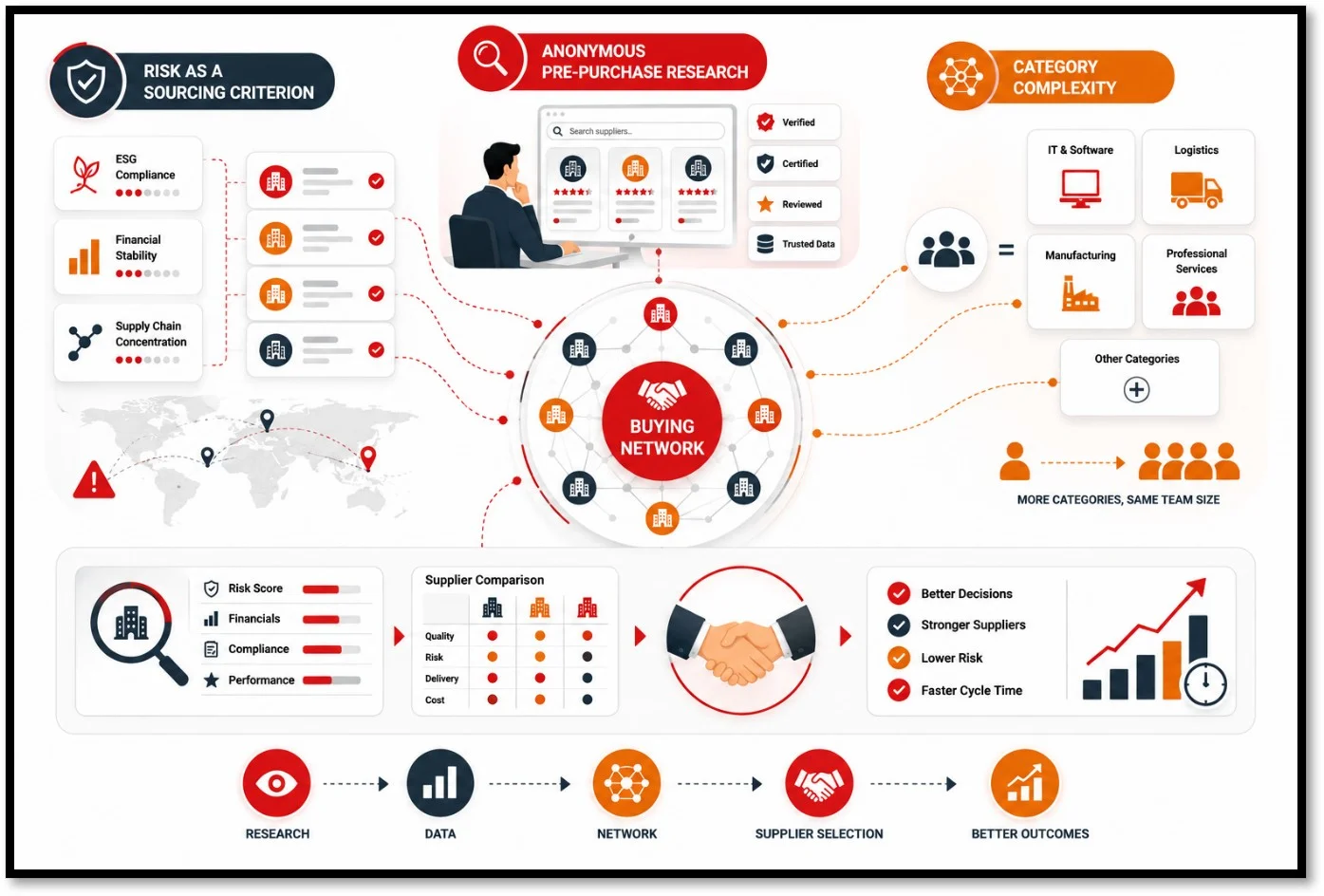
Buying networks enhance procurement decisions before reps negotiate with suppliers. Here are three procurement technology trends that stand as prerequisites for the adoption of buying networks:
- Supplier Risk as a Sourcing Criterion: Supply chain concentration, financial stability, and ESG compliance have shifted from post-selection checks to standard evaluation inputs. Risk signals integrated into buying networks enable evaluation without increasing sourcing cycle time.
- Anonymous Pre-purchase Research: Demand Gen Report finds that 80% of B2B buyers initiate first contact after completing 70% of their buying journey. Buying networks recognize this independent research and consolidate it with verified information from the supplier ecosystem, eliminating aggregated unverified data.
- Category Complexity: Supplier categories have disproportionately increased, and procurement teams manage them with no proportional increase in headcount. Buying networks scale supplier discovery across categories without increasing headcount.
What is the Role of Data and Automation, and How Technology Transforms Procurement
Digital procurement transformation’s commercial value arises from the conversion of supplier market data into sourcing information, and, contradicting the common misconception, the automation of administrative tasks does not add any value. The absence of intelligence in automation leads to poor decisions.
Here is a list of three applications that improve procurement efficiency:
- AI-powered Supplier Matching: Beyond existing relationships, it surfaces performance-based qualified supplier options.
- Predictive Risk Scoring: It flags the compliance and financial exposure of the supplier before becoming an event in the supply chain.
- Spend Analytics: It showcases missed competitive tension opportunities and category-level concentration risks.
Measuring technology investment by process speed makes B2B teams measure the wrong output. Instead, the number of sourcing events generating the best supplier outcome is the correct measure.
Final Thoughts: What Procurement Looks Like Beyond 2026
Treating supplier intelligence and network data density as the core infrastructure will be the procurement future. Buying networks are taking strides toward category-specific and denser ecosystems.
While embedded financial services reduce purchase-to-pay workflow friction, ESG monitoring and real-time compliance replace periodic due diligence tasks. Procurement optimization with these trends in sight will allow B2B enterprises to stay ahead of competitors.
If your current procurement strategy revolves around tools, Marketboats can help you rethink and redevise the architecture that supports them.
FAQs
1. What are the biggest procurement trends in 2026?
Supplier intelligence, ESG-driven procurement, AI-powered sourcing, procurement automation, and predictive risk management are the most vital procurement trends in 2026.
2. How does AI impact procurement?
Procurement teams can make more informed sourcing decisions, assess risk proactively, and recognize suppliers faster using AI, which improves their overall efficiency.
3. How can procurement teams improve supplier discovery?
Supplier discovery can be improved with the help of supplier intelligence platforms, continuous market monitoring, buying networks, and AI-powered sourcing tools.