
AI search visibility demands authority signals over content output, and this is the shift most B2B teams cannot make. Human-operated search engines were traditionally at the centre of B2B discoverability and rewarded keyword coverage, domain authority, and publishing frequency.
However, AI search engines rank, retrieve, and surface data authority differently from traditional models. The majority of B2B players optimize for rankings, but AI chooses answers, and at this point, visibility has declined without any visible traffic drop. As a result, B2B thought leadership visibility becomes difficult to sustain.
Web FX’s 2025 findings claim that B2B informational queries have 43.5% of AI overview rate, implying that the visibility now resides in an answer that the buyer never scrolls past.
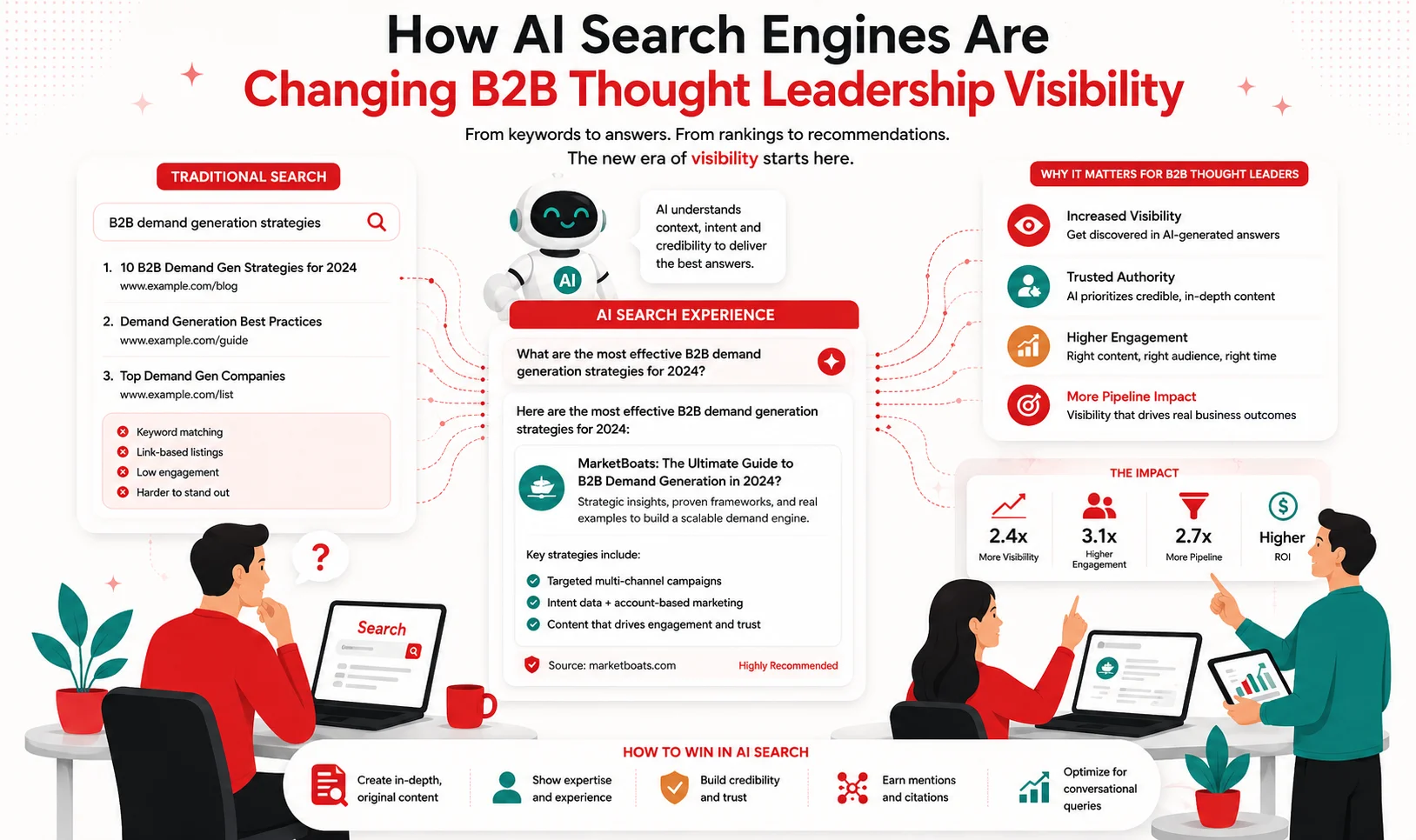
How AI Search Engines Impact B2B Marketing Visibility Beyond Traditional Rankings
While traditional search returns a ranked list, AI search provides the user with an answer from sources that the AI model considers authoritative, and the user directly sees the conclusion before seeing the ranked list.
Visibility was a ranking event in traditional searches, whereas it is a retrieval process for AI search models. If the company is missing from the retrieval pool when the buyer asks a query, it remains structurally invisible, irrespective of the content volume present on its website.
Discovery has shifted from SERPs to synthesized answers, and this is because the content is consumed without clicks. AI search optimization is slowly drifting the search engine marketing toward a GEO-driven environment.
What Is AI Search Optimization in B2B and How It Differs From Traditional SEO
AEO and GEO, rather than serving as rebranded SEO, provide a different retrieval logic. While conventional SEO models are optimized for backlink volume, page authority, and keyword density, AI-oriented frameworks are tweaked for high-intent questions and specific answers.
The SEO-optimized content might rank well on Google or other search engines, but loses visibility in generative AI search engines. On the other hand, AI search retrieves claims. A content piece opening with an answer to a specific question produces a higher retrieval probability than a 2000-word article.
The generative search optimization (GEO) model searches for an extractable answer, and this is why depth on one question performs better over breadth across many. To cater to the model, an ideal content piece must include every asset developed around the answer, followed by the supporting argument.
B2B content is aimed at demonstrating expertise by being optimized for dwell time. However, AI evaluates structure, credibility, and clarity, and this is where the gap is created.
How Generative AI Affects Thought Leadership Visibility and What Builds Citation Authority
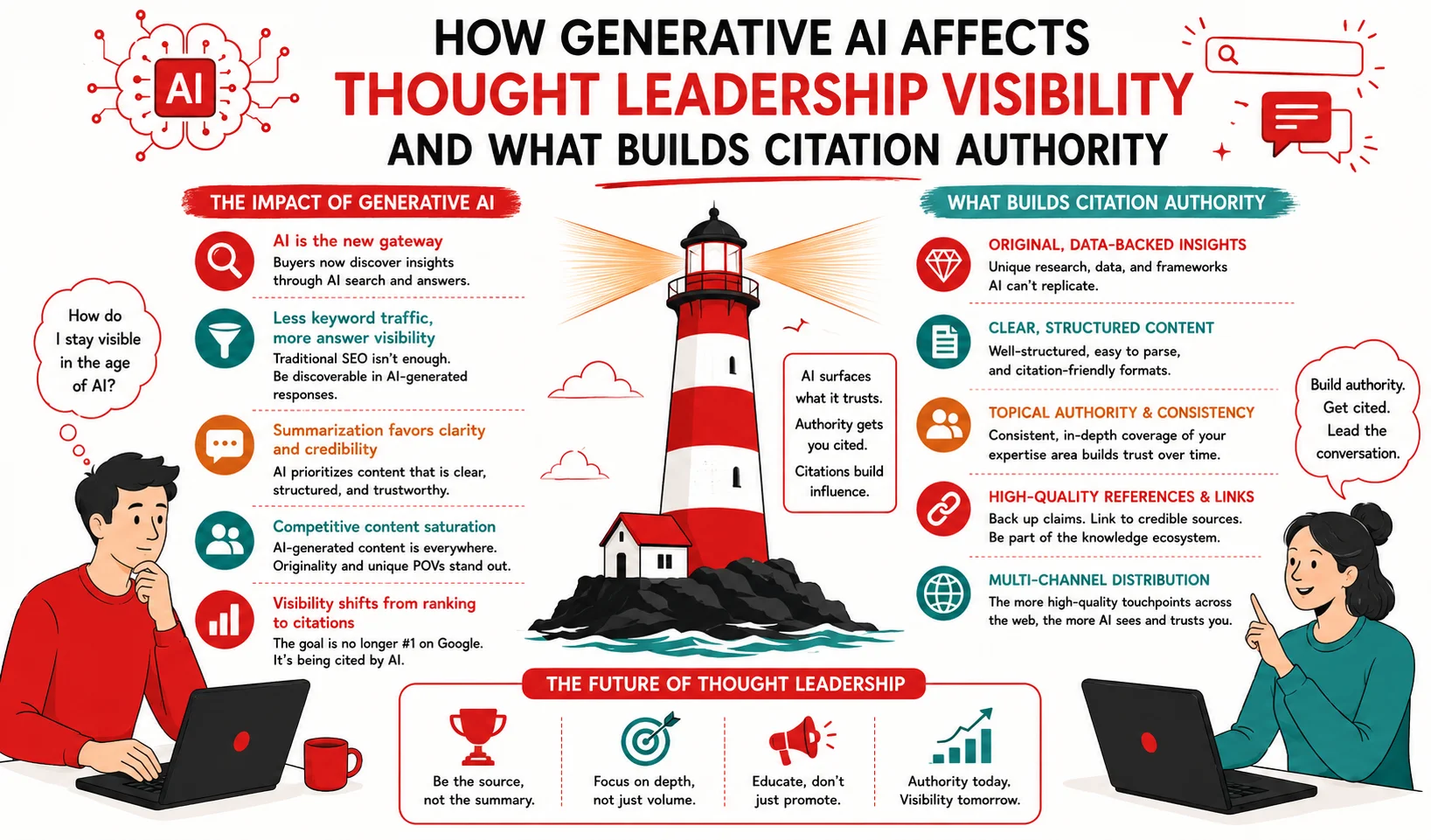
AI search algorithms cite sources that appear repeatedly across credible contexts, including analyst reports, structured data, and industry publications. The content discoverability is measured by the reference frequency across these trusted sources.
External validation, instead of an internal publishing cadence, compounds brand mentions in AI search. The absence of external amplification makes the content volume ineffective in building retrieval authority. The content volume without authority dilutes the discoverability.
Digital Bloom, in 2025, finds that citations across four or more platforms increase the probability of appearing in ChatGPT responses by 2.8 times. This implies that thought leadership competes at the answer-level rather than on the article-level.
How to Improve AI Search Visibility for B2B Brands Through Content Architecture
The content architecture shift originates from shifting the focus from writing for questions instead of topics. The thought leadership content that opens with an argument induces structurally higher retrieval probability than content that builds toward a conclusion at the end.
Further, content authority must extend beyond owned channels, where research co-authorships and analyst publications serve as backlink equivalents in conventional SEO. Consistent content publishing across trusted media channels builds authority signals, which AI SERP features consider credibility.
Specificity is more retrievable than vague claims, where citing a specific source with its name, stated implication, and clear connection with the question increases the visibility. AI-powered search in B2B marketing determines visibility by reference frequency instead of its ranking position.
Final Thoughts: Finding How to Build Authority for AI-driven Searches Will Decide Your Future
The importance of thought leadership raises the citable authority bar higher and narrows the window to build it. Authority signals govern the visibility of B2B companies.
An AI search engine optimization strategy has become a necessity, and B2B teams that lead the market are already building authority through external citations. B2B content visibility on gen-AI engines is earned way before the query is made.
Want to know where your content architecture falls short currently? Contact Marketboats to identify how your content will be visible in an AI-driven search environment.
FAQs
1. Why my content is not showing in AI search results?
AI systems prioritize frequently cited, structured, and authoritative content, where weak external validation and vague structure affects retrieval probability. That is why your content might not be showing in AI search results.
2. Which are the useful strategies to get cited in AI search results?
The foremost strategy you can use is to develop authority through third-party mentions. Apart from that, you can ensure consistent positioning across credible external platforms and publish structured answers periodically.
3. How to rank in AI search engines like ChatGPT and Gemini?
Prioritize clarity, external citations, and claim specificity rather than focusing only on backlinks and keyword density. This will help you rank your content on search engines like ChatGPT and Gemini.